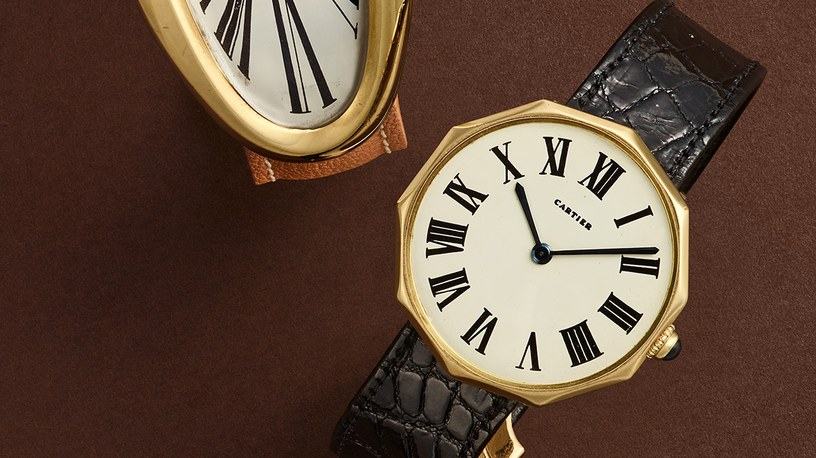
The final Shapes of Cartier watch auction is scheduled for 9 December 2026 in Abu Dhabi, following Sotheby's international presentation of a major vintage collection.
A final destination for an unusual Cartier collection
Sotheby's has scheduled the final chapter of its Shapes of Cartier watch series for 9 December 2026 in Abu Dhabi. The sale concludes an international programme devoted to vintage Cartier timepieces whose distinctive cases have become central to their desirability among collectors. Rather than arranging a conventional selection around movements or precious metals alone, the collection invites buyers to consider how the shape of a watch can carry a design identity across generations.
The auction house describes the wider Shapes of Cartier project as more than 300 historic watches associated with the Paris, London and New York traditions of the maison. Sales are taking place across the world from April through December, and the Abu Dhabi event forms the concluding instalment. This structure has allowed collectors in different markets to examine different portions of a single ambitious historical selection, without treating every piece as interchangeable.
Sotheby's lists the final auction as a one-day event on 9 December, with Abu Dhabi serving as its location. It is important to distinguish that confirmed date from the earlier exhibitions, and to recognise that the precise lot catalogue and final estimates can change before bidding begins. The present announcement is a preview of an upcoming sale, not a report of completed transactions or prices already achieved.
Why shape matters in Cartier watchmaking
Many watches are described first by their movements, complications or metal content, but the collecting history of Cartier offers another way to approach a timepiece. The outline of the case and its relationship with the dial, strap and wrist can make the object recognisable even at a distance. Cartier has explored that relationship through angular, curved and deliberately asymmetrical designs that sit beyond the familiar round wristwatch.
Among the historical families discussed in Sotheby's own collector guides are the Tank, Santos, Baignoire, Crash and Asymétrique. They are not identical expressions of one template: each uses proportion, geometry and visual balance in a different way. Their continuing attraction illustrates that unusual casework can be the central creative element of watch design rather than a container that merely surrounds a mechanism.
That does not mean an unusual silhouette automatically makes a watch rare or valuable. Collectors must still distinguish a common production example from a historically significant variant, and the date, dimensions, hallmarks and degree of originality can change the assessment materially. The collection's wider interest lies in being able to compare successive interpretations of shaped cases across a long period, rather than assuming that every visually striking watch belongs to the same market tier.
Paris, London and New York as three design traditions
The international background of the collection is particularly important to vintage Cartier scholarship. The Paris, London and New York branches operated within the same distinguished identity while developing watches for their own customers and periods. A collector examining a vintage piece must therefore pay close attention to the details of its production and retail history, because superficially similar cases can have different construction, signing and provenance.
Sotheby's calls this one of the most comprehensive vintage Cartier groupings brought to the market. The scale creates an opportunity to compare families of objects rather than concentrating only on a single headline example. It also gives historians and private collectors a reason to study the auction material as a record of design development, even when the eventual successful bidder is interested primarily in wearing a piece.
For the owner of a modern luxury watch collection, such comparisons are revealing. A historic Cartier may be valued for design purity and cultural context as much as for mechanical sophistication, while a technically complex contemporary watch may appeal for very different reasons. Neither priority invalidates the other; the collecting challenge is to understand what makes a particular object compelling and to avoid comparing unlike examples on price alone.
Singapore and Geneva previews before Abu Dhabi
The official auction information identifies a Singapore exhibition running from 23 to 27 October, with a further viewing period on 28 October, at The Gallery, Ital Auto Ferrari Singapore on Leng Kee Road. It also lists a Geneva preview from 5 to 7 November at the Mandarin Oriental on Quai Turrettini. These events allow potential buyers to encounter the sale before its final Abu Dhabi presentation, subject to the auction house's actual display arrangements.
In-person inspection matters because a photograph can conceal aspects of condition that materially affect a vintage watch. Dial surfaces, restoration, case polishing, replacement components and the character of an old strap or bracelet are all relevant. Buyers should request the specific condition report for any lot of interest and ask questions of the auction specialists rather than relying only on the general collection description.
Travelling previews also carry a cultural purpose for an international auction house. They place objects in front of collectors who may not attend the final sale, while highlighting the connections between jewellery, design and watchmaking. The Abu Dhabi setting is part of that broader global presentation, but no estimate of demand or eventual bidding intensity can be inferred simply from the location.
How collectors should approach the December sale
Provenance is an important part of the evaluation of a vintage watch, but its strength varies from lot to lot. Original paperwork, archived records and a coherent ownership history can support confidence, whereas unsupported anecdotes should be treated cautiously. The presence of an object within a well-publicised single-owner grouping is valuable context, but does not eliminate the need to assess the individual lot on its own evidence.
Buyers should also work from the full cost rather than the hammer price alone. Auction premiums, taxes, cross-border shipping, insurance and any subsequent servicing can affect what a winning bid actually costs. For historically delicate or highly unusual watches, future maintenance and the availability of appropriate expertise deserve consideration before entering a bidding contest.
Shapes of Cartier will close in Abu Dhabi on 9 December as the final scheduled chapter of a collection that has examined the maison's shaped watchmaking over a century. The most enduring outcome may be the attention the series brings to case design as a collecting discipline, whether or not a particular watch establishes a new record. Until the catalogue and sale results are complete, the responsible account is one of an approaching auction and a remarkable design survey, not guaranteed investment returns.