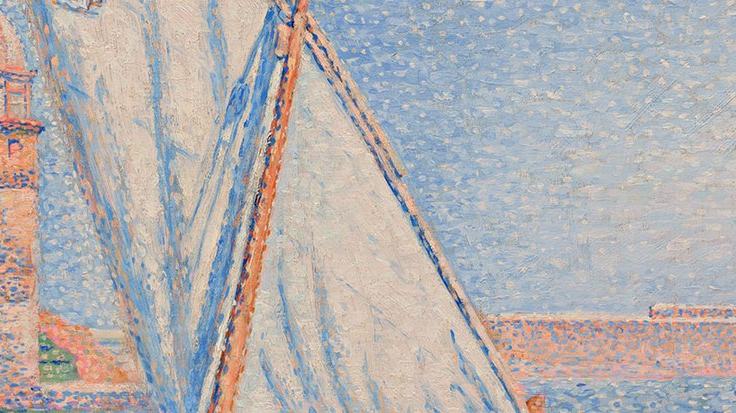
Sotheby's Shaping Modernity collection traces Impressionism and Fauvism through Signac, Derain and Vlaminck to Francis Bacon, with its New York sales running 16–19 November.
Ultra-high-value fine art, 12 November 2026. The source describes separate forthcoming New York sales; estimates remain pre-sale figures. This is an analysis of the named Shaping Modernity collection, not a repeat of the general New York sales calendar.
A private collection tells a history of modern painting Sotheby's is bringing works from Shaping Modernity: Property from a Private American Collection to its New York November sales. The collection traces artistic innovation from the Impressionist period through Pointillism and Fauvism, with a later extension into the expressive painting of Francis Bacon. It is an unusual opportunity to see a private group organised around a historical argument rather than a single fashionable market segment. The auction house has associated selected works with the Modern Evening Auction on 18 November and related sales during the week. What makes the collection interesting for sophisticated buyers is the way individual works demonstrate changes in how painters approached colour, light, gesture and representation. Those relationships can be intellectually richer than a simple ranking of prices. Nevertheless, each work must be independently examined for condition, provenance and the quality of its place within the artist's career.
Paul Signac and the language of colour Among the collection's major works is Paul Signac's Collioure. Les Balancelles, estimated at $12 million to $18 million. Signac's pointillist method developed an approach to colour in which the relationships between adjacent marks were central to perception. A serious collector should study the painting's particular composition and period rather than assume all pointillist works have the same significance. The subject at Collioure adds an appealing connection to the Mediterranean, a coastline familiar to yacht owners but also important in the development of modern French painting. An artwork's geographical association can be personally meaningful, though it should not become a substitute for scholarly evaluation. The estimate communicates the auction house's market expectations for the individual lot, not a guaranteed future sale figure.
Derain and Vlaminck mark a decisive shift André Derain's Londres: La Tamise au pont de Westminster is listed with an estimate of $5 million to $7 million, while Maurice de Vlaminck's La Route carries a $6 million to $8 million range. Their work illustrates the bold use of colour associated with Fauvism, a movement that challenged the idea that paint should imitate the natural appearance of a subject. The contrast with Impressionist observation and pointillist colour theory is central to the collection's narrative. A buyer interested in these works may be attracted by the history of artistic experimentation as much as by a particular image. The correct approach involves examining the work's date, execution and documented history rather than treating an artist's name as sufficient. Where two painters are associated with the same movement, individual artistic choices still matter.
Cézanne and Renoir broaden the argument The series also discusses work by Paul Cézanne and Pierre-Auguste Renoir, whose approaches helped shape later developments in painting. Cézanne's interest in structure and observation exerted influence on subsequent generations, while Renoir's portraits reveal another strand of Impressionist practice. For a private collection, putting these works in dialogue with Signac and Derain can suggest how artistic ideas change rather than evolve in a simple straight line. The challenge is to distinguish a coherent intellectual history from an auction narrative constructed after acquisitions have been made. A collector should look for supporting exhibition histories and scholarship explaining why particular works matter. Some may be especially significant for their period, condition or historical associations, while others may be better understood as attractive examples within a broader body of work.
Francis Bacon gives the collection a different endpoint Sotheby's identifies a Francis Bacon Self-Portrait as part of the collection's later chapter. Bacon's painting takes the narrative far beyond the concerns of nineteenth-century light and colour, towards the psychological intensity of post-war figuration. Including his work can produce a striking contrast with the earlier French painters, showing that modernity is not one style or a single geographical movement. A collector interested in Bacon should review his approach to materials, the work's place within the self-portrait series and any conservation challenges. Images of paintings with complex surfaces may not communicate their physical character adequately. The collection's overall story can make a work particularly compelling, but an individual acquisition requires the same rigorous research whether the object is an iconic twentieth-century portrait or an earlier landscape.
Paintings should be evaluated as physical objects High estimates can distract from the fact that every painting has its own material history. Canvas tension, paint stability, varnish, prior restoration, stretcher condition and environmental exposure may affect both appearance and future conservation. Some interventions may have been appropriate at the time they were carried out; others may be difficult to reverse. A purchaser should read the condition report and, for a major acquisition, consider independent examination by specialists familiar with the artist and period. This is especially relevant when works will move internationally or be installed in a climate very different from that of their previous home. Insurance and shipping preparations should reflect the object's fragility rather than only its monetary value. Collecting great painting is also a commitment to preserving a complex material artefact.
A travelling exhibition adds research opportunities Sotheby's has presented the New York sales selections in a travelling exhibition programme, with stops in London, Hong Kong and Paris before a New York viewing at 945 Madison Avenue through 15 November. Such events can give international buyers an opportunity to inspect works in person, although individual availability and viewing conditions should be confirmed. Experienced collectors may use these visits to compare paintings under carefully controlled lighting and speak directly with specialists. A public catalogue may provide important documentary context but can never reproduce every aspect of a physical work. For clients with limited time, a structured viewing plan and prepared questions can be useful. The objective is to assess whether a painting fits a collecting strategy and meets condition expectations, not simply to absorb the atmosphere of a prestigious preview.
The estimates are not equivalent to realised prices The reported estimates for Signac, Derain, Vlaminck and other highlights are commercial guide figures in advance of auction. They do not establish a final price or determine how the market will receive the works. A buyer's actual costs may also include premiums, taxes, transport and insurance. The art market is not transparent or liquid in the same way as a major exchange-traded security; comparable works may differ greatly in importance and condition. When a collection includes material spanning several movements, one artist's market should not be used mechanically to value another's. An independent appraisal or advisory review may help a family office consider financial consequences, but the decision to acquire art often involves values that cannot be expressed in a spreadsheet alone. Those values should be acknowledged without ignoring the financial commitments.
Private collecting benefits from intellectual coherence One reason to study Shaping Modernity as a group is its apparent commitment to an argument about artistic innovation. A collection assembled around such an idea can provide pleasure over decades, giving owners opportunities to study relationships between artists and to loan works for exhibitions. Yet it is important not to confuse a historical theme with an obligation to buy every available representative. A strong collection may benefit from selectivity, gaps and a willingness to wait for particular objects. Collectors can also preserve their research in catalogues, correspondence and private archives. These records may be invaluable to heirs, scholars and museums long after individual purchases have been completed. The act of collecting becomes a kind of authorship, shaping how works are understood in relation to one another.
Preservation, succession and possible public access A private holding of major paintings may ultimately be divided among family members, placed in trust, loaned to institutions or sold. Early consideration of succession can prevent important records from being separated from works. Loans and gifts may involve complex legal, tax and cultural-property rules, especially when ownership spans jurisdictions. Conservation plans and insurance values should be kept current. A family that intends to maintain the collection as an educational resource should establish governance and a budget for storage, research and access rather than assume future generations will share the original collector's interests. These practical matters can be as important as choosing the next painting. A significant collection creates opportunities for cultural contribution, but only when ownership and stewardship are responsibly organised.
What the New York programme establishes Sotheby's describes Shaping Modernity as a private American collection presenting works from Impressionism through Fauvism to Bacon. The November calendar identifies the Modern Evening Auction on 18 November, with individual estimates including $12 million to $18 million for Signac's Collioure. Les Balancelles, $6 million to $8 million for Vlaminck's La Route and $5 million to $7 million for Derain's Thames scene. No final sale results are established by the pre-sale announcement. Collectors should confirm current catalogue details, condition and bidding terms before acting. For the high-end market, the group's appeal is the opportunity to encounter major artistic developments through a carefully shaped collection rather than through a list of unrelated prestigious names.
Primary source: Sotheby's, Shaping Modernity: Property from a Private American Collection, November 2026.