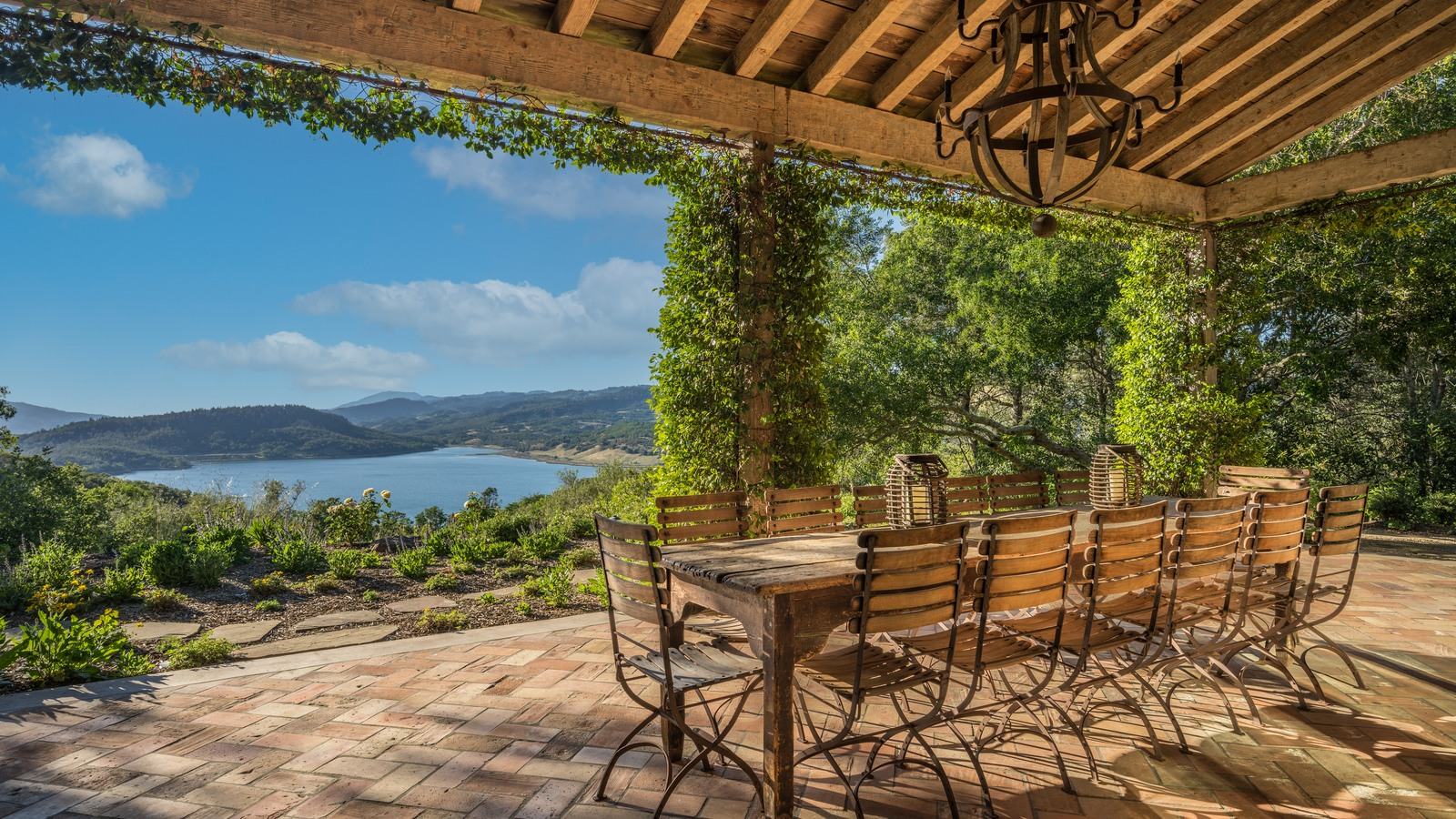
A 40.66-acre St. Helena estate combines an 8,500-square-foot main residence, two guesthouses, cabernet vines, pools, gardens and views over Lake Hennessey.
A 40.66-acre compound in the St. Helena foothills shows why the best wine-country estates operate more like private resorts than conventional country houses. The property centres on an approximately 8,500-square-foot main residence and adds two guesthouses, an infinity-edge pool and spa, a separate 60-foot lap pool, tennis and bocce courts, mature gardens and an acre of Pritchard Hill cabernet vines.
The defining feature is the view across Lake Hennessey and the surrounding Napa Valley landscape. For ultra-high-net-worth buyers, that combination of privacy, land and infrastructure can make a property useful for extended family stays, entertaining and seasonal residence while remaining close enough to established wine-country services and private aviation access.
Forty acres create separation without total isolation
The estate’s scale allows the main house, guest accommodation, recreation areas and vineyard to occupy distinct parts of one property rather than competing for space around a single residence. That separation is valuable when owners host family, friends or advisers for long periods and want guests to have genuine independence rather than simply additional bedrooms down a corridor.
Large acreage also creates a visual buffer from neighbouring properties. At the top of the residential market, privacy is often measured not only by gates and security systems but by how much distance exists between the principal rooms and the public world beyond the estate boundary.
The residence is designed around lake and vineyard views
Sotheby’s describes a French-country influence with pitched rooflines, ironwork, ivy-draped walls, distressed wood and cream-toned stucco. The architecture is intended to feel established in the landscape rather than aggressively contemporary, allowing the setting to remain the dominant visual element.
That can matter to buyers building a portfolio of several homes. A city penthouse, island residence and vineyard estate each need a distinct reason to exist, and properties that express their location clearly are easier to justify than houses that repeat the same international-luxury formula in different countries.
Two guesthouses support extended private stays
Each guesthouse is roughly 1,000 square feet, providing accommodation that can be used for family, friends or support staff without compromising the privacy of the main residence. For owners who travel with assistants, security personnel or household staff, independent accommodation can be operationally important rather than merely generous.
The arrangement also makes the estate more flexible over time. Adult children and their families can occupy separate buildings, visiting guests can maintain their own schedule, and the property can support larger gatherings without forcing every overnight visitor into the principal house.
Wine becomes part of the estate rather than nearby scenery
An acre of Pritchard Hill cabernet vines gives the property a direct connection to Napa Valley’s agricultural identity. The vineyard is not large enough to define the estate commercially, but it gives owners the possibility of participating in viticulture and producing wine tied to their own land.
For collectors who already buy fine wine, owning vines changes the relationship from consumption to stewardship. Even a small vineyard introduces decisions about farming, harvest, winemaking and storage, and can create a family tradition around annual production that is more personal than acquiring another case at auction.
Recreation infrastructure reduces dependence on clubs and resorts
The infinity pool and spa, 60-foot lap pool, tennis court, bocce court and multiple outdoor entertaining areas allow much of the owner’s leisure programme to happen without leaving the property. That level of private infrastructure became increasingly important to wealthy families who value control over schedules and guest access.
It also changes how the estate can be used during a long stay. Exercise, dining, swimming and entertaining do not require repeated journeys into town, allowing the property to function as a self-contained retreat in much the same way a large yacht becomes its own private hospitality environment.
Operational management is the real test of a trophy compound
A property with forty acres, multiple residences, pools, vines, gardens and sports facilities requires permanent systems for maintenance, staffing and security. The purchase decision therefore needs to include operating costs, water management, landscaping, vineyard care and capital reserves alongside the visible architecture.
For family offices already managing yachts and aircraft, that institutional approach will be familiar. The most successful trophy estates are not simply beautiful when acquired; they are organised so that every building, garden and system remains ready for the owner’s arrival even after long periods when the family has been elsewhere in the world.