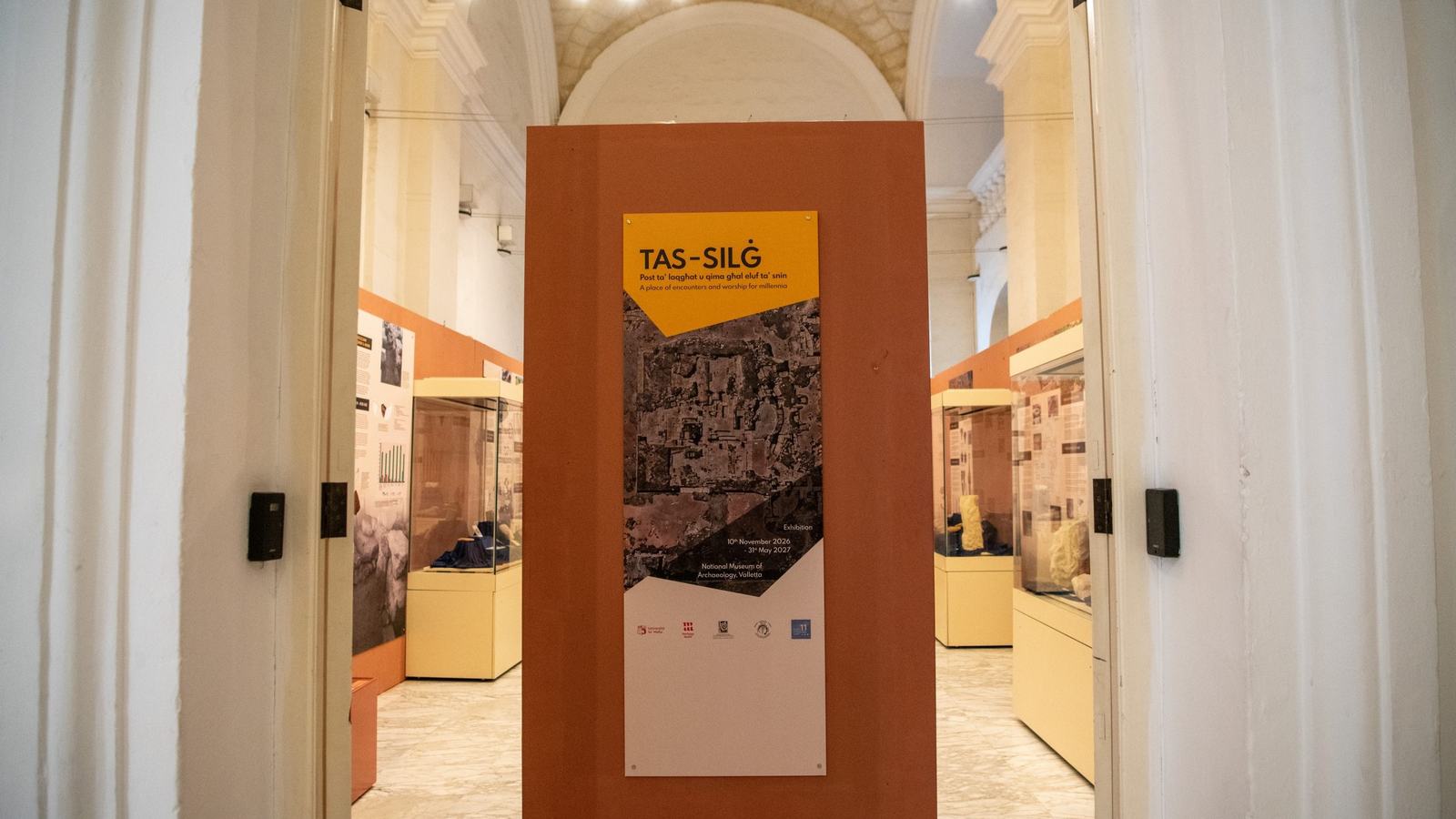
A Valletta exhibition traces over four millennia at Tas-Silġ, presenting artefacts that illuminate ancient encounters, worship and Mediterranean connections.
A new exhibition at Malta's National Museum of Archaeology in Valletta brings together material from one of the Mediterranean's most compelling archaeological sites. Announced by Heritage Malta on 11 November 2026, Tas-Silġ: A Place of Encounters and Worship for Millennia continues until 31 May 2027. It takes the visitor from the remains of a prehistoric temple through successive religious and commercial connections, presenting objects recovered during different campaigns of excavation within a unified interpretation. For those approaching Malta by yacht, the exhibition offers an exceptional opportunity to explore the island as more than a destination for the pleasures of its coastline. It reveals how the Mediterranean has brought distant cultures into contact over many centuries, and how the traces of those encounters can still be read in a comparatively small area of land.
The site overlooks Marsaxlokk Bay in the island's southeast. Its location establishes a useful connection between the physical geography familiar to a modern visitor and the history represented by artefacts in the museum. Rather than offering a conventional sequence of isolated historical periods, the exhibition concentrates on continuities and transformations at a single place over more than four thousand years. That perspective is particularly rewarding for a visitor interested in the architecture of ancient sanctuaries, the circulation of precious objects or the relationship between geography and belief.
A place that changed with successive communities
Archaeological evidence at Tas-Silġ includes remains from a late Neolithic megalithic complex, subsequent activity in the Bronze and Iron Ages, and a sanctuary associated with Phoenician-Punic and Roman worship. A Byzantine ecclesiastical complex followed, before the land eventually became part of an agricultural estate. The sequence is evidence of repeated change rather than a claim that each period maintained identical practices. Each historical phase must be understood through the structures, objects and contexts that survive from it.
This long history is one of the reasons that the museum presentation deserves time. A collector or visitor accustomed to appreciating an individual sculpture or piece of jewellery may be invited to consider an entirely different form of significance: an object placed in a sanctuary, reused in a later building or discovered alongside other traces of human activity can acquire meaning through its relationship with the site. The exhibition makes it possible to approach that relationship without assuming that the historical periods were neatly separated in the lives of their inhabitants. It is an encounter with the accumulated evidence of many generations rather than a reconstruction of a single, unchanging monument.
An object that travelled from Mesopotamia
One of the highlights identified by Heritage Malta is a small agate crescent bearing a cuneiform inscription. The institution associates its origin with Nippur in ancient Mesopotamia and dates it to the thirteenth or early twelfth century BC. Its presence in a Maltese sanctuary raises questions of extraordinary interest: how an object could pass through successive hands and geographical regions, and what meaning it might have acquired in a setting far removed from the society in which it was first made.
The museum suggests that the piece may have been dedicated at the sanctuary by seafarers from the eastern Mediterranean at a later date. The proposed connection is deliberately tentative. The object's material, inscription and archaeological context allow specialists to consider possibilities, but do not provide a passenger list or a documented itinerary. For visitors accustomed to moving between Mediterranean ports, this is a revealing example of what archaeology can establish and what it leaves open. An apparently modest object is capable of prompting questions about long-distance exchange, the transportation of valued possessions and the relationship between private devotion and maritime movement. The scholarly distinction between confirmed evidence and interpretation is part of its fascination.
A glimpse into ancient production and trade
Another highlight comes from a markedly different period. The museum describes a distinctive vessel associated with Sarius, an ancient entrepreneur working in northeastern Italy, and one of his workers of eastern origin. It dates the cup to the first half of the first century AD. Here the focus shifts from the exceptional history of a small inscribed stone to an object that can illuminate production, craftsmanship and the circulation of goods during the Roman period.
The archaeological vessel should not be understood simply as an example of the taste of a modern collector. Its value in an exhibition of this kind is that it connects the finished object to people, materials and places involved in making it. Looking at the form of the cup raises questions about the technical decisions of the maker and how the chosen design related to its intended use. Its association with a manufacturer offers another entry into historical networks. How products circulated around the Mediterranean, how makers acquired skills, and how an object was received in a new setting are important themes running through the exhibition. For visitors with an interest in the history of design and decorative arts, those themes are a useful counterpart to the familiar study of furniture, ceramics or precious metalwork from later centuries.
The sanctuary and Astarte
The exhibition also directs attention to the worship of Astarte, an important deity associated with the sanctuary. Among the material mentioned by Heritage Malta is an ivory ear of approximately human scale dating to the sixth century BC. The institution identifies the possibility that it once belonged to a cult statue. If so, this fragment would be part of a much larger work whose original appearance is not completely recoverable.
An object of this type invites unusually careful observation. The substance in which it is carved, the quality of detail and the degree to which the surviving portion preserves the intentions of its maker can all be considered before discussing the interpretation of its purpose. The absence of the rest of the figure is as significant as the surviving fragment: it defines the limits within which any modern reconstruction must work. A later coin identified in the museum's announcement may depict the goddess as a veiled woman. The accompanying Phoenician inscription on its reverse is interpreted as referring to Malta. Such pieces provide another way of examining the place of religious imagery in the expression of local identity.
Making sense of an archaeological landscape
An exhibition inside a museum inevitably presents a different experience from visiting an excavation. Objects that once belonged to architectural settings are displayed at a scale and within conditions that allow closer observation. But the relationship between those objects and their landscape remains essential. Tas-Silġ is situated above Marsaxlokk Bay, and the museum's account connects successive phases of occupation to a wider Mediterranean setting.
To help visitors appreciate those connections, the exhibition introduces new three-dimensional digital reconstructions of the archaeological complex and its surrounding territory in different periods. These are interpretive models, not direct records of vanished buildings. Their usefulness is that they can show spatial relationships that are difficult to identify from fragments of masonry or a conventional object display. A particularly rewarding approach for those interested in architecture is to compare the digital representations with the archaeological material presented nearby. That comparison encourages the visitor to notice which features have been recovered and which must be represented through research-based reconstruction. Heritage Malta intends to incorporate the reconstructions into a wider digital resource for the site.
A collaboration in archaeological interpretation
The exhibition has been developed by Heritage Malta together with the University of Malta, the Italian Archaeological Mission in Malta and the Superintendence of Cultural Heritage. Its timing coincides with the eleventh International Congress of Phoenician and Punic Studies in Valletta. This institutional collaboration matters because the objects and findings from a site explored over many years can belong to different research programmes. Presenting them together allows the visitor to appreciate the breadth of the investigations.
For patrons of cultural institutions and collectors interested in the relationship between scholarship and public presentation, the exhibition provides a useful example of the work that takes place before an object enters a display case. The careful documentation of finds, analysis of their context, evaluation of earlier research and development of interpretations all contribute to the finished experience. None of these processes can be replaced merely by assembling a collection of aesthetically appealing objects. The exhibition also highlights the importance of coordinated conservation and management of the wider Tas-Silġ complex, including the issue of parts of the site separated by a road.
Planning a visit from the waterfront
Valletta's National Museum of Archaeology offers a way to incorporate an extended cultural visit into a stay in Malta. Heritage Malta states that admission to this temporary exhibition is included with the museum ticket and that the exhibition space is accessible. Its published opening arrangements run from nine in the morning until five in the afternoon daily through 3 January 2027, with later hours to be announced. The exhibition is scheduled to remain in place until the end of May. Anyone organising an itinerary for guests should check the institution's latest information before committing to the details of a visit.
The display also has an accompanying catalogue, available through the museum and Heritage Malta's online shop. It provides a means of continuing the subject beyond the time spent in the galleries. Guests with an interest in maritime archaeology or ancient Mediterranean craftsmanship may find it rewarding to allow a sustained visit rather than pass through the exhibition between appointments. An evening spent elsewhere in Valletta or a visit to the southeastern part of Malta on another day can complement rather than replace the archaeological experience.
A different perspective on the Mediterranean
Tas-Silġ brings a particular depth to the experience of visiting Malta. The island's position within the Mediterranean has played a significant role in its history, and the exhibition allows that importance to be considered through individual examples of craftsmanship, religious activity and exchange. Its appeal is not dependent on explaining every aspect of the past. Indeed, some of the most compelling parts of the display concern objects whose exact journeys or original settings cannot be fully established.
For a superyacht owner or guest who values cultural discovery, this exhibition is an opportunity to connect the experience of travelling between ports with the far older movement of materials, ideas and beliefs. Modern mobility makes it easy to visit an archaeological collection, but the reward of the experience comes through sustained attention to the objects themselves. Heritage Malta's presentation of Tas-Silġ offers a concentrated and thoughtfully researched introduction to these themes, within a city whose own architectural setting adds another layer to the understanding of the island's history.
Primary source: Heritage Malta official press release, 11 November 2026.
Tas-Silġ exhibition entrance — Heritage Malta official press photograph. Official source.
