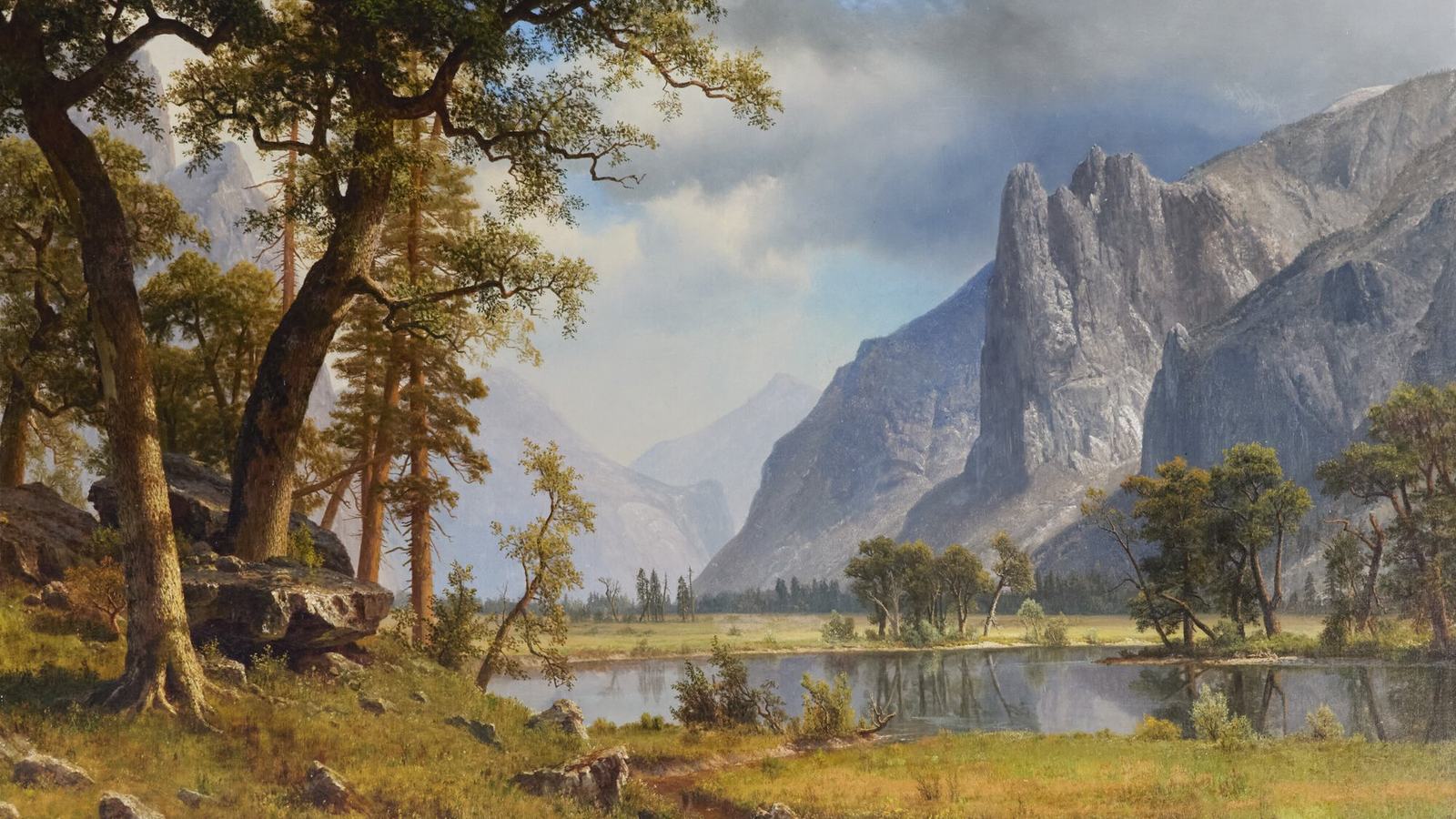
Christie's will offer about 20 paintings by Albert Bierstadt and Thomas Moran from Ted Turner's private collection in January 2027, with proceeds benefiting the Turner Foundation.
Art collecting and philanthropy, 12 November 2026. Christie’s has announced a January 2027 evening auction of paintings from Ted Turner's collection to benefit environmental conservation. The published figures are presale estimates, not completed sale results.
A private collection becomes a conservation fundraising sale Christie's has announced an important New York evening auction presenting approximately twenty works by Albert Bierstadt and Thomas Moran from the private collection of media entrepreneur and conservationist Ted Turner. The sale, Trailblazer: Ted Turner's America, is scheduled for 20 January 2027, with proceeds intended to benefit the Turner Foundation and its environmental-conservation work. The auction is especially notable for the connections between the collector's personal life, his extensive American landholdings and his affection for paintings of the western landscape. These are not merely decorative acquisitions assembled by a detached investor. They represent the visual ideals of a collector whose environmental commitments were a defining part of his public life. Yet the sale has not happened as of November 2026. Estimates published by Christie’s must not be represented as achieved prices, and neither a total auction result nor a buyer list can be reported before the event.
Bierstadt's Yosemite Valley is a central work One of the most important paintings in the selection is Albert Bierstadt's Yosemite Valley, dated 1866 and assigned a presale estimate of $4 million to $6 million. Christie’s describes the work as holding a central place in the collector's Montana ranch, where its sweeping view of the American landscape resonated with Turner's attachment to land conservation. Paintings of such scale can become an emotional centrepiece of a collection, but their market value also depends on scholarship, condition, provenance and the nature of comparable transactions. An estimate may reflect the auction house's assessment of bidding potential, not a fixed valuation guaranteed to be realised. A buyer considering a nineteenth-century landscape should examine conservation reports, canvas and paint condition, historical exhibitions and the documented ownership record. These factors are just as important as the immediate visual impact of the picture.
Thomas Moran's Grand Canyon remains equally compelling Christie's has placed an estimate of $4 million to $6 million on Thomas Moran's The Inner Gorge, Grand Canyon. The work brings a different understanding of the western landscape into the selection, with atmospheric effects and the dramatic geology of the canyon helping to create a sense of scale. Moran and Bierstadt both contributed to the visual imagination of the American West, but they worked through different pictorial strategies and historical experiences. A collection containing major examples by both artists can reveal how different painters approached land as a subject of wonder, national identity and human encounter. The announcement also includes Moran's The Grand Canyon—Hance Trail, estimated at $800,000 to $1.2 million. These numbers are not declarations of value achieved; they are auction estimates that will be tested when international bidders have an opportunity to compete.
A second Bierstadt evokes the American bison Another painting identified by Christie’s is Bierstadt's Buffalo at Sunset, with an estimate of $300,000 to $500,000. The subject has a particular relevance to Turner, whose conservation commitments included the American bison and the broader health of the country's ecosystems. Collectors are sometimes attracted to paintings because of an artist's reputation; in this case the subject also resonates with the personal priorities of the previous owner. That relationship can be a meaningful part of a work's provenance without necessarily increasing its monetary value by a predictable amount. A buyer may appreciate the emotional significance of such a pairing, but should still consider the picture's quality, exhibition history and conservation condition independently. The wider sale presents an opportunity to understand how Turner's interests shaped a coherent visual environment rather than merely assembling a list of famous American painters.
A collection can express an owner's identity Christie's account describes landscapes displayed in a setting closely associated with Turner's Montana life, where the visual experience of the land and the paintings reinforced one another. This is a useful reminder of how important private collections are created. A collector may buy art because a work captures a place, a memory, an ideal or a relationship that cannot easily be summarised by its estimated market price. When such a collection is eventually dispersed, something of that personal context can be lost, even as the works gain new viewers and potentially enter institutions or other private collections. Detailed cataloguing and published provenance can preserve some of the story. Private buyers considering a significant group of works might therefore treat documentation of the original setting as part of responsible stewardship, rather than regarding it only as a commercial selling point.
Turner's maritime and conservation connections Ted Turner was an accomplished sailor as well as a media and environmental figure, having won the America's Cup in 1977. That dimension of his life makes the Christie’s announcement particularly relevant to a yachting audience whose interests extend beyond vessels into art, philanthropy and land. It would be reductive, however, to interpret the paintings as maritime objects merely because their owner had a sailing history. Their subjects are primarily American landscapes, and their conservation connection arises from Turner's public and private commitments to preserving land and wildlife. In 1990 he established the Turner Foundation to support environmental causes. The auction’s charitable purpose builds on that history, rather than on a newly invented relationship between Western painting and marine conservation. Collectors should understand the distinction while appreciating the breadth of the life reflected by the sale.
Provenance from a prominent collector attracts attention A work's association with a prominent collector can add interest, particularly where there is credible documentation of how long it was owned and where it was displayed. It can also prompt greater scrutiny. Buyers should establish that the catalogue's account of provenance is supported by records and that the work has been properly attributed, conserved and described. Fame alone does not remove the possibility of questions about condition or history. The same applies to conservation treatment: an important painting may have undergone necessary work during its life, and buyers should understand that work before making a substantial bid. Families managing private collections can learn from such examples by keeping acquisition invoices, exhibition loans, photographs and conservation files together. An object’s story becomes much stronger when future researchers can examine evidence rather than rely only on a remembered anecdote.
The Turner Foundation is the intended beneficiary The auction house says the proceeds are intended to benefit the Turner Foundation's work in environmental conservation. That purpose distinguishes the sale from a conventional private-collection disposal, though the final amount raised will depend on the auction's result and the applicable arrangements. It should not be assumed that a buyer's entire payment automatically constitutes a charitable donation deductible under every jurisdiction's tax rules. A bidder is acquiring art through a commercial auction governed by its published terms, with the beneficiary identified in the seller's arrangements. Clients wishing to support environmental causes independently can make separate decisions about philanthropy. The conservation connection is nevertheless central to the collector's legacy, and it provides a powerful narrative through which the paintings may find new stewards who share some of that concern for the natural world.
The market will assess each work individually The collection is being presented as a coherent group, but bidders will still evaluate each painting according to its own qualities. Bierstadt and Moran have established places within American art history, yet differences in subject, scale, condition, date and provenance can lead to substantial price variation. A headline estimate for a major Yosemite landscape does not make a small canvas by the same artist equally valuable. Conversely, a more modest estimate does not imply that a picture is less meaningful to a collector. Auction demand can be influenced by museum interest, private collecting priorities, currency movements and the number of bidders competing for an individual work. Those factors are difficult to predict precisely. The responsible editorial position is to report the published estimates and wait for the sale before discussing realised outcomes or drawing conclusions about market direction.
New York will host the January presentation The paintings are scheduled for a live Christie’s evening auction in New York on 20 January 2027. An international audience may examine the catalogue and, where permitted, arrange to view the works before bidding. A prospective purchaser of important paintings should consider conservation reports, import or export requirements and insurance, particularly if the objects will move between countries. The sale's location and the artist's nationality do not settle the rules governing a buyer's eventual use or display of a work elsewhere. A careful acquisition process should also establish the method of payment, buyer's premium and any additional charges. Such practical matters may be less glamorous than a dramatic landscape, but they determine whether the eventual transfer can proceed smoothly and responsibly.
What is known before bidding begins Christie's has announced approximately twenty paintings by Albert Bierstadt and Thomas Moran from Ted Turner's private collection for a New York sale on 20 January 2027, with proceeds to benefit the Turner Foundation. The leading estimates include $4 million–$6 million for Bierstadt's Yosemite Valley and Moran's The Inner Gorge, Grand Canyon. The auction is not yet complete, and its total proceeds, successful bidders and final prices remain unknown. The significance of the collection lies in the relationship between major nineteenth-century American landscape paintings and a collector who was personally committed to environmental protection. For a discerning private collector, it presents both a chance to acquire important art and an occasion to consider the responsibilities that accompany ownership of cultural works. Its next factual milestone will be the documented auction result.
Primary source: Christie's, 11 November 2026, Trailblazer: Ted Turner's America auction announcement.