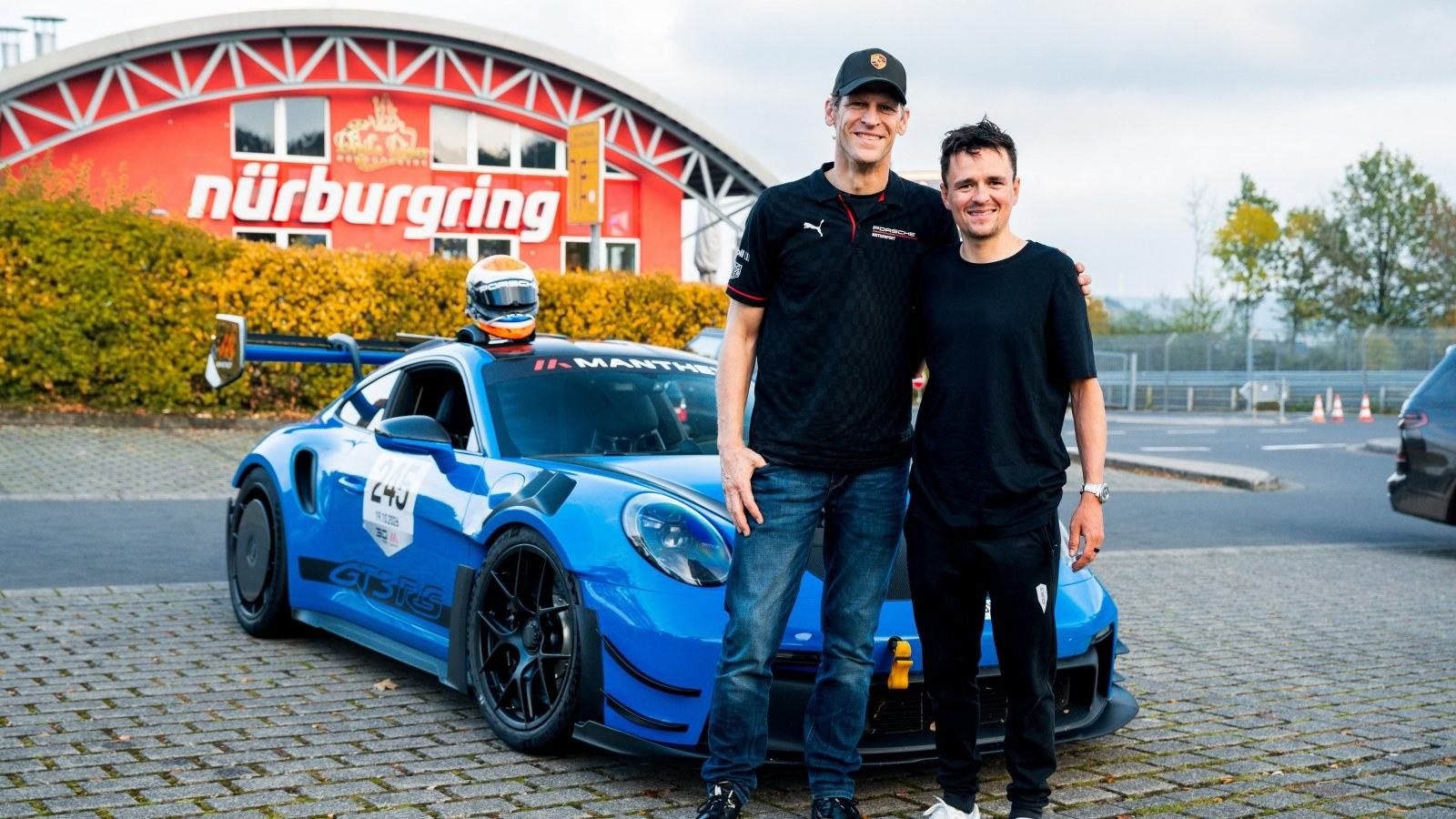
Two-time Olympic mountain-bike champion Tom Pidcock joined Porsche driver Jörg Bergmeister for a Nürburgring track day exploring the feel, precision and engineering of his Manthey-equipped 911 GT3 RS.
From Olympic trails to the Nordschleife
Double Olympic mountain-bike champion Tom Pidcock has taken his enthusiasm for precision and speed from cycling to the Nürburgring. In a Porsche feature published on 4 November 2026, the British athlete joined development driver and former racer Jörg Bergmeister for a track day with Manthey. The car was Pidcock's own 992.1-generation Porsche 911 GT3 RS, fitted with a Manthey Kit developed to sharpen performance on circuits.
The story is not about a new Porsche model or a professional racing debut. It is about the shared thinking required to make a bicycle and a high-performance car feel predictable when pushed towards their limits. Pidcock's background crosses road racing, mountain biking and cyclo-cross, giving him an unusually broad appreciation of grip, balance and the confidence needed to carry speed through changing conditions. Although the original assignment was a track-day experience, it also illuminates how professional athletes approach unfamiliar disciplines. Pidcock's achievements give him a strong foundation in reading surfaces and managing risk, but a racing circuit still requires specialised instruction and an understanding of how a much heavier machine responds.
A track day shaped by bad weather
The Nürburgring initially offered an unpromising setting, with heavy rain leaving the Nordschleife too wet for the intended driving programme. Pidcock and Bergmeister spent part of the morning visiting the nearby Manthey facility instead. The engineering and organisational side of the operation struck Pidcock as familiar, particularly the way equipment, components and support procedures are arranged around a high-performance team.
The comparison with elite cycling was more than a casual observation. Both sports rely on preparation and detailed organisation before anyone performs in public. Teams need mechanics who understand the equipment, clear processes for changes and systems for learning from each outing. Pidcock recognised that the professional service areas of cycling teams have much in common with the methodical atmosphere at a motorsport workshop. Rain made the event a reminder that preparation determines what can be achieved safely. Postponing the fastest running until conditions improved was a practical decision, not a disappointing footnote. It allowed the drivers to use time productively at Manthey and return to the circuit with a better sense of the available grip.
The role of data and driver feel
Motorsport teams record extensive performance information, and professional cyclists use power, heart-rate and other measurements to guide training and equipment choices. But numbers cannot completely describe how confident a person feels when responding to a surface. Pidcock told Porsche that developing a car for the Nürburgring involves judgement that goes beyond what telemetry can show, drawing a comparison with the development of racing bicycles.
A machine that gives clear feedback can make performance repeatable rather than merely impressive on one lap. Bergmeister's view is that confidence allows a driver to approach braking points and corners with greater precision. That should not be confused with an invitation to disregard safety or track conditions. Real confidence comes from understanding limits and being able to respond consistently when the available grip changes. The conversation about data is particularly revealing in an era when athletes receive more numbers than ever before. Measurements can highlight changes, but the person operating a machine must interpret them under pressure. This is why feedback from an experienced engineer or instructor can complement telemetry rather than compete with it.
Wet-weather tyres and a drying circuit
When the weather improved, the two drivers went onto the circuit using Michelin Pilot Sport S 5 tyres, which Porsche describes as a wet-weather option for the 911 GT3 RS. This was a sensible progression on a surface that had started the day in heavy rain. Pidcock chose to build speed gradually, even as Bergmeister noticed how quickly the cyclist could follow him through sections of the track.
As the surface dried further, the cars moved to dry-weather tyres and Bergmeister suggested subtle damper adjustments. Such changes are meaningful only when considered alongside the conditions, tyre specifications and vehicle setup. The article does not claim that a particular setting is correct for all owners or circuits. Its lesson is that careful adjustment and observation matter as much as the headline capabilities of the hardware. Tyre choice is an essential distinction in the account. Performance that is impressive on a dry surface can become irrelevant when standing water alters contact with the road. The careful transition between wet and dry setups shows that technique, preparation and suitable equipment are inseparable elements of a responsible circuit outing.
What the Manthey Kit changes
The Manthey Kit for the Porsche 911 GT3 RS is intended to improve performance under controlled circuit conditions. Porsche identifies targeted modifications to suspension, brakes and aerodynamics, developed as a coordinated package rather than isolated decorative accessories. The intention is to help a capable track car operate more effectively when tyres, chassis and aerodynamic loads are working together. Owners should not interpret that as a claim that road limits or safety rules no longer apply.
Manthey's history in endurance racing gives its engineers experience of making small changes that combine into a more predictable system. Bergmeister emphasised this attention to detail during the visit, noting that the whole package matters more than one component. That is a useful perspective for enthusiasts who might otherwise focus on headline downforce figures or the visual drama of additional aerodynamic surfaces. Drivers considering a performance package should also understand that its benefits depend on the entire setup. Suspension changes influence how the tyres use the road, while aerodynamic effects become more pronounced at higher speeds. A professionally installed package is not a replacement for driver training, vehicle inspection or compliance with track regulations.
Pidcock's earlier Nordschleife lap
Porsche reports that Pidcock had previously set a bridge-to-gantry time of 6 minutes 52.37 seconds on the Nordschleife earlier in 2026. The figure provides context for his enthusiasm and familiarity with the circuit, but it is not presented as a new record from the featured track day. Bridge-to-gantry timing also differs from the full official lap measurements used for many manufacturer records.
Comparisons between lap times require caution because configuration, traffic, weather, timing method and tyres can alter the result considerably. The attraction of Pidcock's visit is not that it produced a definitive ranking against professional racing drivers. Instead, it illustrates how an athlete with considerable experience interpreting grip on two wheels can acquire and refine similar skills in a high-performance car. The earlier bridge-to-gantry figure also demonstrates why a lap time should always include its method of measurement. A short video or isolated number can leave out the details that explain its significance. By identifying the timing format, the report gives readers a way to distinguish Pidcock's personal achievement from formal manufacturer records.
The contrast between elite sport and a pastime
Pidcock is a world-class competitor who has won Olympic mountain-bike gold at both the Tokyo and Paris Games, as well as a cyclo-cross world title. Porsche portrays his track driving as a different kind of challenge, away from the expectations surrounding professional competition. He can concentrate on improving his technique for personal satisfaction rather than measuring every action against a championship outcome.
That distinction may resonate with owners who enjoy driving courses without seeking competitive licences or race results. A properly organised track day offers an opportunity to learn from instructors, understand equipment and appreciate a car away from ordinary traffic. It remains a specialised environment with risks and strict safety procedures, not a setting for improvisation or attempting public-road speeds. Pidcock's perspective adds another dimension to the familiar promotional track-day narrative. A person accustomed to intense competition can still find satisfaction in learning a new discipline. That makes the encounter interesting to amateur enthusiasts: the reward may be the feeling of a smoother, more controlled lap rather than a claim of superiority.
What the story reveals about high performance
The most interesting element in Porsche's account is the relationship between a person and a machine, rather than the presence of an Olympic champion beside a famous racing driver. Pidcock and Bergmeister discuss attention to detail, feedback and the progressive building of confidence. Those ideas are relevant across elite sports, but they must be applied with respect for the particular demands of cars and circuits.
For enthusiasts considering track use, expert tuition, suitable equipment and an understanding of venue rules are better starting points than trying to imitate an athlete's lap time. Porsche's report provides a thoughtful example of learning through collaboration with experienced specialists. It also shows how an established performance car can continue to reward careful study, even when its owner already has exceptional competitive instincts. The broader conclusion is that progress comes from small, cumulative adjustments. Weather awareness, instruction, choice of tyres and careful setup each contribute to the outcome. For a discerning owner, those lessons are more transferable than trying to copy the pace of a celebrated athlete on one particular day.
Editorial source: Porsche Newsroom. This original lifestyle feature is based on information from the named source; check current local navigation requirements and the equipment manufacturer before departure.
Source
Porsche Newsroom