A Gozo exhibition explores how Victor Pasmore interpreted the Cave of Calypso through abstract geometric compositions and reliefs from an international collection.
A new exhibition at Il-Ħaġar, Heart of Gozo, invites visitors to explore an important chapter in the career of British abstract artist Victor Pasmore through his relationship with a particularly evocative location on the island. Victor Pasmore: The Cave of Calypso opened on 14 November 2026 and is scheduled to continue until 10 January 2027. Organised at the museum in Victoria, the exhibition brings together works selected to illuminate connections between the artist's creative practice and a place that stimulated his imagination. Much of the material belongs to Milan gallery lorenzelli arte, an institution with a long association with the presentation of Pasmore's work.
The subject offers an interesting proposition for visitors familiar with the island's landscapes and for collectors seeking to understand the development of modern European abstraction. The museum emphasises that Pasmore's response to the cave was not primarily one of literal depiction. Instead, it identifies a relationship between the place's perceptual qualities and the artist's geometric compositions and reliefs. This distinction makes the exhibition a particularly interesting companion to an extended stay in the Maltese islands. It focuses on how an artist transforms the act of looking into something that can be understood independently of a conventional landscape painting.
A British artist's Maltese chapter
Victor Pasmore was born in 1908 and died in Malta in 1998. His relocation to the islands in the 1960s is an important part of the context of the exhibition. The decision to live and work in a distinctive Mediterranean environment placed the artist in surroundings quite different from those in which his earlier career had developed. The museum's announcement identifies Gozo's Cave of Calypso as one of the places that fed into the artistic concerns explored by the present selection.
For a visitor seeking to understand Pasmore's art, it is useful to resist the assumption that a Mediterranean setting must necessarily result in pictures of recognisable coastal views. An abstract work can engage with the experience of a place without preserving the outline of any particular hill, building or stretch of water. The artist may be concerned instead with relationships among shapes, surfaces, empty areas and elements that appear to stand forward or recede. In that respect, looking at Pasmore's work offers a different form of engagement with the environment: the viewer must pay attention to the internal relationships of the work rather than identify it as a straightforward record of the view from a particular point.
The significance of the cave
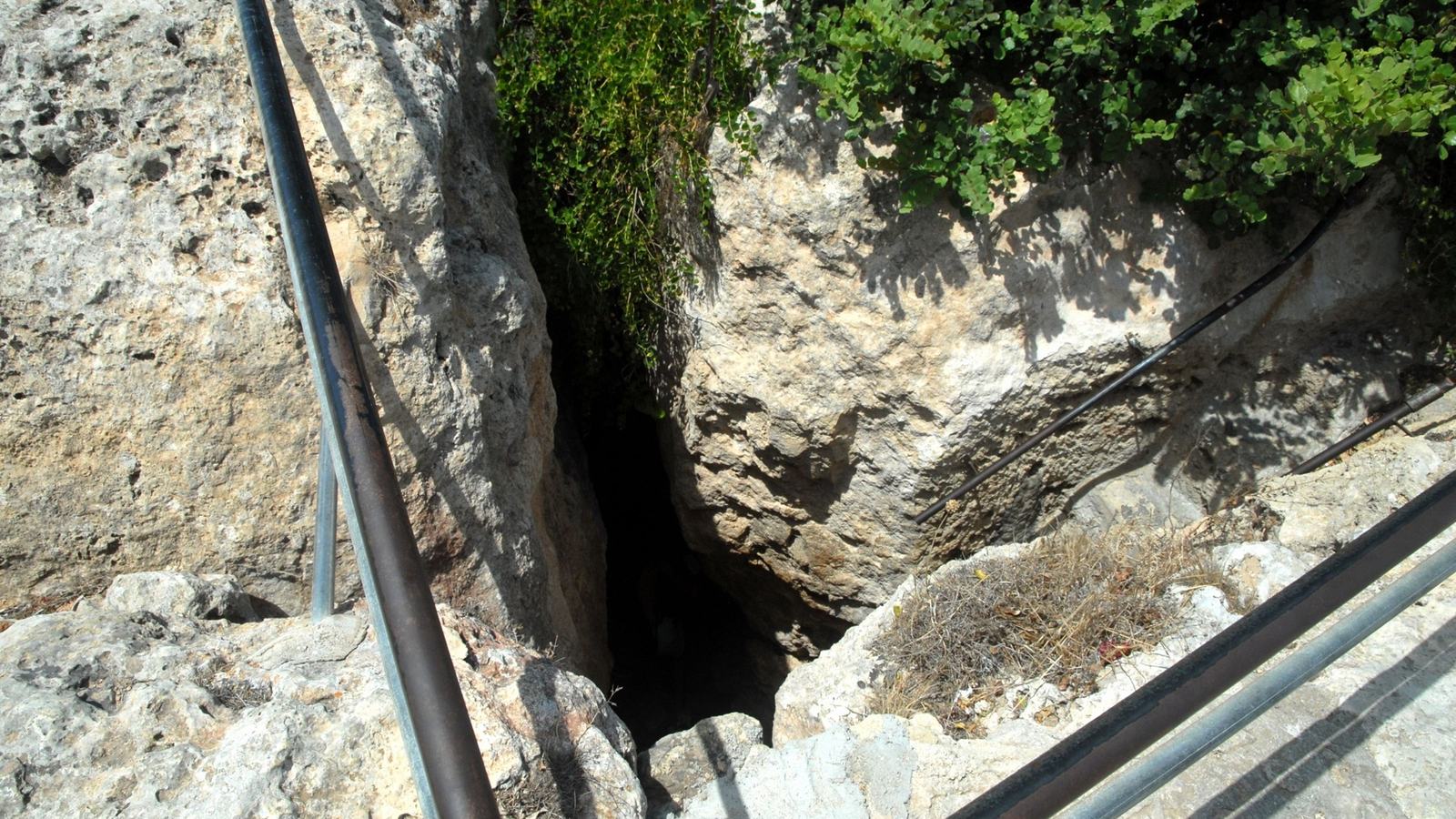
Il-Ħaġar's curatorial premise draws attention to the conceptual relationship between Pasmore's work and the Cave of Calypso. This is a productive point of departure because a cave is an environment defined by the interaction of form, enclosure and light. The presence of an opening, the depth of a shadow and the transition from an enclosed space towards the surrounding landscape can all structure what a visitor sees. The island's associations with mythology add another dimension to its cultural resonance.
The exhibition is not presented as an archaeological investigation of the cave or a demonstration of the literal sources of every compositional element in Pasmore's work. Instead, it offers an opportunity to think about the way in which perceptual experience can be transformed by an artist. That transformation is especially relevant to abstraction. The relationships established in an artwork may remind the viewer of the experience of enclosure, movement or illumination without reproducing the place itself. Collectors can approach the works through this conceptual connection while remaining attentive to each object's specific qualities. The significance of the exhibition lies in the relationship it proposes, rather than in identifying every abstract form with an individual feature in the landscape.
Looking carefully at geometric composition
Geometric abstraction can initially appear straightforward, especially where a work is organised around a limited number of clearly identifiable shapes. A closer examination can reveal quite complex decisions about scale, placement, balance and proportion. A shape near the edge of a composition may act differently from the same shape at the centre; the size of an unoccupied area can be as consequential as the size of a drawn or constructed element.
The works described in the exhibition announcement invite this kind of observation. A worthwhile approach is to allow time for the eye to move between the whole and the individual components rather than immediately seek a narrative explanation. In a geometric composition, the relationship between parts often supplies much of the visual interest. Edges can establish tension, gaps can create separation and a shift in emphasis can change the way surrounding elements are perceived. These are not rules that provide a fixed meaning for an abstract artwork. They are opportunities for looking more closely. An exhibition built around a specific aspect of an artist's career can help make such observations more rewarding by allowing the visitor to compare different works within the same curatorial framework.
Relief and the experience of space
The exhibition's reference to reliefs is especially interesting for anyone familiar with the world of architectural and interior design. A relief has attributes that depend not only on its composition but on its physical presence. When a surface projects into the space of the viewer, a relationship with surrounding light becomes part of the experience of looking at it. This is a different question from the illusion of depth suggested by perspective in a picture.
Such a work rewards an appreciation of both the overall arrangement and the materials and techniques involved in its construction. Visitors should look at the objects as they are presented by the museum rather than assume that all works made by the artist were constructed in the same way. The curatorial connection to the Cave of Calypso offers a particular way of considering the relationship between surface and depth. It can also encourage a more general interest in the way modern artists investigate form in three dimensions. For collectors who have encountered abstract works principally through reproductions, the physical character of a relief is a compelling reason to experience an exhibition in person.
The contribution of lorenzelli arte
The organising museum states that the majority of the works on display come from the collection of lorenzelli arte, based in Milan. The gallery has a longstanding involvement with the exhibition and promotion of Pasmore's art. Its participation in the Gozo project establishes an international connection between a local museum and a collection developed through sustained engagement with the artist.
An exhibition of this nature provides an interesting example of the relationship between private collections, galleries and public cultural presentations. A concentrated body of works can acquire additional value when viewed within a curatorial argument rather than individually or in the setting of a sale. The opportunity to examine selected pieces together allows visitors to consider continuities and differences in the artist's practice. It also reinforces the importance of the records and expertise associated with a collection. For those who support cultural institutions or assemble collections of their own, there is much to appreciate in the way a collaboration can make privately assembled material available to the wider public for a defined period.
A close encounter with the Maltese art world
The exhibition is curated by Professor Vince Briffa and coordinated by Valerio Ballotta of GBK Ltd. Il-Ħaġar identifies lorenzelli arte, GBK Malta Ltd, the Victoria International Arts Festival Foundation and the Victoria Local Council among the collaborators, with support from cultural and tourism organisations. These relationships are particularly relevant to the exhibition's location. An artist with an international reputation is being considered in the setting of an island that formed part of his long period of residence and artistic activity.
For a visitor whose previous encounters with modern British art have taken place in London or other large cultural centres, the Gozo exhibition offers a different kind of setting. The surrounding island belongs to the subject of the presentation. This does not mean that a visit to the cave is essential to appreciating the works, or that the exhibition itself provides access to the site. It means that the geographical context is more immediately present than it might be in a distant gallery. An itinerary that includes unhurried time in Victoria can make it possible to consider that relationship without reducing the art to a souvenir of the destination.
Making time for the exhibition in Victoria
Il-Ħaġar is located in Pjazza San Ġorġ in Victoria. The museum's event listing gives the exhibition dates as 14 November 2026 to 10 January 2027, and states that admission is free. It also lists normal museum hours of nine in the morning to five in the afternoon. Yacht guests considering a visit should confirm current opening arrangements and local transport options rather than assume that all days during the festive season will follow the same routine.
In organising a cultural visit to Gozo, it is worth setting aside enough time to explore the exhibition at a comfortable pace. There is no requirement to understand every aspect of abstraction before entering the galleries. Looking carefully at each work, returning to earlier pieces after encountering others, and paying attention to the curatorial interpretation can be a rewarding way to engage with the material. For those with a specific collecting interest, the museum and its participating institutions are appropriate starting points for questions about the exhibition and the artist. The works should be treated as objects on exhibition, not assumed to be available for purchase.
The lasting value of seeing works in context
The distinctive quality of Victor Pasmore: The Cave of Calypso is its focus on the relationship between an artist's imaginative response and the surroundings he encountered. The question posed by the exhibition is one that has relevance beyond Pasmore himself: what happens when a place is translated into an artwork that does not seek to describe it literally? That question offers a way to reflect on the nature of abstraction and on the importance of the viewer's own attention.
For visitors to the Maltese islands who have an interest in art and design, the exhibition is a reason to consider Gozo as a destination for sustained cultural discovery. It is also an opportunity to appreciate the work of the organisations and collections that bring art into a public setting. The ability to look directly at the work of an artist in the geographical and conceptual context that inspired the selected exhibition is valuable in a way that cannot be entirely reproduced through an online image or a short account of his career. The museum's presentation makes that opportunity available in Victoria through the beginning of January.
Primary source: Il-Ħaġar official exhibition announcement, November 2026.
Calypso Cave, Gozo — User: (WT-shared) Double oh at wts wikivoyage; via Wikimedia Commons, CC BY-SA 3.0. Resized; contextual photograph, not an exhibition view. Official source.

