The ship-inspired French garden, nine themed landscapes and Riviera art collection make Villa Ephrussi de Rothschild a rewarding cultural shore visit for superyacht guests.
Cap-Ferrat's most imaginative shore stop
The Villa Ephrussi de Rothschild occupies an extraordinary position on Saint-Jean-Cap-Ferrat, with the Mediterranean visible on both sides of the peninsula. For a superyacht itinerary along the Côte d’Azur, its appeal is unusually complete: a Belle Époque house, an art collection, landscaped gardens and a sense of place that cannot be reproduced in a private lounge.
Guests cruising between Monaco, Villefranche-sur-Mer and Beaulieu-sur-Mer can approach the estate as a deliberate cultural appointment rather than an incidental excursion. The property is a public museum, not a private yacht club, and its pleasures come from exploring the work of its patron and gardeners at a pace that allows for details.
The villa was created for Béatrice Ephrussi de Rothschild, whose interest in collecting and design shaped both the interiors and the landscape. The property is now associated with the Académie des Beaux-Arts, and the official visitor experience places artistic heritage beside an enduring panorama of the Riviera.
An excellent half-day need not attempt every nearby attraction. Allowing the villa to be the centrepiece leaves room to appreciate the gardens properly, pause in the tea room and return to the yacht without turning a refined experience into a hurried checklist.
A French garden conceived as the deck of a ship
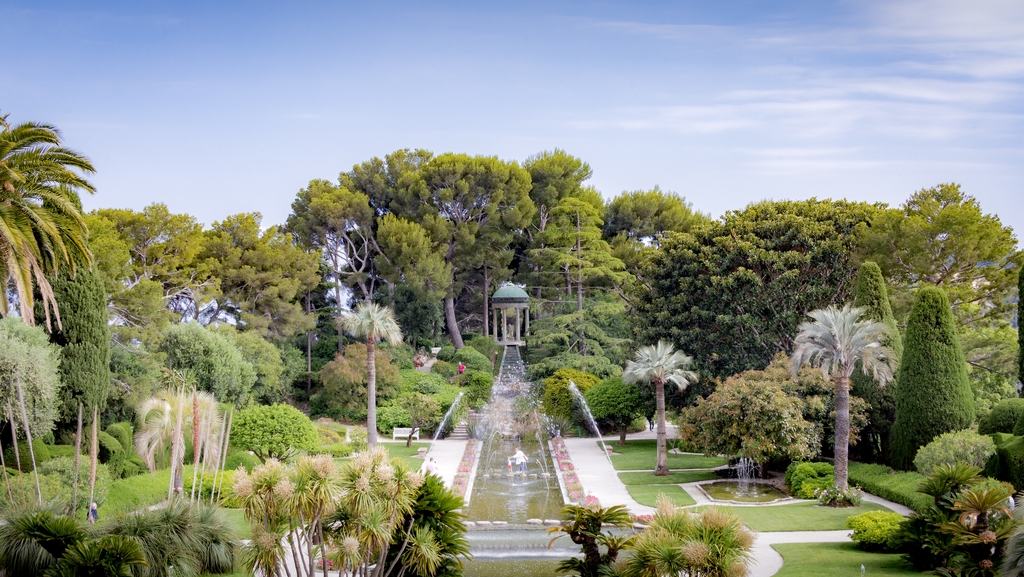
The estate's remarkable maritime connection is built into the French garden itself. The villa's official guide explains that Béatrice conceived the principal garden in the shape of a ship's deck, with a decorative watercourse, ponds and the Temple of Love positioned toward the imagined bow.
From the loggia she could look across sea on either side of the property and imagine herself aboard a steamship. She named the villa Île de France in memory of a voyage, a personal association that makes the grounds unexpectedly resonant for people arriving on the Riviera by yacht.
The layout encourages a visitor to look both along the formal garden axis and outward beyond its boundaries. Stately urns, precisely organised planting and water features provide a carefully constructed foreground, while the real bays and distant headlands supply a backdrop no designer could command.
This is where a good guide can make the visit more interesting for an owner or charter party. Rather than describing the gardens simply as a pretty setting for photographs, the guide can explain how Béatrice turned the language of travel, shipboard outlook and Mediterranean light into an architectural idea.
Nine gardens, many different atmospheres
Beyond the central French composition, the official estate describes nine themed gardens, each offering a distinct change in planting, texture and mood. The Spanish, Florentine, Japanese, exotic, rose, Provençal, stone and Sèvres areas broaden the visit beyond the symmetry of the central vista.
In the Spanish garden, water and greenery create a more enclosed atmosphere, contrasting with the broad coastal outlook of the main terrace. The Florentine section introduces Italianate architectural references, while the stone garden incorporates carved historic fragments and shaded spaces that reward close attention.
The Japanese garden is known as Cho-Seki-Tei, a name the estate translates through the idea of listening calmly to waves at twilight. Its traditional pavilion, bridge, lanterns and water features invite a slower circuit than a guest might expect from a conventional photo stop.
The exotic garden presents robust sculptural forms in agaves, aloes and cacti, a vivid contrast to neighbouring rose planting. Seasonal appearances change, however, so a concierge should never promise a particular flower display without checking the timing and current conditions with the estate.
The rose garden becomes especially fragrant during its principal flowering season, which the villa identifies as late spring into summer. An October visit can still be exceptionally beautiful, but the case for going rests on the whole landscape, architecture and views rather than an expectation of peak roses.
Inside: personal taste and an unusually rich setting
The house adds an essential second dimension to a garden-focused excursion. Its richly decorated rooms and collections show the taste of a collector who assembled artworks, furniture and objects as part of a distinctive private world, now presented for visitors to discover.
Guests with an interest in interior design can look for relationships between the setting of objects and the views through windows and doors. The contrast between formal rooms and expanses of garden gives the estate its particular character; indoors and outdoors were intended to work together.
The official visitor information describes an audioguide offered in several languages, helping independent visitors explore without organising a private guide. Groups seeking deeper interpretation should ask about available guided experiences ahead of time, especially if language or mobility needs are important.
Photography may be part of the pleasure, but guests should check the estate's current rules for professional equipment, drones and organised shoots. A visitor ticket should not be understood to include unrestricted commercial photography or exclusive use of rooms and terraces.
A graceful lunch or tea-room interlude
The villa's Restaurant and Tea-Room Béatrice gives the itinerary a natural pause after the principal rooms and before or after the garden circuit. The setting makes it possible to remain inside the estate rather than treating lunch as a separate transfer with another arrival and departure.
A luxury guest programme can build around the preferences of the party without overstating what the venue promises. A tea stop, a relaxed light meal or an unhurried conversation about the gardens may be preferable to another high-profile restaurant reservation.
Opening times, menus, reservations and private arrangements should always be checked directly with the venue. The official site currently advertises daily public opening in late October, but operational conditions and special closures may change and any dining plan needs its own confirmation.
For groups contemplating an evening reception or a more formal occasion, the villa has a separate private-events channel. That is an enquiry process with its own conditions and permissions, not an automatic extension of ordinary visitor admission or an entitlement associated with arriving by superyacht.
Practical planning from yacht to shore
The first decision belongs to the captain: establish where the yacht will be legally berthed or anchored and how guests will transfer safely ashore. Nothing in the villa's location should be read as permission to tender to an arbitrary stretch of coastline or to use the estate as a landing point.
Once an authorised shore arrival is agreed, the concierge can arrange the appropriate road transfer to Saint-Jean-Cap-Ferrat and allow realistic margins for traffic, weather and the needs of the party. The estate lists its address on Avenue Ephrussi de Rothschild, making clear destination instructions relatively straightforward.
Late-October hours on the official website are listed as ten in the morning until six in the evening, with last admission earlier than closing. Confirm the live calendar immediately before visiting and leave enough time for both interiors and gardens; a rushed arrival near closing forfeits much of the value.
Walking surfaces, changes in level and outdoor conditions deserve attention when there are older guests, young children or people with reduced mobility. The official access information is the appropriate starting point, but a group with specific requirements should speak directly to the visitor team about the intended route.
The strongest approach is quiet and flexible: a knowledgeable shore contact, timed transport and a little breathing room before the return journey. The reward is an excursion that connects maritime imagination with garden design and Riviera heritage, giving guests something memorable to discuss when they are back on board.