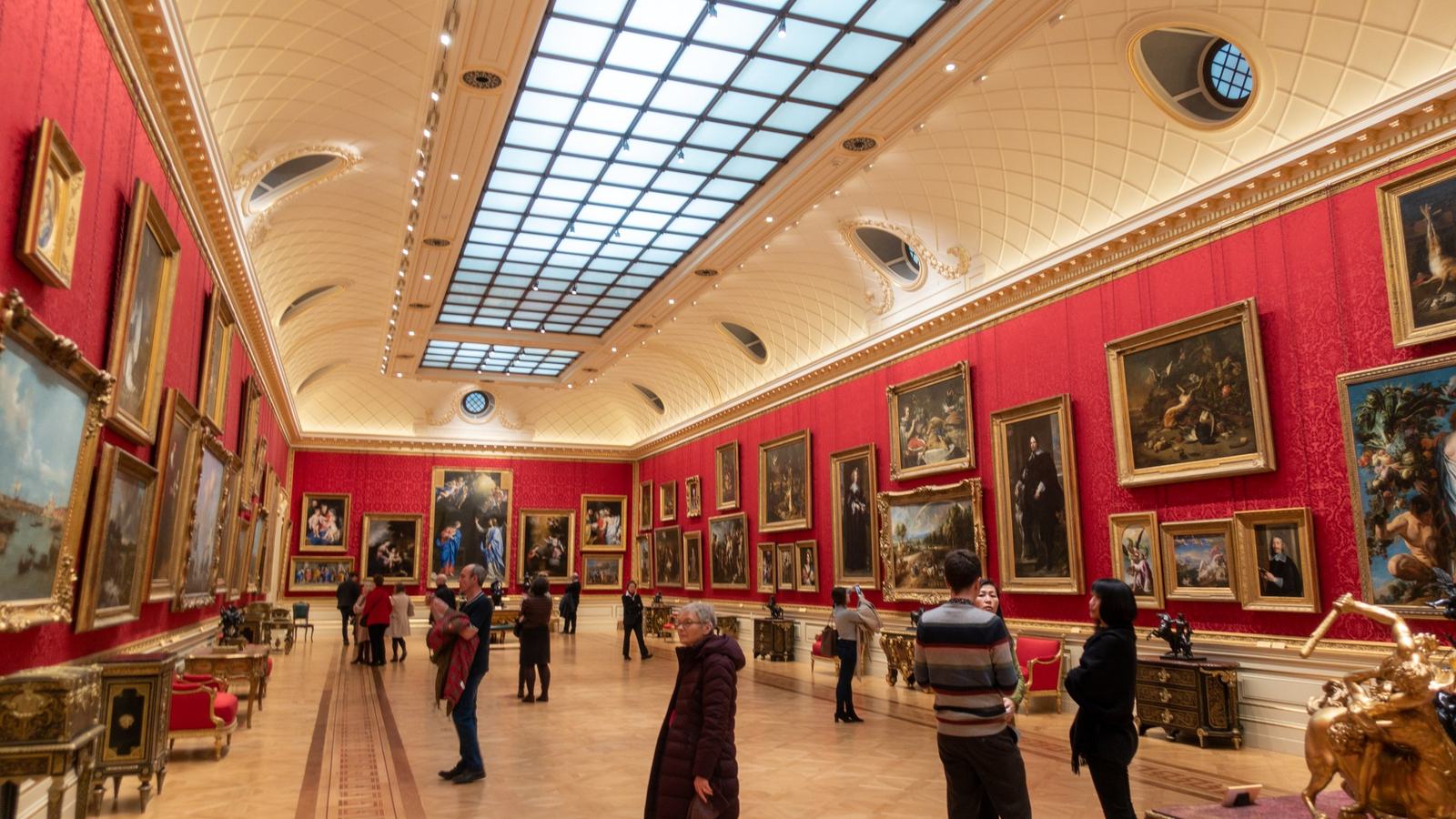
Discover the Wallace Collection’s French decorative arts, fine cabinetmaking and the lessons of historic interiors for discerning collectors and yacht owners.
A private client looking for inspiration for an important interior commission might profitably spend a morning at Hertford House on London's Manchester Square. The Wallace Collection is not an interior-design showroom. It is a museum in which important works of art and craftsmanship can be studied together, within rooms that retain a relationship to the domestic tastes of the people who assembled them. That setting gives a prospective collector something more valuable than a catalogue of styles: a context in which to assess how objects of very different character can enrich one another.
The museum's account of its holdings identifies fine painting, historic arms and armour, sculpture and decorative arts as important strengths. Its eighteenth-century French material is of particular interest to visitors who are considering exceptional cabinetmaking, precious materials and hand-finished interiors. The opportunity is as relevant to someone commissioning a contemporary residence or yacht as to a patron interested in acquiring antiques. The point of looking at furniture made for previous generations is not necessarily to reproduce it, but to appreciate the decisions that made particular pieces important enough to be preserved.
Understanding the relationship between object and room
The domestic scale of Hertford House rewards a form of observation that can be difficult in the vast galleries of a larger museum. The relationship between a painting, a cabinet, a wall and an adjacent doorway can be observed as a composition rather than as a series of isolated objects. An interior that appears convincing at this scale is not simply one in which every object is expensive. Proportion and placement determine how objects relate to their surroundings, while the distance between a visitor and a piece affects the details that can be appreciated.
The relevance to contemporary design is considerable. In a large yacht salon an owner may request important decorative objects while also specifying unrestricted circulation, excellent views and accommodation for entertainment. These demands have to be reconciled at the design stage. One large object may require considerably more space than its physical dimensions suggest if people are to view it properly. A designer working with a collector should therefore discuss the actual viewing positions within the room, including the perspective from the seats where occupants are likely to spend their time. This approach can make the interior more satisfying even where the proposed collection is entirely contemporary.
Cabinetmaking as a collaboration of different skills
The Wallace Collection's educational resources include material on the furniture of Jean-Henri Riesener and André-Charles Boulle. Each is an important point of departure for anyone interested in the nature of high-level historical cabinetmaking. Their works invite attention to surface, construction, metalwork and the combination of different materials within a single object. A visitor does not need to understand every historical distinction in advance, although preparation will make the experience more rewarding.
The analysis is valuable when commissioning new furniture. Rather than treating a cabinetmaker as a supplier responsible solely for delivering a specified external appearance, the patron can ask how the object is engineered and which specialist crafts contribute to its construction. Wood selection, veneering, mechanical fittings and the quality of moving parts can have consequences long after an initial presentation. A bespoke writing desk that looks elegant in a photograph may prove less successful if the drawers are awkward to use or if the joinery is difficult to service. Discussing the proposed construction with the maker can produce a different result from choosing a finish at the end of a project.
The distinction between materials and workmanship
There is an instructive difference between the rarity of a material and the skill with which it has been employed. Some materials attract considerable attention because they are difficult to obtain or expensive to prepare. That does not make every object fabricated from them a work of outstanding quality. The surfaces and details of historic French furniture provide examples of how visual effects depend on careful decisions about the direction, scale and arrangement of decoration.
An owner commissioning contemporary furniture can establish an appropriate hierarchy of expenditure by asking which elements actually contribute to the design. A well-made transition between adjacent surfaces may have a greater effect on everyday enjoyment than the addition of another rare material. The selection of responsible present-day alternatives to historically used substances is another important consideration. Some older materials are now subject to legal controls or conservation concerns, and a maker proposing comparable effects should be able to document the lawful and responsible origin of the materials used. New commissions need not copy historic material choices to demonstrate an appreciation of the craftsmanship exhibited by the older objects.
Living with a collection rather than accumulating trophies
Hertford House provides a useful setting in which to consider the difference between individual ownership and the development of a collection. A number of admirable objects assembled without regard for one another may not produce a satisfying room. By studying how different categories of object participate in a larger composition, a visitor can begin to identify their own preferences with greater precision. The presence of paintings and sculpture alongside decorative arts makes this closer to the circumstances in which many private clients live than an exhibition devoted to just one category.
The process might begin with a small group of works that the owner genuinely enjoys. An adviser can then help identify the characteristics that connect those pieces, such as a particular treatment of colour, interest in a historical period or affinity for an artisanal process. The result need not be stylistically uniform. Indeed, the contrast between a modern sculpture and a carefully selected antique cabinet can be one of the most appealing qualities of a contemporary interior. What matters is that the juxtaposition is intentional rather than a consequence of buying attractive objects without reference to the spaces in which they will ultimately be enjoyed.
Condition, documentation and informed acquisition
A museum is a useful place to appreciate the significance of an object's condition, even if a visitor is not able to inspect its concealed construction or consult its conservation records. Furniture with a long ownership history may have been modified, repaired or restored. The existence of such interventions is not in itself a reason to reject a piece, but the nature and quality of the treatment can affect both its interpretation and its suitability for a proposed setting.
Before acquiring an important object, a private client should arrange an appropriate independent examination and request sufficient documentation to establish its identity, provenance and relevant ownership history. Expert assistance is particularly important where an attribution is central to its price. Buyers should also investigate any export requirements, restrictions on materials and insurance implications before agreeing to transport an object internationally. For a collection involving several residences, good documentation enables advisers and family members to maintain continuity in its management. In the event of a future sale or conservation intervention, the availability of reliable records can make a complicated process considerably easier to administer.
Decorative art in the marine environment
The enduring appeal of carefully made furniture does not remove the technical limitations of installing sensitive works aboard a yacht. Unlike a house, a vessel is subject to sustained movement, vibration and changes in the surrounding marine conditions. A piece selected solely because it suits the proportions of a cabin might be unsuitable for the environment or difficult to secure without damage. Owners should involve their design team and appropriately qualified conservation specialists before deciding to take important historic pieces to sea.
Those constraints can lead to creative commissions rather than a diminished interior. A contemporary maker might reinterpret the visual rhythm of a historical piece while using construction techniques and materials suitable for the intended installation. Mechanical systems can be designed for the actual operating environment, and provisions for inspection and maintenance can be included from the outset. In cases where the original object is especially fragile or significant, it may be preferable to keep it at a residence and commission a distinct companion work for the yacht. This respects the older object without requiring the owner to abandon the aesthetic qualities that made it attractive in the first place.
Arranging a visit with a specific purpose
The official museum website provides information about the different parts of the collection and the facilities available to visitors. An owner visiting London in preparation for an interiors project might choose to concentrate on decorative arts during one visit and return later to examine paintings or sculpture. A limited objective can be preferable to trying to see everything in one morning, particularly when a designer or specialist adviser is accompanying the party.
It is worth having the discussion before arriving. Which objects or types of workmanship are relevant to the commission? What questions would benefit from being considered in front of an actual piece of furniture? If the party has a particular scholarly or access requirement, the museum should be contacted through the appropriate published channel, rather than assuming that a curator or conservator will be available on request. The official website should also be consulted for current opening arrangements and any booking requirements. Private clients who wish to acquire or reproduce imagery must respect the museum's separate licensing policies.
A lasting reference for contemporary patrons
The Wallace Collection rewards attention because its objects have the capacity to prompt specific questions. A visitor may find themselves returning to the relationship between two surfaces, the subtle proportions of a cabinet or the placement of a painting within a furnished room. Such observations can become part of a private design brief without prescribing the adoption of an eighteenth-century decorative scheme.
For the superyacht owner, this is a useful alternative to commissioning an interior on the basis of a succession of trend reports. The museum demonstrates the value of looking beyond contemporary commercial offerings and understanding the long history of specialist workmanship. A thoughtful commission remains an exercise in solving present-day practical and aesthetic problems, but the development of a personal understanding of older work can improve the conversation between client and maker. That understanding may be one of the most lasting rewards of visiting Hertford House.
Primary source: The Wallace Collection — The Collection.
The Wallace Collection, London — Kent Wang; source: Wikimedia Commons, BY-SA/2.0. Image resized. Photograph and attribution · Licence.
