53.5m Admiral Silvia Delivered After Custom Hybrid Build
By Superyacht Guide Newsroom · Edited by Superyacht Guide Newsroom
The Italian Sea Group's 53.5-metre Admiral Silvia has reportedly been delivered, bringing a heavily customised Panorama-series yacht with an aluminium hull and hybrid hotel mode to completion.
The 53.5-metre motor yacht Silvia has reached delivery, according to a report published on 6 November 2026 by SuperYacht24. Built by The Italian Sea Group under its Admiral brand, the all-aluminium vessel is the second yacht in the Panorama family. Her launch at Marina di Carrara in July was already public; the new development is the reported handover to the owner after the remaining construction and acceptance processes. The distinction matters because an impressive launch ceremony does not mean a vessel is ready for the owner's first voyage.
FGI Yacht Group, which represented the buyer, confirmed the launch in its own July announcement and explained its involvement throughout the new-build programme. The latest delivery reporting identifies founder and chairman Frank Grzeszczak Sr. as the owner's representative through the final stages. As with any newly delivered yacht, details such as precise operating range, crew complement and actual battery endurance should be judged against verified operating documentation. Those figures have not been independently established in the sources reviewed for this report.
Silvia is based on the Admiral Panorama programme, but she is not simply a repeat of an earlier vessel. The builder and owner's representative describe a substantial level of customisation, especially in the way accommodation and exterior appearance respond to a particular brief. This makes her relevant beyond a straightforward new-delivery notice: she offers an example of how a common architectural starting point can be adapted into a distinct private yacht. The familiar design vocabulary remains, while the choices of finishes, layout and technology belong to this commission.
The new report quotes a length of 53.5 metres, maximum beam of 8.8 metres and internal volume of 499 gross tonnes. Gross tonnage measures enclosed volume under a specific convention; it is not a weight in tonnes and should not be confused with displacement. The reported figure places Silvia immediately below the 500-GT threshold. That boundary is often relevant in large-yacht design discussions, although the applicable rules depend on flag, service, certification and other specifics which have not been published here.
A blue hull gives Silvia a strong visual identity, yet colour is the least complicated part of delivering a customised yacht. Exterior designer Piredda & Partners developed the lines, while The Italian Sea Group supplied naval architecture and production expertise. The two disciplines must meet at a practical level: the appearance of long glazing bands, terraces and open decks cannot be separated from stability, structural support and weather protection. A photograph can illustrate the final silhouette, but it cannot reveal all of those decisions.
Her aluminium hull and superstructure also distinguish the project from a steel-hulled long-range expedition yacht. Aluminium enables particular engineering and weight-distribution choices, but performance and seaworthiness cannot be inferred solely from construction material. Designers must account for hull form, structure, machinery, noise and the loading of equipment placed high above the waterline. In Silvia's case, published dimensions and the owner's design brief are reliable starting points; precise displacement, speed and fuel-consumption claims would require separately released yard documentation.
Accommodation is arranged for up to twelve guests in six staterooms, according to both FGI's launch announcement and the new delivery account. The full-beam owner's suite is reported to have its own terrace, providing a distinct private outdoor area alongside the shared spaces used by family and visitors. That is a useful example of tailoring a yacht around how its owner intends to live rather than prioritising an abstract number of amenities. The sense of privacy arises from circulation and separation as much as from floor area.
Interior design was undertaken by RADYCA, a studio working with the client's requirements. A bespoke interior faces two parallel tests. It must express a coherent atmosphere at the point of delivery, and it must remain practical for crew, maintenance and guests over years of operation. Moving a decorative wall may alter storage or service access; changing a seating arrangement can affect circulation in seaway. The public announcements do not include full general-arrangement plans, so more specific descriptions of service routes or the exact location of each cabin would be speculative.
Silvia is reported to have two MAN main engines paired with a hybrid system intended to reduce noise and vibration and allow a period of zero-emission hotel operation. FGI's original release described several hours of hotel mode. In practical terms, hotel load includes services such as air conditioning, refrigeration, lighting, pumps and electronic equipment while the yacht is at anchor. A system capable of supplying these loads without running traditional generators can change the soundscape on board, particularly at night in a quiet anchorage.
The expression zero-emission hotel mode should be treated carefully. It normally describes the absence of direct local exhaust emissions while a stored-energy system supplies hotel loads. It does not mean the vessel has no lifecycle emissions or that propulsion is emissions-free on every passage. Nor does the description establish battery capacity or precisely how long the system will run under different temperatures and guest demands. The operator must balance electrical consumption, available storage, charging opportunities and reserve margins according to the approved installation.
The owner's representative emphasised quieter cruising and reduced vibration as benefits of Silvia's technology package. Those claims are plausible goals for a hybrid newbuild, but the results depend on much more than a single battery installation. Main-engine mounting, propellers, shaft alignment, machinery-room isolation and the routing of ventilation can all influence noise transmission into guest spaces. Even the operation of a chiller may be noticeable at night if the surrounding cabin is otherwise very quiet. Good design looks at the entire acoustic chain.
A commissioning team would typically examine the behaviour of these systems under different operating loads, both underway and at anchor. The public sources reviewed do not provide measured decibel levels, vibration readings or a comparison with another Panorama yacht. It would therefore be inappropriate to publish a numerical acoustic improvement or a fuel-saving percentage for Silvia. Her hybrid equipment is a confirmed feature; its real-world performance should be documented through trials and the owner's eventual operating experience.
FGI says its relationship with the client extends over more than 28 years, seven transactions and three custom new-build projects. That continuity is significant for the construction process. A broker or owner's representative who knows how a client has used earlier yachts may be able to translate broad preferences into clearer technical requirements. The work begins before a keel is laid, with negotiation and design review, and continues through construction oversight and the steps needed to accept the finished yacht.
The final handover is an especially important stage because an owner takes responsibility for operating a complicated, interconnected machine as well as a floating residence. Manuals, spare-parts inventories, crew familiarisation and practical defect-resolution procedures matter alongside the visual finish. The report attributes the programme's representation to Frank Grzeszczak Sr. through final acceptance testing. It does not disclose the contractual acceptance terms or any remaining warranty matters, and none should be assumed from the announcement alone.
The public milestones in Silvia's history are now easier to separate. Her sale was agreed in 2023, construction proceeded in Marina di Carrara, the yacht entered the water during the summer of 2026 and the new November account says she has been delivered. Each event represents different work. A launch makes the hull available for afloat testing, while handover ordinarily follows inspections, testing and the close-out of obligations agreed between the parties. A yacht may still undergo owner familiarisation or finishing adjustments after delivery.
Readers should also avoid interpreting delivery as evidence of the yacht's next cruising destination. A new vessel can remain near the yard, undertake further training or move to a home port according to private arrangements. The sources reviewed do not identify a first itinerary, flag, charter programme or public availability. Those omissions are normal for an owner-focused commission. What is newsworthy here is that the named 53.5-metre yacht has progressed from its previously reported launch to the next contractual milestone.
The project illustrates a recurring challenge for shipyards building around the 50-metre mark: how to deliver a substantially personalised interior, significant guest volume and advanced onboard systems without turning every commission into an entirely new engineering exercise. A common design platform can provide a starting point, while client decisions still affect layouts, weight budgets and construction scheduling. Whether this achieves a faster build or lower cost in a particular case cannot be determined from marketing descriptions alone.
There is also a lesson for buyers evaluating hybrid claims. The most useful question is not whether a yacht displays the word hybrid in a brochure, but which loads the system covers, for how long, with what reserve and under which measurable conditions. A quiet night at anchor and a long passage at cruising speed are very different engineering problems. Silvia's reported hotel mode is one defined capability; further technical details would be required for an objective comparison with other new-generation superyachts.
The new delivery news adds an important final step to the story of Silvia, which had previously centred on her launch, blue hull and hybrid accommodation systems. Her 53.5-metre length places her firmly within Superyacht Guide's larger-vessel coverage. Confirmed points include the Admiral Panorama lineage, Italian construction, exterior work by Piredda & Partners, RADYCA interiors, six guest cabins and the prominent role of FGI Yacht Group. The available reporting also identifies a 499-GT volume figure and a hybrid system with generator-free hotel operation for a limited period.
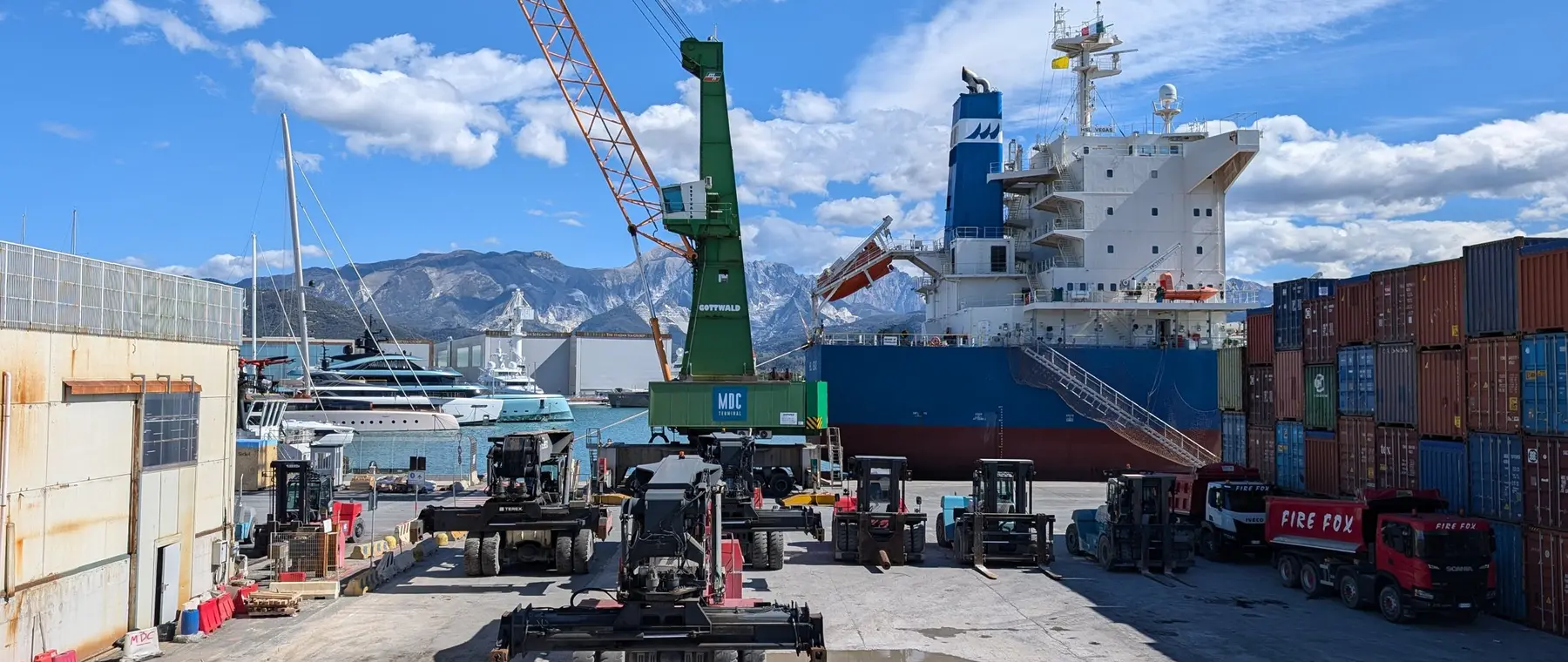
Further details should be added only as technical documentation or authorised photographs become available. In particular, the exact emissions profile, real hotel-mode endurance, speed and range cannot responsibly be manufactured from the limited public material. The image alongside this article is a licensed archive photograph of the Port of Carrara, providing geographical context for the build; it is not a photograph of Silvia herself. That distinction is important when reporting on private yachts whose official delivery imagery may remain restricted.
Sources: FGI Yacht Group's project and launch statement; 6 November 2026 handover report by SuperYacht24. The yacht was launched in July; the reported delivery is the new development.
Lead photograph: the Port of Marina di Carrara in an archive view by Basilicofresco / Wikimedia Commons, CC BY-SA 4.0. Resized from the original; it is a geographical-context photograph and does not show the yacht Silvia.
Explore
Go deeper into the yachts, companies, events and destinations directly connected to this article.
Continue reading
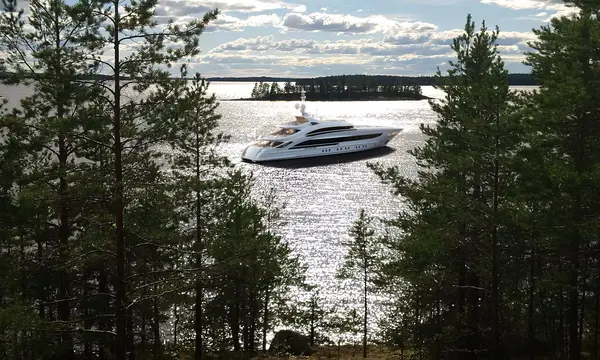
In December 2020 Heesen announced the sale of steel-hulled Project Oslo24, a 50-metre hybrid yacht later known as Cinderella Noel IV.
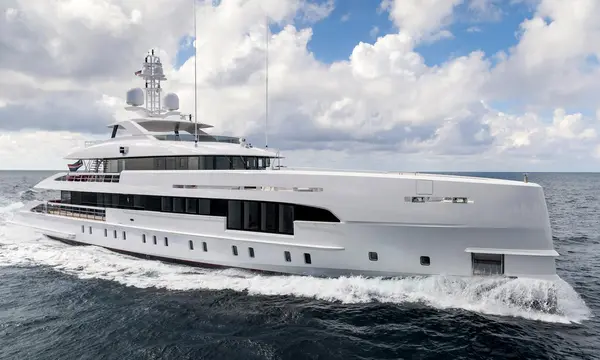
Heesen is delighted to announce the sale of YN 19150 Project Electra, the second hybrid yacht in the 5000 aluminium class.
The Italian Sea Group's unaudited court filing shows a €58.7 million year-to-date loss at 30 September 2026, with cash down to €1.75 million and …

Northrop & Johnson has profiled StarEDGE's approach to superyacht communications, including multi-orbit satellite links, mobile networks and a dashboard for yacht managers.
Superyacht Guide
Continue into the wider Superyacht Guide.
Business opportunities · Superyacht Guide
Companies serving the superyacht market can discuss clearly identified advertising, sponsorship and business-profile opportunities. Commercial activity remains separate from independent editorial coverage.
