The Canary Islands: The Atlantic Stopover More Yachts Should Understand
Aug. 9, 2026
Destinations
For yachts moving between Europe and the Caribbean, the Canary Islands can be far more than somewhere to take fuel before heading west. Las Palmas and Santa Cruz offer serious port infrastructure, technical support and provisioning, but berth limitations, seasonal congestion and the islands’ unusual tax position require advance planning.
For many superyachts, the Canary Islands appear on the passage plan as a waypoint rather than a destination. The Mediterranean season finishes, Gibraltar disappears astern and the yacht heads southwest before the long Atlantic leg towards the Caribbean. Somewhere between Europe and the trade winds, Las Palmas or Santa Cruz de Tenerife becomes the place to bunker, provision, fix the last technical problem and wait for an acceptable weather window.
That description is accurate, but incomplete. The Canary Islands occupy one of the most useful operational positions in the eastern Atlantic. They are Spanish, politically part of the European Union and connected to substantial commercial ports, yet geographically they sit off the northwest coast of Africa and outside the EU VAT territory. For a yacht approaching an ocean crossing, that combination creates something unusual: European-standard infrastructure in a location already well into the Atlantic passage.
Las Palmas has built much of its yachting identity around exactly this role. Marina Las Palmas describes the port as an Atlantic crossroads for yachts arriving from Europe, the Mediterranean and the Americas and specifically promotes it as a place to prepare for transatlantic passages. The marina sits within one of Spain's major commercial ports, giving visiting yachts access not merely to pontoon services but to the wider engineering, supply and maritime infrastructure that surrounds a working ocean port.
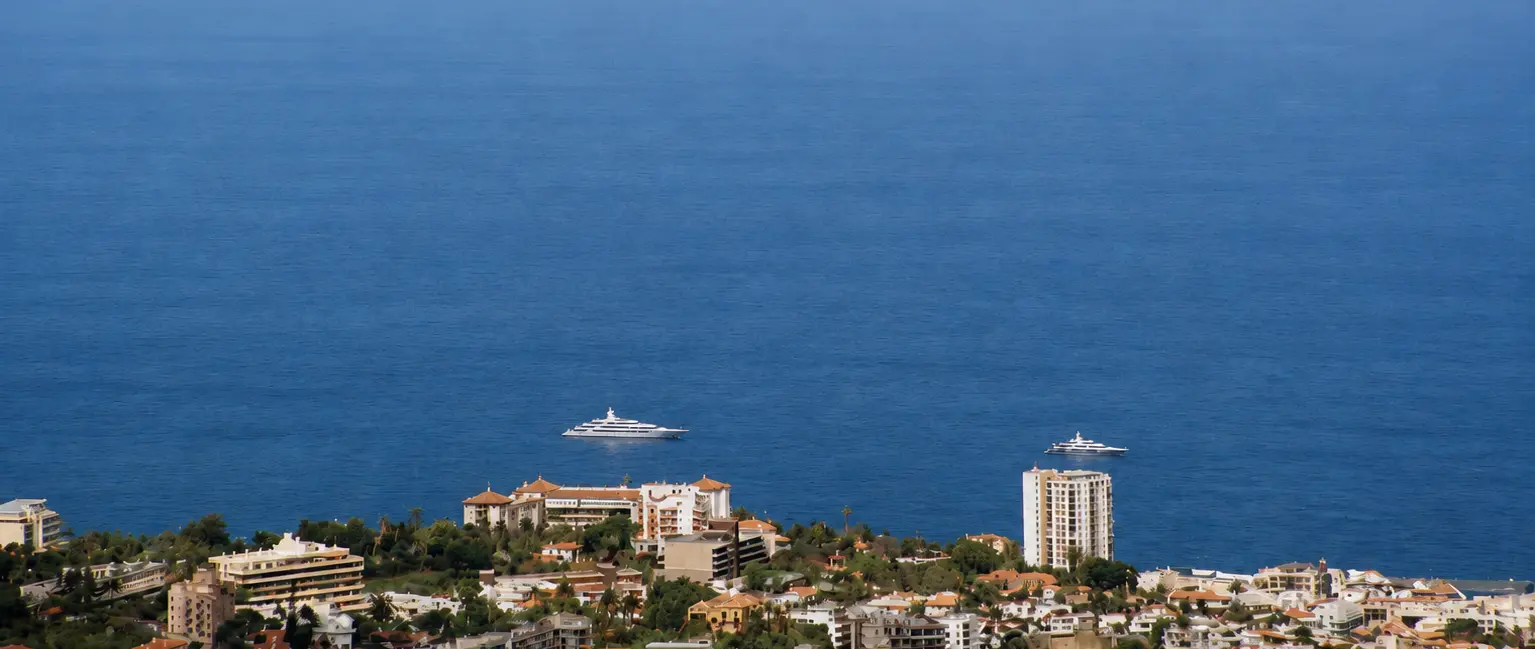
The same strategic logic applies to Tenerife. The Port Authority of Santa Cruz de Tenerife describes the islands' position between continents as the reason its marinas become important staging points before Atlantic crossings, while Santa Cruz itself combines large-vessel berthing, commercial-port services, bunkering and sheltered anchorage.
For owners and captains, however, the real value of the Canaries is not simply that they are conveniently located. It is that they can solve several different operational problems at once — provided the yacht understands which island, which port and which services actually suit its size and programme.
Gran Canaria's importance becomes obvious when the yacht reaches Las Palmas. Marina Las Palmas lists more than a thousand pontoon berths covering a broad range of yacht sizes, while also acknowledging high occupancy and the need for specific planning for larger vessels. That matters because the port may be one of the Atlantic's best-known yacht staging points, but a large superyacht cannot assume that the normal marina arrangement will accommodate it simply because Las Palmas is accustomed to transatlantic traffic.
For yachts within the marina's normal dimensional range, its strength is the ecosystem around the berth. Specialised workshops and maintenance services operate within the harbour, while yachts can access technical services, spare parts and marine assistance through the wider Port of Las Palmas. That is very different from arriving at an attractive seasonal marina whose surrounding economy is principally hospitality.
Before an Atlantic passage, a captain may be interested in fresh food and crew facilities, but the engineering department may simultaneously need filters, pumps, hydraulic components, refrigeration parts, lubricants or a specialist technician. The distinction between a marina with amenities and a port with a functioning supply chain becomes important when departure is delayed by one defective component.
The yacht's next leg also explains why so much preparation takes place here. The Atlantic Rally for Cruisers continues to use Las Palmas as its traditional westbound starting point. The organiser describes the passage from Gran Canaria to Saint Lucia as approximately 2,700 nautical miles. Although a large motor yacht operates very differently from an ARC sailing boat, the route demonstrates the same geographic logic that has made Gran Canaria a staging point for generations of Atlantic traffic.
A superyacht departing the Mediterranean can therefore use Las Palmas as the point where a coastal or regional European programme becomes a genuine ocean passage. Fuel can be brought to the required level, engineering spares checked, deck equipment secured, provisions loaded, crew arrangements completed and weather routing reconsidered with the yacht already positioned substantially farther west and south than Gibraltar.
There is also an important psychological advantage for the crew. Once the yacht leaves the Canaries westbound, the next port may be thousands of miles away. Discovering a minor defect in Palma is inconvenient; discovering the same defect after several days of Atlantic running may turn it into an operational problem. A competent stop in the Canaries can therefore function as the final opportunity to remove uncertainties before the yacht commits to the ocean leg.
Las Palmas is not the only serious option, and for some larger yachts Santa Cruz de Tenerife may be more relevant.
The Port Authority lists Marina Santa Cruz with conventional marina berths as well as quay positions capable of accepting substantially larger yachts. The facility sits directly in Santa Cruz rather than in an isolated resort environment, making it a practical city stop as well as an operational one.
More important for large yachts is the infrastructure surrounding the marina. Santa Cruz is a significant commercial port with a dedicated bunkering operation. The Port Authority says fuel supply is available around the clock and describes Santa Cruz as an important North Atlantic bunkering location, with fuel available to vessels at berth or anchor.
Its anchorage is also relevant to vessels that do not need or cannot obtain a conventional marina berth. The Port Authority describes the area as having strong year-round operability and shelter from prevailing conditions provided in part by the Anaga massif, together with access to pilots, tugs and shoreside services. For a large yacht conducting bunkering, taking stores or awaiting a weather window, that commercial-port capability may matter more than whether there is a conventional superyacht marina berth available.
Tenerife also illustrates why the Canaries should not be treated as one interchangeable group of marinas. The Port Authority manages facilities across Tenerife, La Palma, La Gomera and El Hierro, but their vessel capacities vary substantially. Marina La Palma, for example, is aimed at considerably smaller vessels than the large-yacht facilities available in Santa Cruz. Those ports can be useful cruising destinations for appropriate yachts, but they are not substitutes for Santa Cruz when a large superyacht is looking for operational infrastructure.
The practical lesson is that an itinerary reading simply “Canary Islands” is not detailed enough. A captain needs to decide whether the objective is a marina berth, commercial quay, anchorage, fuel uplift, engineering intervention, provisioning, owner visit or a combination of several requirements. Las Palmas and Santa Cruz overlap in capability, but they are not identical products.
That distinction becomes particularly useful if the yacht does not intend to leave immediately for the Caribbean. A vessel can arrive from the Mediterranean, complete maintenance or crew logistics and then wait in the archipelago rather than committing to an Atlantic departure date prematurely. For a yacht operating to a commercial charter schedule, the ability to separate technical preparation from the final weather decision can protect the programme at the other end of the crossing.
The Canary Islands also have an unusual fiscal status that is frequently reduced to statements such as “the Canaries are outside EU VAT”. That statement contains an important truth, but on its own it is not enough information to make a decision about a yacht.
The European Commission's territorial guidance records the Canary Islands as EU territory where EU customs rules apply, but EU VAT and excise rules do not. They are therefore part of the EU customs territory while sitting outside the territorial scope of the EU VAT system.
That is not the same as saying that transactions in the Canaries are tax-free. Local taxation applies, and movements of goods between the islands and the EU VAT territory can involve import or export treatment for VAT purposes. The European Commission states that goods moving from territories such as the Canary Islands into the EU VAT area are treated for VAT purposes in a similar manner to goods arriving from outside that territory, even though customs rules continue to apply.
For a superyacht, the distinction can become important when considering fuel, parts, repairs, stores, temporary importation, commercial operations or the VAT status of the yacht itself. The correct treatment depends on facts such as ownership, flag, whether the yacht is private or commercial, where it has been imported, where goods are supplied and what happens to them afterwards.
The islands should therefore not be presented to owners as a convenient VAT loophole. They are better understood as a different tax territory within a wider European customs framework, and that difference needs to be addressed by the yacht's manager, fiscal adviser and local agent before significant work or movements of high-value goods are undertaken.
The same principle applies to port formalities more generally. Santa Cruz's commercial port infrastructure includes a Port Inspection Centre bringing together Customs, health and other inspection functions. For a yacht arriving internationally, this is evidence of a mature port system — but mature systems still require the yacht and agent to submit the correct information.
For captains accustomed to moving rapidly between Mediterranean marinas, the Canaries can therefore feel simultaneously familiar and different. The language, legal jurisdiction and overall port environment are Spanish, yet some tax treatment is not the same as mainland Spain. That is exactly the kind of detail that should be understood before the yacht arrives rather than reconstructed from invoices afterwards.
There is one major reason not to treat the Canaries as an effortless last-minute option: seasonality.
The Port Authority of Santa Cruz de Tenerife says its recreational docks can approach very high occupancy during the autumn Atlantic migration, precisely the period when westbound traffic is building. Marina Las Palmas likewise warns of high average occupancy. In other words, the months when the islands are most useful to Atlantic-bound yachts are also the months when demand for berthing and marine services becomes most concentrated.
This matters disproportionately for superyachts because larger vessels have fewer alternatives. A smaller sailing yacht that cannot obtain its preferred berth may find another marina without radically changing the operation. A 70-metre motor yacht with a deep draught, substantial power requirements and a large fuel order has a much narrower list of suitable positions. The captain or management company should therefore be talking to the port, marina and agent well before arrival, particularly when the planned call falls into the autumn Atlantic migration.
The Canaries also remain Atlantic islands rather than sheltered extensions of the Mediterranean. The yacht is operating in open-ocean conditions, and inter-island movements or approaches can be influenced by local wind acceleration, swell and the substantial topography of the islands. The fact that Santa Cruz's anchorage gains shelter from the Anaga massif is itself a reminder that the islands' mountains materially affect local conditions.
Nor is every yacht crossing west obliged to stop. A vessel leaving Gibraltar with sufficient range, fully completed maintenance and a favourable forecast may decide that proceeding directly is operationally preferable. Others may use Cape Verde, while some may have already completed their principal technical stop in Palma, Barcelona or another Mediterranean yard. The value of the Canary Islands is therefore not that they should become a compulsory waypoint, but that they provide a credible alternative when the programme needs one.
For yachts that do stop, there is also no reason every visit must last only long enough to connect a bunker hose. Gran Canaria and Tenerife offer the possibility of crew rest, owner movements and a deliberate pause between the intensity of a Mediterranean season and the isolation of an ocean passage. That can be operationally valuable in its own right. A rested crew departing a technically prepared yacht is a better starting point for a transatlantic passage than a rushed turnaround driven solely by the desire to keep moving.
This is ultimately what the Canary Islands offer the superyacht fleet: optionality. Las Palmas provides a major maritime economy and a marina built around transatlantic traffic. Santa Cruz combines large-yacht berthing, serious bunkering capability and commercial-port support. The wider archipelago offers additional cruising and stopping opportunities, though often with tighter vessel-size limitations. The fiscal regime adds another layer that can be useful when properly understood and problematic when reduced to simplistic assumptions.
For an owner, the islands may still appear to be little more than a few days between Monaco and the Caribbean. For the captain and manager, they can represent something far more valuable: the last substantial European-connected operational platform before several thousand miles of Atlantic water.
A good Canary Islands call therefore does not begin when the yacht enters the harbour. It begins weeks earlier, when the captain decides exactly what must be achieved before leaving Europe behind, identifies the port capable of doing it, confirms the berth or anchorage, understands the formalities and ensures that the yacht departs with no unfinished business waiting on the eastern side of the Atlantic.
Explore
Go deeper into the yachts, companies, events and destinations directly connected to this article.
Continue reading
Balearic port authority PortsIB has approved five new pontoon-end structures at Santa Eulària marina, with concessionaire Merlin SA funding a €2.001m project subject to …

Pacific Tourism Organisation and Market Development Facility have launched a regional yachting strategy covering infrastructure, regulation, local enterprises and environmental safeguards.
Clear Water Bay Yacht Club reports July approval for its Hainan port to open to international yachts; 301 berths are built and 873 remain …

AMAALA Yacht Club has begun operations on Saudi Arabia’s Red Sea coast, adding 119 berths and capacity for superyachts over 100 metres.
Superyacht Guide
Continue into the wider Superyacht Guide.