Can Charter Income Cover Superyacht Running Costs?
Can Charter Income Cover Superyacht Running Costs? Charter income can offset a meaningful share of superyacht operating costs, but it rarely makes ownership cost-free …
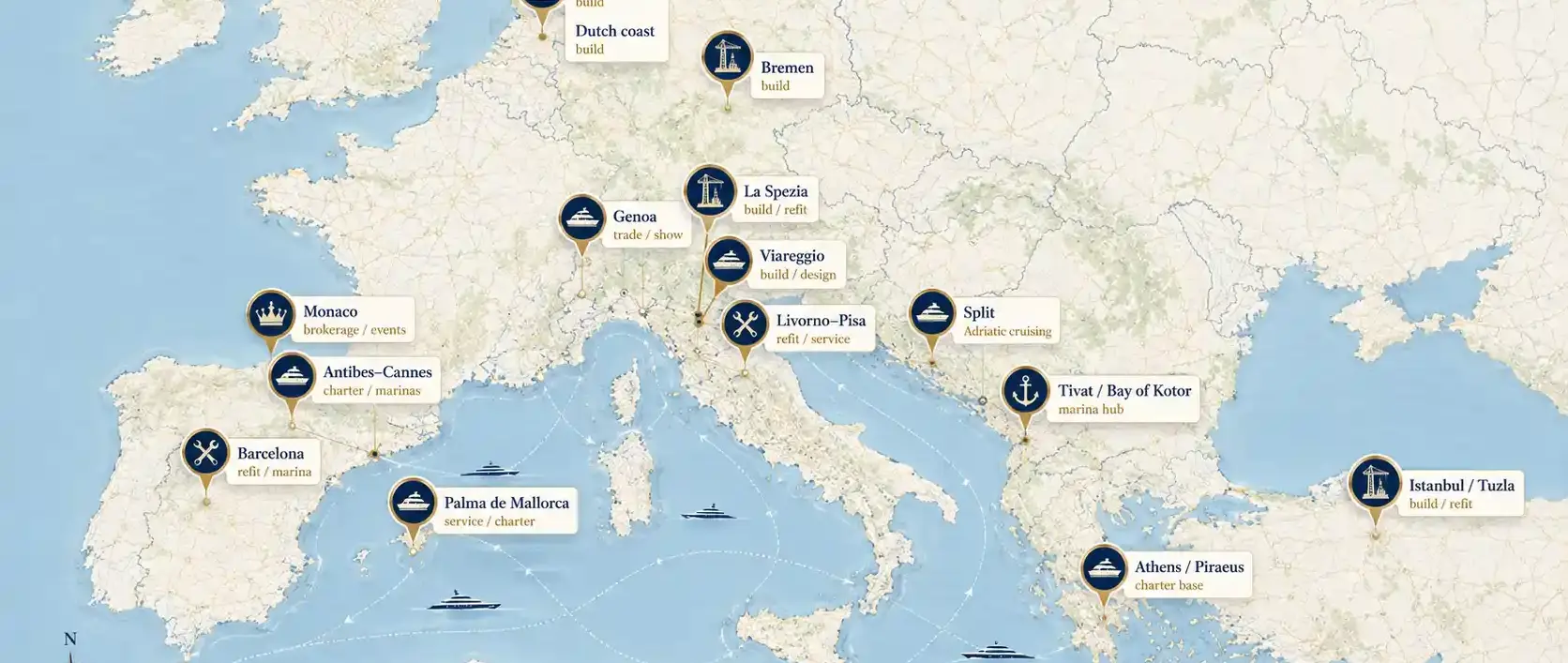
Europe is increasingly becoming the centre of gravity of global superyachting, combining dominant new-build production with the Mediterranean’s charter, brokerage, refit and event infrastructure while the United States remains the industry’s largest ownership market.
For decades, Fort Lauderdale has carried one of the most recognisable titles in international yachting: the Yachting Capital of the World. The claim is not empty marketing, because South Florida combines an extraordinary concentration of yachts, marinas, repair facilities, crew, brokers, suppliers and one of the largest marine exhibitions anywhere in the world. Yet when the question is narrowed from recreational boating generally to the modern superyacht industry, the centre of gravity increasingly lies thousands of miles to the east.
Europe now combines the industry's dominant new-build base, its most important summer cruising grounds, some of its strongest brokerage markets, its premier superyacht show, and a dense network of specialist refit, marina and technical infrastructure stretching from the Netherlands and Germany through Italy, France and Spain to Greece, Croatia and Turkey. Fort Lauderdale remains one of the world's great yacht cities, but Europe increasingly functions as something larger: the operating capital of the global superyacht economy.
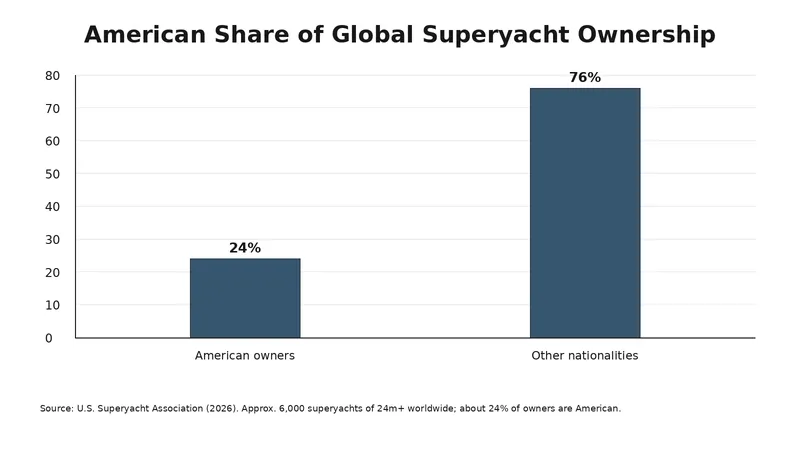
Any argument that Europe has overtaken the United States has to begin with what America still controls: demand. The U.S. Superyacht Association says the worldwide fleet numbers roughly 6,000 yachts of 24 metres and above and that about 24% of superyacht owners are American, making the United States the largest single ownership nationality.
Applying that 24% ownership share mechanically to a global fleet of about 6,000 gives an indicative figure of roughly 1,440 American-owned superyachts. That is not a U.S. registry count and should not be presented as one, because yacht ownership is frequently held through companies and one person can own more than one yacht, but it does show the scale of American capital in the market.
The often-repeated claim that Fort Lauderdale has more than 50,000 yachts does not mean that it has 50,000 superyachts. Greater Fort Lauderdale's official tourism organisation promotes the destination as having more than 50,000 registered yachts and more than 100 marinas, while the city itself describes an extensive network of navigable waterways, but those are broad boating statistics covering vessels far below superyacht size.
Fort Lauderdale nevertheless has strong grounds for retaining its traditional title. The Fort Lauderdale International Boat Show reported more than 100,000 visitors, around 1,000 exhibitors and more than 1,300 vessels for its 2025 edition, while the wider South Florida marine economy supports a deep network of refit, brokerage, service and crew businesses.
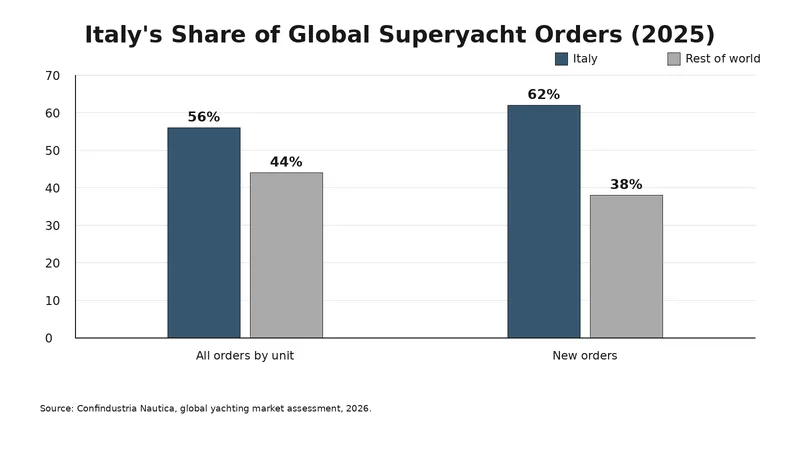
The strongest evidence for Europe's new position comes from construction. Confindustria Nautica's global market assessment says Italy held 56% of the global superyacht order book by number of units in 2025 and 36% by value, while Italian yards captured 62% of new superyacht orders placed during the year.
Those figures are more significant than the broad claim that Europe builds more than 40% of the world's luxury yachts, because they suggest that Italy alone accounts for more than half of current superyacht orders by unit before Dutch, German, British, Turkish and other European production is added. Northern European yards remain particularly strong at the largest custom end of the market, while Turkey has developed into a major superyacht construction nation in its own right.
Manufacturing alone would make Europe a shipbuilding capital, not necessarily the capital of yachting. Brokerage data strengthens the argument, with IYC market tracking reporting that 55% of global yacht sales in its 2025 dataset took place in Europe compared with 25% in the United States.
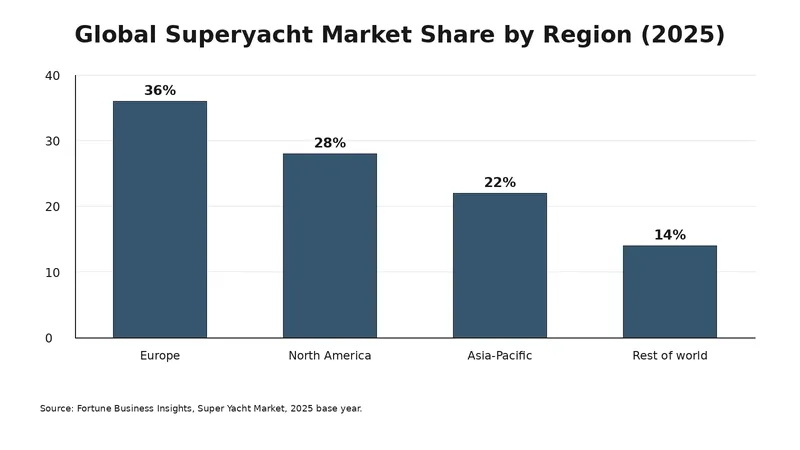
A separate commercial market estimate from Fortune Business Insights put Europe at 36% of the global superyacht market in 2025, ahead of North America at 28%, Asia-Pacific at 22% and the rest of the world at 14%. Commercial market-share estimates should not be confused with physical yacht counts or order books, but they independently point towards the same concentration of activity.
The capital argument becomes stronger when yacht use is considered. IYC's Mediterranean charter analysis says 96% of its recorded summer charters in 2025 took place in the Mediterranean, while more than 70% of the global charter fleet was positioned in the region during peak months.
Europe's geography turns that concentration into an industrial advantage. A yacht can move from Palma or Barcelona refit work into the South of France, Monaco and northern Italy, cross to Corsica and Sardinia, continue towards Croatia and Montenegro, or spend a season among Greece and Turkey without leaving one interconnected cruising theatre, and around that movement sits a corresponding network of marinas, agents, crew, provisioning and technical businesses.
Fort Lauderdale possesses the larger boat show by overall vessel count, but Monaco illustrates Europe's concentration at the highest end of the market. The Monaco Yacht Show reported 120 superyachts for its 2025 edition, with an average fleet length of 47 metres and an estimated combined value of €4.3 billion for the 30-metre-plus fleet.
That is a different proposition from a broad recreational boating exhibition. Monaco's importance comes from placing large-yacht builders, brokers, designers, owners, managers, suppliers and newly delivered yachts inside Port Hercule at the point when the Mediterranean season is drawing towards its conclusion.
The European advantage continues after a yacht leaves the builder. STP Shipyard Palma operates a 130,000-square-metre technical area with berths for yachts up to 120 metres, a 1,000-tonne travel lift and a large network of specialist companies, while MB92 has developed major refit facilities in Barcelona and La Ciotat for some of the world's largest yachts.
This matters because the economic relationship with a superyacht begins rather than ends at delivery. Large yachts require continuous engineering, paint, classification work, surveys, electronics, interiors, machinery servicing and periodic refit, and Europe's cruising geography places several of the world's deepest technical ecosystems beside the waters where the yachts spend their summers.
Fort Lauderdale and Europe are not competing on equal geographic terms. Fort Lauderdale is arguably the world's most complete single-city yachting ecosystem, while Europe is a network containing the dominant shipbuilding countries, the Mediterranean cruising basin, Monaco's concentrated superyacht marketplace, major brokerage centres and multiple world-class refit hubs.
If Yachting Capital of the World means the place with the most complete boating culture concentrated into one city, Fort Lauderdale retains an exceptional claim. If it means the location around which the global superyacht lifecycle increasingly revolves — design, construction, brokerage, charter, cruising, refit, events and specialist services — the stronger answer in 2026 is Europe.
The industry's owners remain global and Americans remain its largest individual ownership nationality, but many of the yachts they buy are conceived and built in European yards, trade through European commercial networks, spend their summers in European waters and return to European technical centres for maintenance and refit. That combination is what turns production strength into something larger: a genuine centre of gravity for the modern superyacht industry.
Continue reading
Can Charter Income Cover Superyacht Running Costs? Charter income can offset a meaningful share of superyacht operating costs, but it rarely makes ownership cost-free …
The largest superyachts publicly marketed for charter in 2026 now extend beyond 100 metres. This ranking uses current primary broker listings checked on 10 …
Is a Superyacht an Investment? Depreciation, Income and Resale A superyacht should usually be treated as a lifestyle asset rather than a conventional investment: …
Is It Cheaper to Charter or Own a Superyacht? Chartering is usually far cheaper for people who only want several weeks of yacht use …
Superyacht Guide
Continue into the wider Superyacht Guide.
Business opportunities · Superyacht Guide
Companies serving the superyacht market can discuss clearly identified advertising, sponsorship and business-profile opportunities. Commercial activity remains separate from independent editorial coverage.