Company
International Superyacht Society
Explore the company profile and related Superyacht Guide coverage.
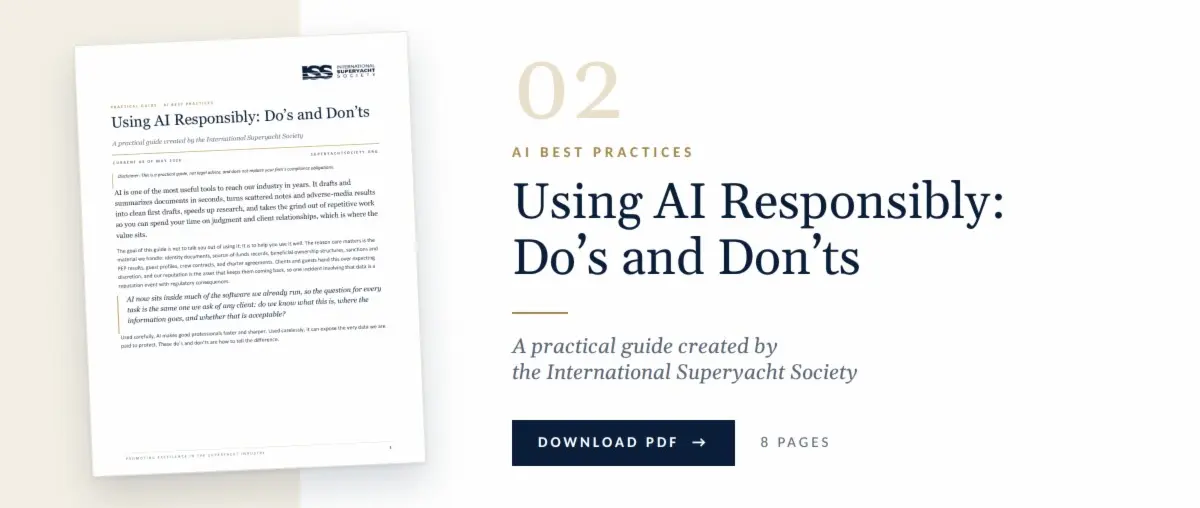
The International Superyacht Society has followed its AI in Action Monaco seminar with practical guides on AI security and responsible business use.
The International Superyacht Society has published follow-up material from its AI in Action leadership seminar at the Yacht Club de Monaco on 23 September 2026. The event brought together yacht-sector professionals to discuss the possible benefits of artificial intelligence and the risks of using it without appropriate controls. Two practical guides have now been made available through the society's official event recap.
This is a follow-up to a completed seminar, not an announcement that a new artificial intelligence product has been installed aboard a yacht. The society's emphasis is on understanding where AI can assist everyday work while protecting commercially sensitive information. The topic is relevant to shipyards, captains, designers, yacht managers and other businesses handling confidential owner or vessel records.
The seminar took place during the Monaco Yacht Show period and formed part of the ISS Leadership Series. According to the organiser's account, Kevin Frisch of Foster Garvey moderated the programme, which was divided into two sessions. The central discussion concerned the practical use of AI across the industry, with particular attention to risk management and responsible decision-making.
The published recap does not reproduce a complete transcript or attribute a detailed set of quotes to every participant. Its summary instead identifies themes that were shared across the discussion. That distinction matters because a short newsletter is not sufficient evidence to claim that specific speakers endorsed individual products, software suppliers or methods. The reporting should stay with what ISS actually published.
ISS describes a broad message from the panel: professionals should explore how AI can help them, but recognise that consumer applications may not offer the security arrangements needed for enterprise use. The advice is particularly relevant where a staff member considers pasting information from a private yacht file, commercial contract or guest itinerary into a public chat service.
Using an AI assistant does not by itself establish whether data will remain private, how it may be processed or whether the answers can be relied upon. Each organisation needs to examine the actual service terms, access controls and permitted use cases before introducing a tool into everyday work. The seminar's message supports careful adoption rather than an assumption that all consumer platforms have identical security characteristics.
Yacht management involves records that can be sensitive even when they are not formal trade secrets. Supplier prices, maintenance faults, personnel information, owner preferences and operational movements are examples that require appropriate handling. An AI workflow might be useful for organising a task list, but that does not automatically authorise exposing the underlying documents to an external service.
A sensible policy starts by determining which categories of information may be processed and who is allowed to submit them. Managers should also know how accounts are controlled and what happens when an employee leaves. The society's material points readers toward understanding security and privacy instead of relying on the convenience of a new interface. Such arrangements require organisational responsibility.
The ISS education committee followed the discussion with two downloadable guides. The first, AI Security, in Depth, addresses the need to understand the security implications of deploying AI in business. The second, Using AI Responsibly: Do's and Don'ts, is presented as a practical aid for day-to-day use. Both are promoted through the society's official seminar recap.
Providing concise reference material can help an organisation start a structured conversation about a subject that may otherwise be approached informally. It does not mean a general guide will resolve every legal or technical question. Companies should adapt any recommended safeguards to their own systems and obtain specialist advice where necessary. The documents are educational resources, not independent certificates of compliance.
Superyacht businesses may be tempted to test AI for correspondence, document search, technical records or routine research. A small experiment can identify possible benefits, but useful results require accurate source material and someone qualified to check the output. A generated summary of a technical manual should not replace reading the relevant maintenance procedure before work begins.
Equally, a draft email or purchasing note should not be treated as approved merely because an assistant can produce it quickly. People must continue to check facts, figures and confidentiality before sending or using the result. This practical separation between assistance and authority is an important part of responsible deployment, regardless of whether software runs within a private network or a hosted service.
The recap also mentions a promotional trial offered to ISS members by an AI company, with a sign-up deadline in September and an October trial period. That invitation is a commercial offer associated with the event, not evidence that the society has independently verified every technical claim made by the supplier. The original enrolment deadline has passed and should not be advertised as an active offer.
Owners and management companies evaluating any platform should compare contractual terms, data processing arrangements, audit capabilities and the support available in practice. Marketing descriptions such as private or encrypted require specific technical and legal confirmation. An educational seminar can encourage investigation, but procurement decisions should follow the organisation's normal due diligence procedures rather than a limited-time promotion.
The International Superyacht Society describes its work through networking, education, events and cooperation across the international yachting community. The Monaco seminar was supported by industry sponsors and aimed to turn a rapidly developing topic into practical conversation among professionals. Its follow-up materials offer a point of reference for organisations considering formal guidance for their own teams.
The accompanying graphic is the society's official artwork promoting its Using AI Responsibly guide, taken from its seminar recap newsletter. It is a relevant illustration of the published resource, not a photograph purporting to show people at the event. ISS has provided the recap and guides, while independent validation of particular AI products and deployment methods remains a separate responsibility.
Explore
Go deeper into the yachts, companies, events and destinations directly connected to this article.
Company
Explore the company profile and related Superyacht Guide coverage.
Continue reading
The International Superyacht Society has announced the finalists for its 2026 Design Awards, with winners to be revealed in Fort Lauderdale on 28 October.
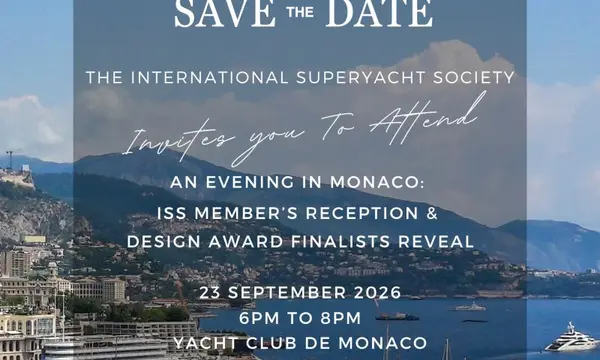
The International Superyacht Society will hold an AI-focused Leadership Series and its members reception at Yacht Club de Monaco on 23 September 2026.

SeaKeepers prepares its Founders 2026 event for 29 October, recognising ocean researchers and yacht-backed expeditions, alongside the DISCOVERY Fleet.
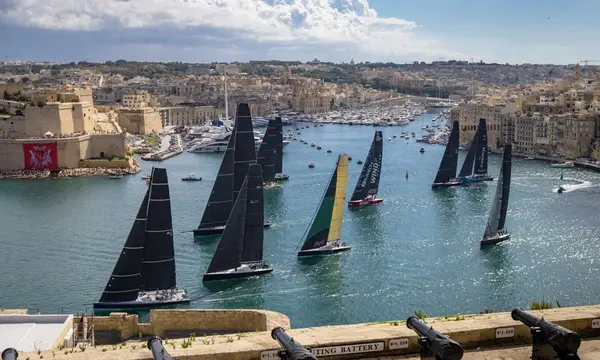
The 47th Rolex Middle Sea Race started from Grand Harbour with 107 yachts and 945 sailors. By late afternoon the 30.48m Black Jack 100 …
Superyacht Guide
Continue into the wider Superyacht Guide.
Business opportunities · Superyacht Guide
Companies serving the superyacht market can discuss clearly identified advertising, sponsorship and business-profile opportunities. Commercial activity remains separate from independent editorial coverage.