
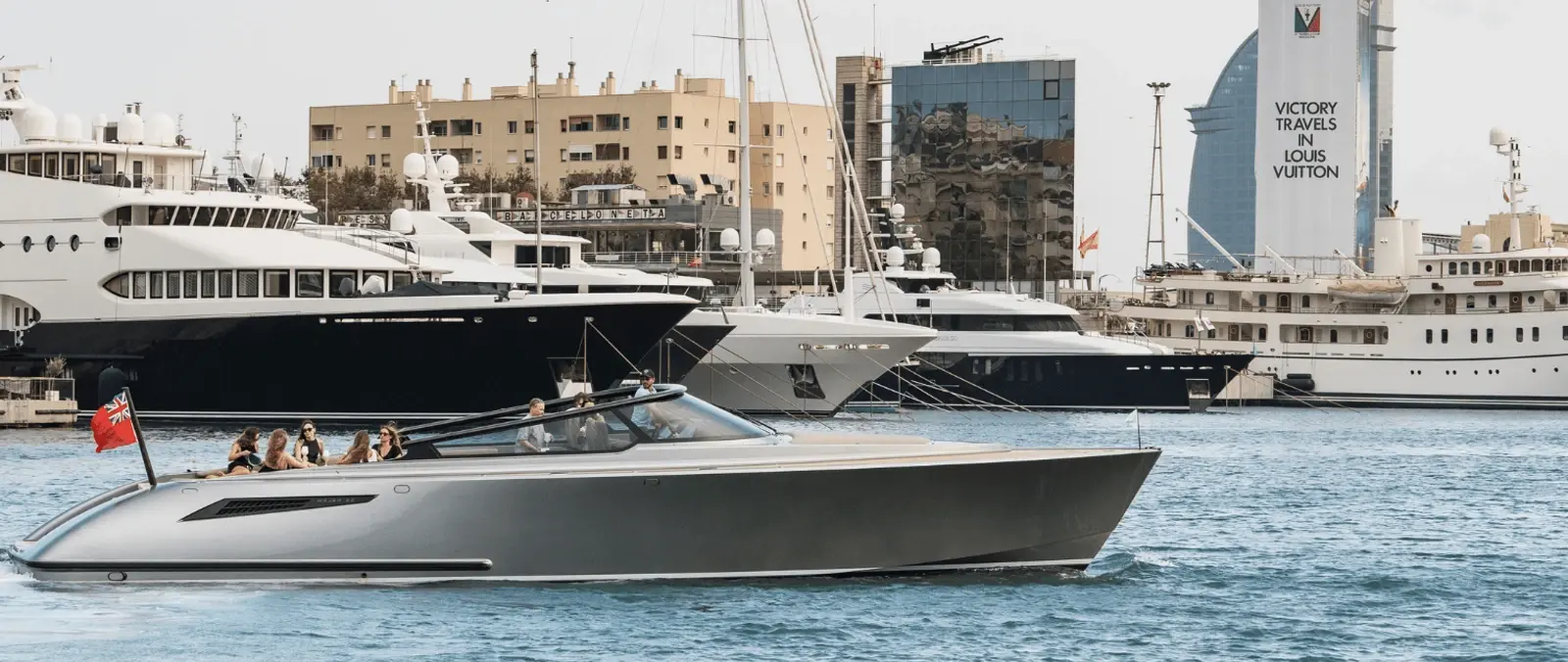
The Mediterranean still has thousands of marina berths, but suitable space for the largest yachts in the most desirable ports is becoming a strategic constraint on cruising and ownership.
The Mediterranean does not have a shortage of coastline, but the superyacht market is discovering that coastline is not the same thing as usable berth capacity. The pressure is concentrated in the places owners most want to be, at the dates they most want to arrive, and in berths capable of taking increasingly large yachts with the power, security and service infrastructure they require.
That distinction is turning dockage from a background logistics issue into a strategic part of ownership. Marina groups are adding capacity and selling network access, while operators in Barcelona, the Riviera and other established hubs are investing heavily simply to keep pace with a fleet whose physical requirements continue to rise.
D-Marin reported a 95% occupancy rate across its portfolio and said 700 superyachts were on annual contracts, alongside transient and charter traffic. The group had more than 1,000 specialised superyacht resources and said berths were being filled quickly as demand increased.
Headline berth counts can disguise the constraint because only part of a marina can accommodate the longest, widest and deepest-draught vessels. A nominally large marina may therefore have very little space that is operationally interchangeable for a 70-metre yacht arriving in July at the same time as several comparable vessels.
Marina Port Vell completed a €20 million transformation programme in 2024 aimed at increasing infrastructure capacity and improving superyacht services. During the America's Cup that year, the marina hosted more than 150 superyachts and increased its workforce from 30 people to more than 120 to support the surge.
The Barcelona example shows why additional capacity is neither quick nor cheap. Prime waterfront has competing uses, harbour geometry is fixed, dredging and utility upgrades are expensive, and the most valuable locations are often embedded in cities where expansion has to coexist with commercial shipping, residents and public waterfront policy.
D-Marin has responded by adding marinas and more large-yacht spaces, including 86 additional berths through Porto Mirabello and Camille Rayon. Network growth can distribute demand across a wider geography, but it cannot manufacture unlimited quay length in the handful of ports where yachts converge for the same summer weeks.
This is why the problem is better understood as a shortage of the right berth rather than a shortage of all berths. A yacht that can anchor, move to a secondary harbour or change dates still has options, but the premium for being alongside in the right place at the right time is becoming more visible.
D-Marin’s own operating figures show why the berth problem is structural rather than merely seasonal. The marina group reported 95% occupancy and 700 superyachts on annual contracts, while recent additions at Porto Mirabello and Camille Rayon brought another 86 berths to Mediterranean coastline already under heavy pressure.
That changes the competitive logic for Mediterranean ports because the scarce asset is no longer simply waterfront, but waterfront capable of taking larger yachts with the access, services and operating network that follow them. D-Marin says its network now offers more than 1,000 specialised superyacht resources, illustrating how berth capacity is increasingly being developed as a regional system rather than as isolated marina projects.
The operational consequences reach beyond marina operators. Charter planning, owner itineraries, provisioning, guest transfers and crew logistics become more complex when berth certainty falls, while yachts with long-term arrangements in prime locations gain something increasingly difficult to replicate.
The Mediterranean remains the centre of the global superyacht season because of the density of destinations, yards, airports and services around it. Its next infrastructure challenge is that the fleet it helped nurture is becoming larger and more numerous, while the most desirable pieces of waterfront remain stubbornly finite.
Explore
Go deeper into the yachts, companies, events and destinations directly connected to this article.
Continue reading
D-Marin has partnered with ult. Insurance to connect yacht owners at its UAE marinas with specialist cover reviews, placement, claims assistance and a dedicated …
Burgess has identified near-completion new-build opportunities that can shorten the route to ownership, including a 47m Benetti and 65m Royal Hakvoort.

D-Marin Livorno has opened 2027 annual berth bookings with savings of up to 15%, offering berthing for yachts up to 80m during the marina's …

D-Marin says June and July bookings for yachts over 50 metres rose 33% year-on-year, while bookings for 30–50m yachts increased by 10%.
Superyacht Guide
Continue into the wider Superyacht Guide.
Business opportunities · Superyacht Guide
Companies serving the superyacht market can discuss clearly identified advertising, sponsorship and business-profile opportunities. Commercial activity remains separate from independent editorial coverage.