
Antigua Charter Show Names ALTA, ASAHI, GALENE and LULUS for 2026
Organisers say more than 70 yachts have registered for December's Antigua Charter Yacht Show and highlight ALTA, ASAHI, GALENE, LEMON TREE and LULUS.
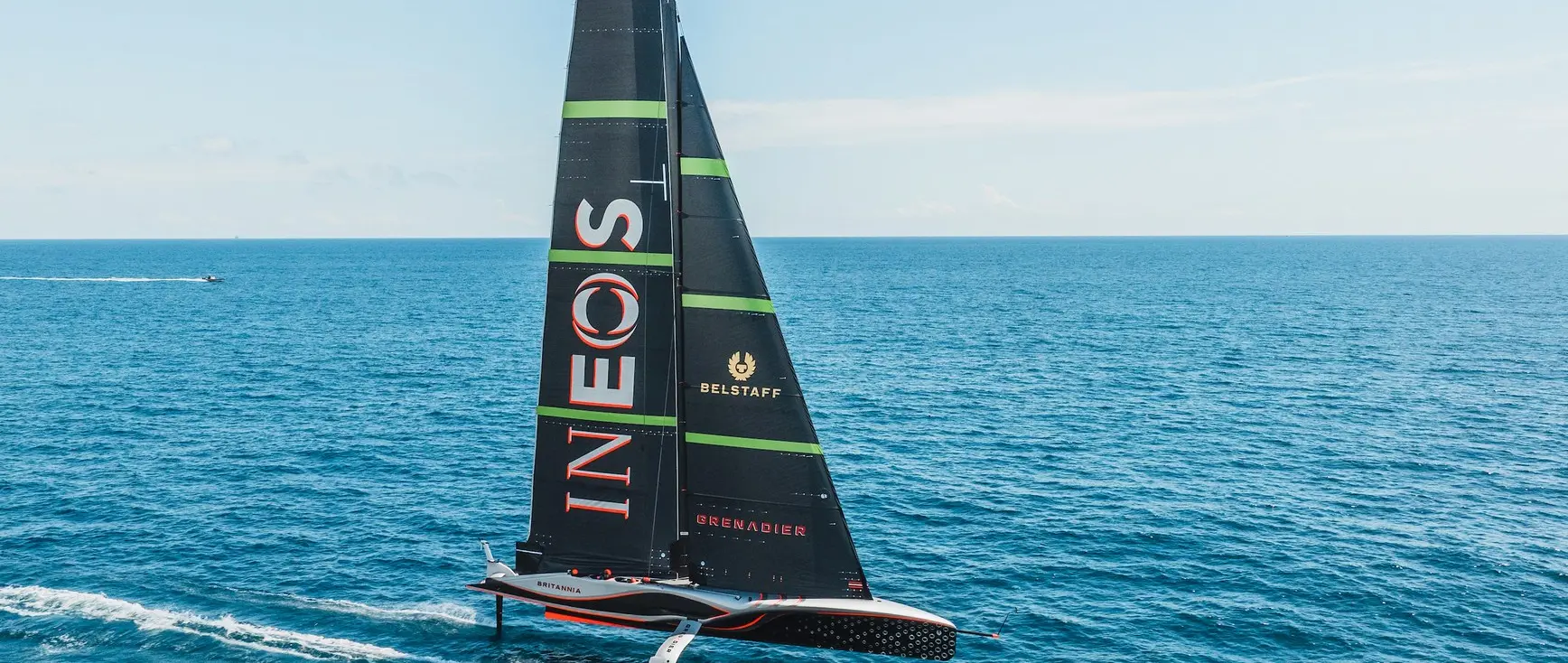
INEOS Britannia AC75 in Barcelona, May 2024
Metstrade lists a 19 November discussion on what racing technology may contribute to the next generation of superyachts, from controls to design practice.
Design and technology preview, 11 November 2026. The session is listed for Thursday 19 November; the 2024 AC75 photograph illustrates the technological background, not a boat announced as an exhibit.
The distinction is important because the phrase technology transfer is easily stretched. A racing solution may demonstrate a principle under extreme conditions without being appropriate for long-range passages, guest comfort or regulatory approval. The most interesting part of the discussion is therefore likely to be the selection process: identifying valuable ideas, reengineering them for a different use and discarding those that fail real operational tests. Owners, naval architects, captains and shipyards all have a stake in that process, though their measures of success can be very different from those of a professional race team.
These features explain why engineers outside racing follow the class. A foil-supported monohull requires careful coordination of lift, stability, steering, crew input and rapidly changing loads. The systems are tightly coupled, making it difficult to optimise one part without considering another. Yet such a boat is not an ordinary superyacht in miniature. Its crew, operating window, range, duty cycle and passenger expectations are fundamentally different. Readers should understand the AC75 as an example of concentrated research and development, not as a ready-made catalogue of parts suitable for copying onto a 60-metre motor yacht.
For superyachts, comparable discipline might mean structured sea trials, analysis of vibration or energy demand, or monitoring selected components under different operating loads. Those are possible areas of application, not announced results from the Metstrade session. A project would need clear ownership of data, calibration procedures, practical access for maintenance and a plan for turning measurements into decisions. Installing sensors solely because a racing programme uses them is not a strategy. The value comes from knowing what problem is being investigated and how the information will improve comfort, reliability, safety or efficiency.
It is therefore useful to distinguish the transfer of a specific foil from the transfer of knowledge developed while designing one. Research into materials, structural load cases, computational modelling or fast control responses may have an indirect benefit even where a full foiling arrangement makes no sense. Any claim that a particular installation saves fuel or improves ride quality needs test evidence under representative conditions. A stage discussion might explore these opportunities, but the public programme does not name a delivered superyacht or publish independent performance measurements for such a transfer.
Transfer to a leisure vessel raises additional concerns: redundancy, predictable failure modes, cybersecurity, serviceability and training across rotating crews. Racing teams can devote specialists to a tightly scheduled competition; a cruising yacht may operate around the world with limited access to the original designers. The technology therefore has to survive ordinary maintenance routines and real handovers. These are editorial examples of the questions that should govern adaptation, not claims that Metstrade's speakers have endorsed one particular control architecture or that classification societies have accepted a new standard.
The sensible route is to compare options against a carefully stated brief, with the relevant class and flag requirements considered from the outset. Changes that improve one performance metric can create unexpected cost or maintenance burdens elsewhere. This is why technology transfer should involve builders and operators as well as designers. Crew members who will service an installation can identify concerns that may not appear in an early render or simulation, while shipyard experience can establish whether a delicate concept can be manufactured consistently and supported after delivery.
Independent assessment is particularly important when suppliers present performance forecasts. What has been measured, on which vessel, in what conditions and against what baseline? Have maintenance and training implications been included? Are the claimed savings or comfort improvements maintained through a realistic operating year? These questions apply as much to incremental improvements as to radical new equipment. They separate genuine engineering progress from branding. The Metstrade session title suggests an opportunity to ask them, although its published listing alone cannot establish which answers will be offered.
Metstrade identifies RAI Amsterdam as the venue for its 17–19 November 2026 exhibition, with the session placed on Thursday afternoon. The event schedule should be checked directly before travel because programme listings can change. For technical background, the America's Cup's official coverage of the new AC75 designs and its class information explain the racing context: https://37th.americascup.com/news/3002_REVEALING-REVEALS-THE-NEW-AC75-LAUNCHES and https://37th.americascup.com/the-boats. The story to follow after 19 November will be what real, attributable engineering evidence emerges, rather than the mere possibility that racing and superyachting may learn from one another.
Primary source: Metstrade 2026, official Thursday programme.
Continue reading
Organisers say more than 70 yachts have registered for December's Antigua Charter Yacht Show and highlight ALTA, ASAHI, GALENE, LEMON TREE and LULUS.
A Metstrade session on 19 November will examine how environmental rules operate in marinas and aboard leisure craft, including insurance implications.
The Dubai International Boat Show is scheduled to return to Dubai Harbour on 25–29 November 2026, with several international superyacht builders confirming or being …

Superyacht Investor Miami will hold its one-day conference at the Fontainebleau Miami Beach on 16 November 2026, bringing together yacht brokers, shipyards, financiers, lawyers, …
Superyacht Guide
Continue into the wider Superyacht Guide.
Business opportunities · Superyacht Guide
Companies serving the superyacht market can discuss clearly identified advertising, sponsorship and business-profile opportunities. Commercial activity remains separate from independent editorial coverage.