Palumbo has outlined a €221m proposal and an industrial plan involving current jobs and 200 potential new positions. Florence court admission and auction arrangements remain unconfirmed.
A higher price is only the beginning
The future of The Italian Sea Group entered another uncertain phase on 12 November as Naples-based Palumbo Group presented more detail about a €221 million proposal for the troubled yacht builder. Its intervention puts a slightly higher headline price alongside the previously announced €220 million reference offer from SRI Group Global Limited. Palumbo says its industrial approach would protect existing employment, help return shipyard activity to full capacity and create approximately 200 new roles. Yet the fresh plan is not an agreed acquisition, and its admissibility within the court-supervised process has not been established. The Florence court has not publicly confirmed a final auction date or the full list of participants. For clients, employees and suppliers, the immediate question is therefore not who has won but what a workable transfer of the shipbuilding operation would require.
What Palumbo says it is offering
In a statement reported by the specialist publication PressMare on Thursday, Palumbo described a proposal that combines an acquisition price of €221 million with a strategy to restart and progressively expand production. The group says it intends to safeguard the workforce already attached to the business. It also sets out an aim of returning employees affected by reduced-working-time solidarity arrangements to full-time employment within three years, while creating conditions for roughly 200 additional hires. Those points are ambitions expressed by the bidder rather than independently audited outcomes. Neither the employment timetable nor the eventual capital expenditure can be taken as a binding result of a transaction that has not been approved. The difference matters particularly in a shipyard, where retaining highly specialised trades and restoring a stable production schedule is a longer process than transferring ownership of buildings and equipment.
The court has not settled admission
Palumbo's offer arrived after the original deadline for binding proposals, according to accounts of the Florence hearing and the specialist Italian reporting published on 11 and 12 November. That timing creates an additional procedural question: can a new potential buyer participate without prejudicing a court-supervised competition already organised around earlier bids? Reporting from T24, Blue Economy and PressMare agrees that the hearing did not definitively establish the bidder list or officially confirm an auction day. Some industry accounts discuss 16 November as a possible next date, but it should not be represented as a settled court instruction. Nor does the new €221 million figure, by itself, confer priority over SRI's proposal. Conditions, financial support, asset scope and creditor outcomes must all be assessed within the relevant legal framework.
SRI's €220 million reference position
The Italian Sea Group's regulated filing on 2 November identified SRI Group Global Limited as the provisional buyer for a proposal of approximately €220 million. The company described a contemplated indirect-continuity arrangement: the operating business would be leased to a buyer while the proposed transfer proceeds, with the business ultimately sold once the process is completed. It also outlined how value from the transaction might be allocated among creditor classes. Those are elements of a proposed restructuring, not a final court-approved distribution. That filing remains the clearest company-issued starting point for understanding why Palumbo's entrance is commercially relevant. A €1 million nominal increase is modest relative to the overall value, and it says little without comparing what is being bought, the funding support and the continuing obligations associated with the operation.
The underlying industrial perimeter matters
One reported point of contention concerns which assets and liabilities would fall within a potential purchase. Italian accounts of the earlier proposal referred to operations spanning Marina di Carrara, La Spezia, connected industrial activities and the group's overseas interests. Palumbo has said its reservations about certain Turkish liabilities should not be interpreted as a categorical refusal to include the Turkish activities in the industrial perimeter. Its position is that significant historic debt exposures would need analysis before they were assumed. This is more than a drafting issue. A purchase price attached to one collection of assets cannot automatically be compared with a price for a materially different business. Creditors and shipowners also need to understand which entity would be responsible for contracts, warranties, unfinished projects and future delivery commitments.
Financial support is still a point for examination
Palumbo has also disputed suggestions that its financial evidence was insufficient. The group says the procedure called for a comfort letter from a leading bank and maintains that it complied with the relevant requirement. A comfort letter, however, is not necessarily equivalent to a callable payment guarantee. Its commercial significance depends on the wording, the parties and the obligations actually undertaken. An outside observer cannot verify financial certainty from the existence of a reported letter alone. The court and authorised advisers must assess the offer against the applicable conditions. Until that happens, describing any of the competing proposals as funded and unconditional would overstate the evidence. Owners and suppliers should watch for a formal explanation of the bidder qualifications rather than relying on the relative prices circulating in headlines.
A workforce of specialists, not just a headcount
The group behind Admiral, Tecnomar and Perini Navi relies on naval architects, project engineers, aluminium and steel specialists, outfitters, commissioning personnel and an extensive supplier network. Press reports describe approximately 500 current employees at the affected business. Palumbo's promise to preserve the existing workforce and expand it is therefore one of the most consequential parts of its statement. Whether such a target is credible cannot be judged from the number alone. Teams may be assigned to different hulls, specialist subcontractors may need reassurance and delayed procurement can interrupt an otherwise viable construction sequence. Rebuilding confidence requires regular salary and supplier payments, realistic project milestones and clarity on which contracts survive the restructuring. A successful industrial plan would have to address all of those interdependent obligations.
What it means for superyacht owners
Superyacht construction is unusual because customers can be committed to complex projects years before delivery. A buyer of a shipbuilding business is not necessarily taking over every historic promise in the form a customer originally signed. That makes the distinction between a company's operating assets and its contractual liabilities important for owners whose vessels remain in build, or who rely on long-term technical support. The publicly available reports do not establish the precise status of individual client contracts. It would therefore be irresponsible to declare that any particular yacht delivery is secured, delayed or cancelled merely because an offer has surfaced. Owners should seek project-specific advice through their appointed representatives and the relevant counterparties. The same caution applies to guarantees, subcontractor appointments and planned after-sales services.
Palumbo's experience and the integration challenge
Palumbo's presence in commercial ship repair, superyacht building and refit gives it an identifiable industrial rationale for examining another yacht operation. The group has a Mediterranean yard network and a track record working with large vessels. That experience is relevant to the practical tasks of reorganising production, yet it is not evidence that integration would be quick or risk-free. The Italian Sea Group operates brands, intellectual property, engineering processes and relationships with owners that would need continuity, not merely a new name above a yard gate. A credible buyer would need to show how it intends to protect those assets while keeping existing client obligations and new orders under control. It may also need to distinguish work suited to each location, to avoid disrupting projects already under way.
Azimut-Benetti's separate position
The wider bidding picture also includes Azimut-Benetti, whose previously reported offer was approximately €210 million. Italian and international industry accounts have described its reluctance to participate in a further round of bidding, while also noting that an earlier proposal may not automatically cease to exist. It is important not to collapse those two propositions into a definitive claim that the group has withdrawn every offer. Similarly, no competing company should be described as the successful purchaser until there is an authoritative decision. The presence of several interested industrial and financial parties demonstrates the strategic appeal of the yard assets, but competitive tension cannot resolve uncertainty over liabilities, contracts and judicial approval. Those are the issues upon which the eventual transaction depends.
The restructuring proposal and creditor priorities
In the 2 November regulated statement, The Italian Sea Group outlined a restructuring structure under which proceeds from a business transfer would support creditor settlement. The company described full payment for certain priority claims and a substantially lower recovery for unsecured claims, together with no proposed value for shareholders. These were stated terms of a plan to be submitted under the Italian framework, not a guarantee of a particular payout. Subsequent bids could affect the economics, but the relevant creditor treatment depends on far more than a headline increase in purchase price. Legal costs, assumed obligations, excluded liabilities, financing terms and execution risk all affect the realisable value. For the market, a revised formal filing will be more informative than informal calculations of how an extra million euros might be distributed.
The significance of the December hearing
A hearing on admission to the indirect-continuity restructuring procedure is scheduled for 23 December, according to the reporting available on 12 November. That date offers a useful marker for following the legal process, but it should not be confused with a confirmed date for the competitive auction. Further procedural notices could clarify the timing before then. It is equally possible that additional documents or questions about guarantees will change the sequence. The group has said it will inform the market of material developments through the appropriate disclosure channels. Investors, suppliers and industry partners should therefore distinguish formal company or court communications from commentary about what might happen next. A changing timetable would not, on its own, establish which bidder's industrial plan has prevailed.
Why the wider yacht sector is watching
The case has implications well beyond one balance sheet. Italy's large-yacht supply chain depends on specialised designers, yards, marine equipment makers and service contractors whose planning horizons extend over several seasons. An extended period of uncertainty at a prominent builder may complicate capacity planning for subcontractors and can influence owners considering new commitments. Conversely, a genuine, adequately financed industrial restart could preserve knowledge that is difficult to replace and eventually restore confidence in the participating brands. These are plausible sector effects, not measurable outcomes that can yet be attributed to Palumbo's proposed bid. The main lesson for the industry is that business continuity must be supported by contracts, governance and liquidity; the scale of a yard or reputation of a brand cannot substitute for those essentials.
What needs confirmation next
The immediate points to monitor are straightforward. First, the Florence court must clarify the status of the late Palumbo proposal and the conditions for any further competition. Second, authoritative documents need to explain the precise assets and liabilities attached to each admissible bid. Third, the financial evidence supporting completion and the arrangements for an operating transition must be assessed. Finally, the consequences for employees, creditors, suppliers and unfinished yachts should be communicated with greater precision. Until those steps are documented, the bidder's figures remain proposed commitments and SRI's reference position remains part of a process still in motion. Superyacht Guide will continue to distinguish confirmed filings and statements from market reports, and will report a transaction as concluded only when reliable evidence supports that description.
Sources and reporting basis
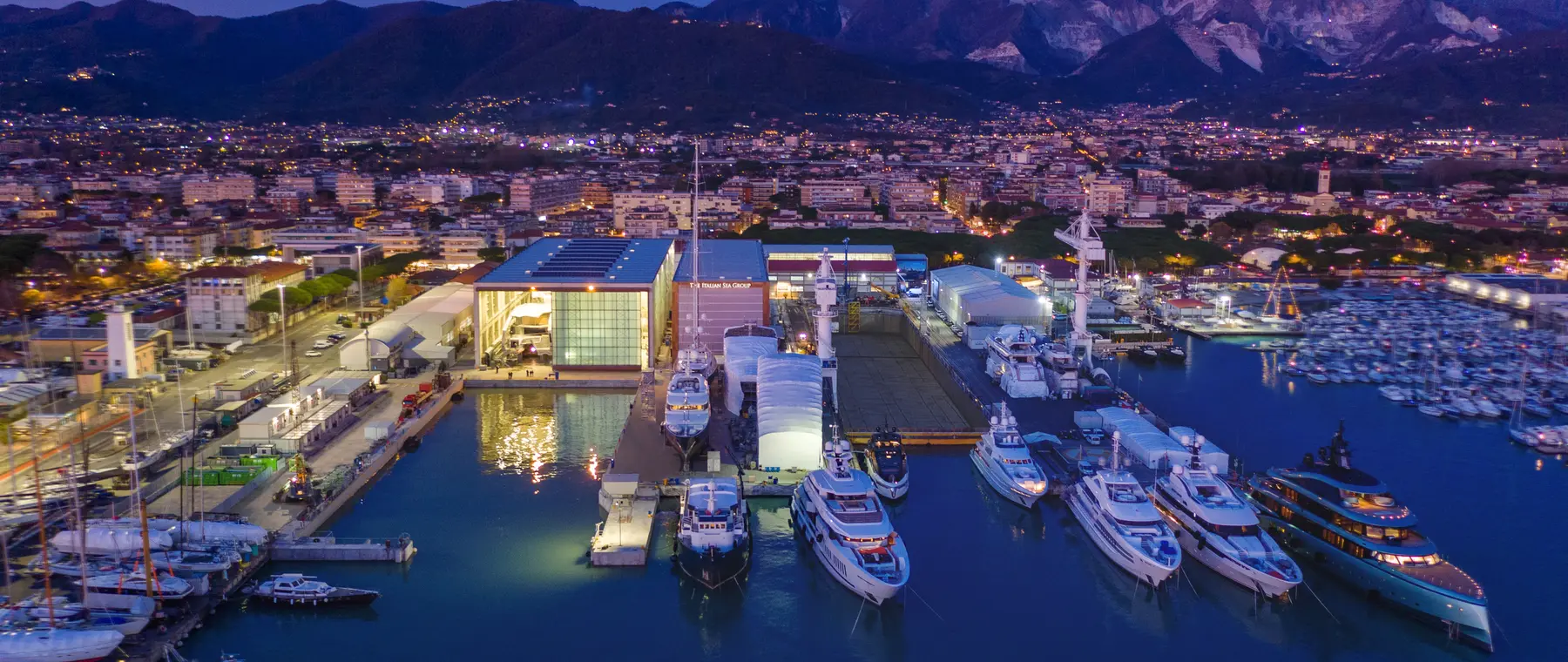
This report is based on the Palumbo statement described by PressMare on 12 November, the Italian Sea Group's regulated announcement of 2 November, and contemporaneous coverage of the Florence proceedings from T24 and Blue Economy. The analysis distinguishes reported positions from the decisions of the court and does not claim independent access to confidential bids or owner contracts. The accompanying photograph is an archival image of Marina di Carrara harbour, not a photograph of the relevant TISG industrial assets, a court hearing or a confirmed change of ownership.