
A berth is never just a berth. Sanctions, ownership, security, safety rules and political pressure can turn a superyacht from a welcome visitor into a vessel a port cannot—or will not—accept.
For most of a yacht’s operating life, port access feels like a logistical problem. The captain or agent checks draft, berth dimensions, shore power, customs procedures and availability, the marina confirms the reservation, and the yacht enters as another high-value visitor bringing crew, guests and expenditure ashore.
That apparent simplicity disappears when the vessel itself becomes politically, legally or commercially sensitive. A yacht can be technically seaworthy, properly flagged and fully crewed yet still find that entry is restricted, delayed or refused because governments, harbour authorities, security officials or private marina operators no longer regard the call as routine.
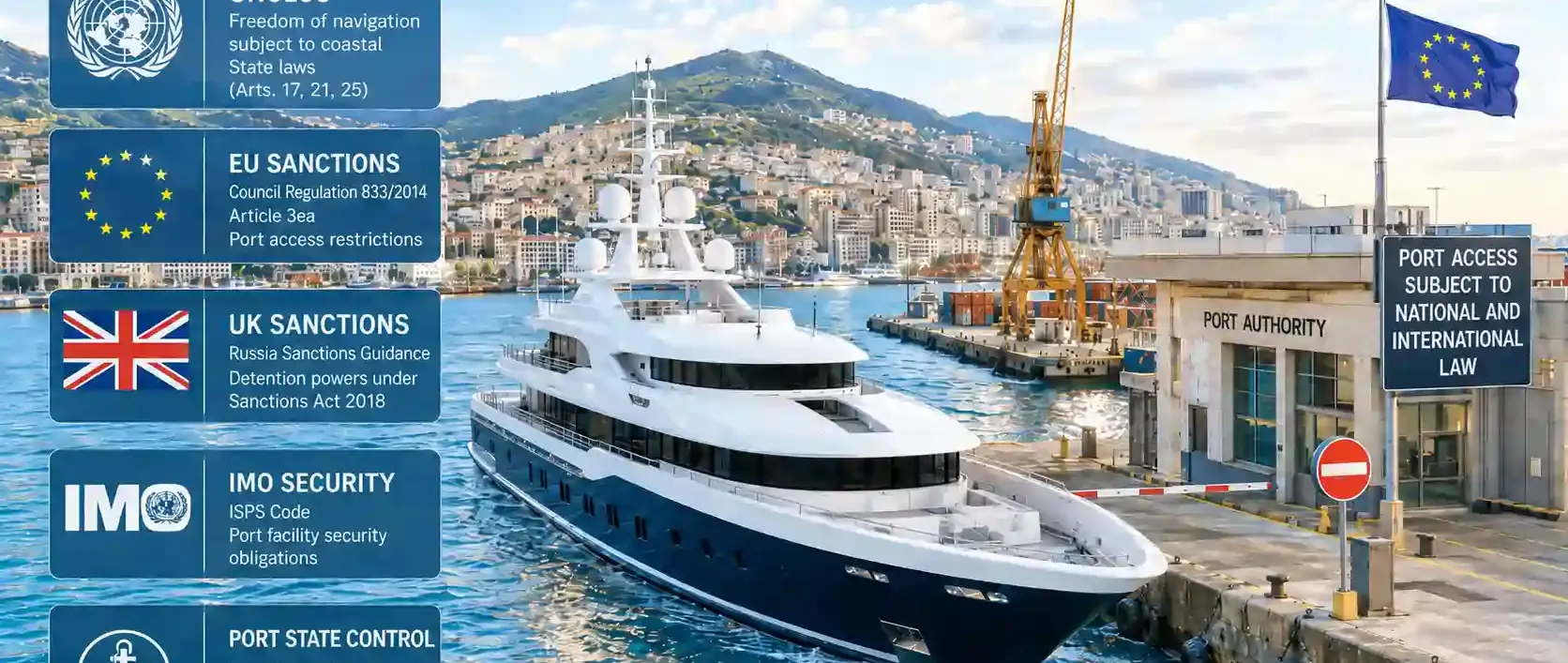
International law draws an important distinction between moving through territorial waters and entering a State’s internal waters or ports. The United Nations Convention on the Law of the Sea recognises a right of innocent passage through the territorial sea, but it also gives coastal States authority to enforce the conditions under which ships are admitted to internal waters and port facilities.
That distinction matters enormously to superyachts. A vessel may have a navigational right to pass along a coast under the applicable rules while having no equivalent automatic entitlement to berth in the harbour it can see ahead of it, because admission brings the yacht directly within the coastal State’s regulatory, security, customs and enforcement environment.
UNCLOS also expressly recognises environmental requirements associated with port entry, including conditions that States may establish for foreign vessels entering ports or internal waters. Port entry has therefore always been more conditional than the apparent freedom of the sea might suggest.
For captains, this means that “can we navigate there?” and “will they admit us?” are separate questions. The first is principally about navigation and coastal-State rights at sea, while the second can depend on sanctions, ownership, security information, statutory compliance, immigration, environmental rules and the discretion of the authorities ashore.
Nothing has demonstrated the political character of port access more clearly than the sanctions imposed following Russia’s invasion of Ukraine. The European Union prohibited Russian-flagged vessels from accessing EU ports, and Article 3ea of Regulation 833/2014 expressly includes yachts of 15 metres or more meeting the regulation’s specified passenger and cargo criteria.
The rule also sought to prevent a simple change of registration from defeating the restriction by covering certain vessels that changed Russian flag or registration after 24 February 2022. At the same time, the legislation preserved defined exceptions and derogations, illustrating how political exclusion still has to coexist with maritime-safety requirements.
EU restrictions have since gone beyond flag alone. Council Regulation (EU) 2026/1848 of 23 July 2026 further amended the sanctions framework, while vessel-specific measures can affect port access and the services available to listed vessels.
The effect is dramatic from an operational perspective. A yacht that might previously have moved routinely between Mediterranean ports can suddenly face a legal barrier that no marina manager, captain or owner representative has authority to waive.
Sanctions have also made beneficial ownership central to port-access decisions. Authorities may need to determine not merely where a yacht is registered, but who owns, controls, charters or operates it and whether any of those connections bring the vessel within a sanctions regime.
The United Kingdom’s Russia sanctions guidance states that port-entry and detention powers can apply to ships owned, controlled, chartered or operated by designated persons or by persons connected with Russia, as well as ships registered in or flying the flag of Russia and specifically designated vessels. Harbour authorities and the Secretary of State also have powers relating to detention at ports or anchorages.
The detention of the superyacht Phi became an unusually clear example of how broad those questions can become. The UK government recorded in its post-legislative scrutiny memorandum that the yacht was detained in March 2022 on the basis that it was owned or controlled by a person connected with Russia, while also noting that the individual concerned was not a designated person at the time.
For a captain approaching a port, the implication is uncomfortable but straightforward. A registration certificate may answer one ownership question while sanctions authorities are asking another, and uncertainty over beneficial ownership can itself create delays while agents, banks, lawyers and officials establish whether the call can lawfully proceed.
Port politics is not confined to sanctions. Since the introduction of the International Ship and Port Facility Security Code, qualifying ships and port facilities have operated within a formal security framework designed to assess threats and apply corresponding protective measures.
The International Maritime Organization describes the ISPS Code as a risk-management system linking governments, port authorities and shipping companies. It also explains that governments have control and compliance measures available where qualifying ships fail to meet applicable requirements, including measures that can prevent or terminate a port call.
Applicability to an individual yacht depends on its regulatory status and operation, so the ISPS regime should not be treated as applying identically to every private yacht. Where it does apply, however, security is not a courtesy requested by the marina but part of the legal architecture governing the relationship between vessel and port.
Pre-arrival security information can therefore become as important as berth dimensions. A yacht whose documentation, security status or recent port history causes concern may attract additional scrutiny before the harbour master ever considers where it will physically berth.
Being allowed through the harbour entrance does not mean the yacht is free to depart again. Port State Control gives authorities the ability to inspect foreign vessels within the scope of the relevant conventions and verify that the ship, its equipment and its operation comply with international requirements.
The International Maritime Organization describes Port State Control as a second line of defence against substandard shipping and confirms that deficiencies can result in corrective action and, where justified, detention. The procedures are intended to be harmonised internationally, but the practical experience for the yacht is intensely local: the inspection occurs in a particular port under the authority of that State.
For a commercially operated large yacht subject to the relevant conventions, technical deficiencies, certification problems or serious safety-management failures can therefore transform a routine call into an extended stay. The politics may be less visible than in a sanctions case, but the result for an owner waiting for the yacht to leave can look remarkably similar.
This is why captains distinguish between a port being socially welcoming and a vessel being administratively acceptable. Hospitality has little value when statutory deficiencies, security concerns or missing documentation give the authorities lawful grounds to intervene.
Environmental regulation creates another route by which access can become politically sensitive. Coastal communities increasingly debate pollution, emissions, anchoring damage, noise, congestion and the visual impact of large vessels, and ports can find themselves balancing marine tourism revenue against local pressure for tighter controls.
International law leaves significant room for States to impose published environmental conditions on vessels entering ports or internal waters. UNCLOS Part XII specifically recognises port-entry requirements in relation to prevention, reduction and control of marine pollution, creating a legal basis for admission conditions that may be stricter than the rules governing simple passage offshore.
For superyachts, those rules can appear in many forms rather than as a sign saying “yachts prohibited.” Waste-management requirements, fuel restrictions, anchoring controls, emissions measures, protected zones, harbour operating rules and local permit systems can progressively narrow where and how a yacht can operate.
Political pressure matters because environmental rules are rarely developed in a vacuum. A destination that once competed aggressively for visiting yachts may later decide that ecological protection, resident concerns or congestion deserves greater weight, and the operational map changes even though the coastline has not.
Government permission and berth availability are also different things. Even when a yacht is legally entitled to enter a country, a privately operated marina may have commercial, insurance, reputational or operational reasons for declining the reservation.
A marina may be uncomfortable with unresolved ownership questions, potential sanctions exposure, protests, heightened security needs or the prospect that service providers will refuse to work with the yacht. None of those decisions necessarily amounts to a government port ban, but they can produce the same practical result for a captain searching for somewhere to berth.
This distinction became increasingly important after sanctions scrutiny spread beyond governments into banks, insurers, brokers, fuel suppliers and other private businesses. A yacht may not be formally prohibited from an entire jurisdiction yet still discover that the commercial infrastructure required to support the visit has become reluctant to participate.
The reverse is also possible. A government may permit entry under a statutory exception while a marina decides that accepting the vessel is commercially undesirable, which is why an agent’s confirmation of national clearance and a marina’s confirmation of berth acceptance should never be treated as the same approval.
Large yachts are conspicuous assets, particularly when ownership is politically controversial. A vessel capable of arriving quietly in technical terms may still attract press attention, demonstrations or political criticism simply because of who is believed to own or use it.
That creates an unusual form of operational risk. Harbour authorities may have to consider policing and security demands, while marina operators may weigh the value of the berth against disruption to other clients, employees or the surrounding community.
Captains cannot resolve that problem through better seamanship. Once a yacht becomes a political symbol, its identity may precede it into every destination, and an AIS track, press report or photograph can shape the reception before the vessel has requested formal clearance.
The danger is assuming that reputation and law are interchangeable. Public hostility does not itself establish a sanctions violation, while lawful ownership does not guarantee commercial welcome, so captains and managers need to keep legal prohibition, regulatory risk and reputational sensitivity as three separate questions.
A politically sensitive yacht requires considerably more pre-arrival work than an ordinary berth request. Ownership information, flag status, sanctions screening, security documentation, insurance, customs position, crew details and the availability of local services may all need to be checked before the yacht commits to the approach.
Agents become crucial because port-access decisions are intensely jurisdiction-specific. A yacht acceptable in one country may face additional documentation in another, while a change in sanctions designation or local policy can make advice that was correct several weeks earlier dangerously out of date.
Captains also need alternatives. If a berth is refused after arrival, the vessel may need enough fuel, provisions and crew flexibility to divert without creating a new safety or immigration problem, particularly in regions where suitable superyacht facilities are separated by significant distances.
The operational rule is increasingly simple: never assume that previous access predicts future access. A yacht’s technical condition may be unchanged while its political, legal or reputational environment has shifted completely.
Port access has always reflected sovereignty, but superyachts make that sovereignty unusually visible. Their value, ownership structures, international mobility and public profile mean that sanctions, security and political disputes can become physical decisions about whether a particular vessel is allowed beyond the breakwater.
The post-2022 sanctions regime demonstrated this with exceptional clarity. EU law explicitly turned port access into a restrictive measure, UK legislation created port-entry and detention powers, and enforcement cases showed that ownership and control could matter at least as much as the flag flying from the stern.
Yet sanctions are only the most obvious example. Security compliance, Port State Control, environmental conditions and commercial marina decisions can all restrict a yacht’s practical freedom to move, even when none of them is described publicly as a political ban.
For owners, the important lesson is that global mobility is not guaranteed by owning a vessel capable of crossing oceans. A superyacht can possess the range to reach almost anywhere in the world while still depending, at every destination, on the willingness of governments, ports and commercial operators to let it stop.
Explore
Go deeper into the yachts, companies, events and destinations directly connected to this article.
Continue reading

Royal Huisman will return to Monaco Yacht Show 2026 at stand QE18, highlighting the 58.5m PHI and the yard’s custom superyacht engineering.
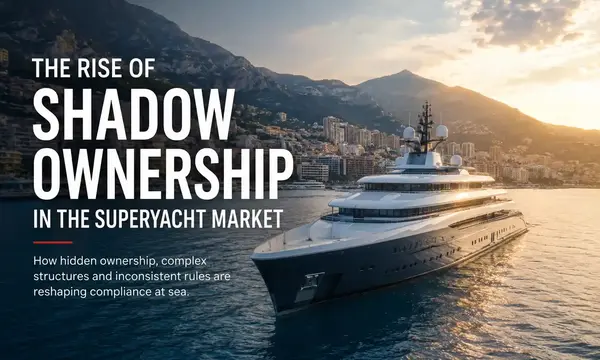
Corporate structures are a routine part of superyacht ownership, but the compliance risk changes when they obscure the person who ultimately owns or controls …
Yacht brokers, managers and shipyards face sanctions risk through ownership structures, payments and services, making effective due diligence essential.
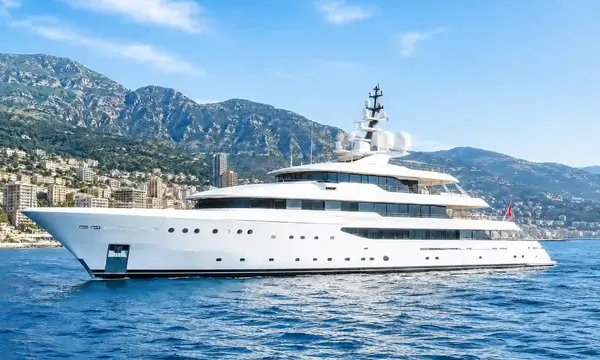
After Russia’s invasion of Ukraine, superyachts linked to sanctioned Russian elites became unusually visible test cases for asset freezes, ownership investigations and international enforcement.
Superyacht Guide
Continue into the wider Superyacht Guide.
Business opportunities · Superyacht Guide
Companies serving the superyacht market can discuss clearly identified advertising, sponsorship and business-profile opportunities. Commercial activity remains separate from independent editorial coverage.