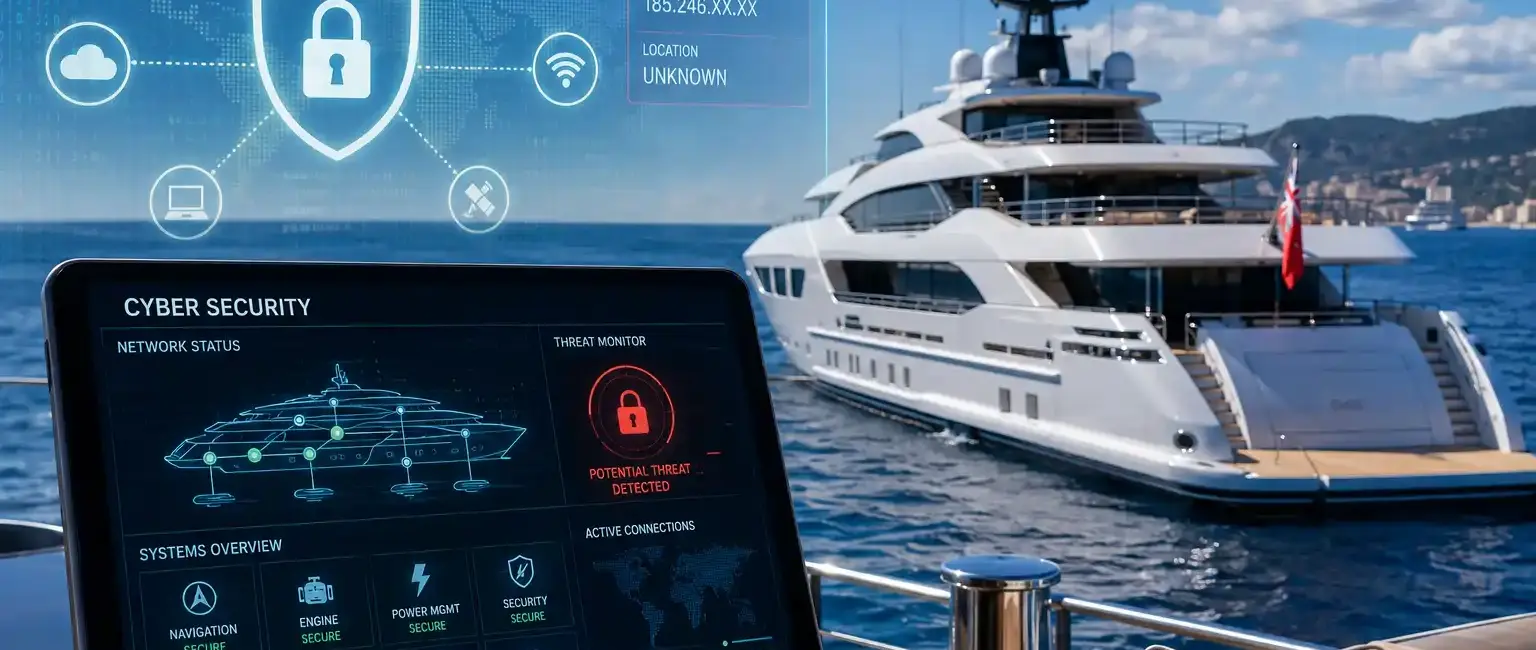
As superyachts become more connected, the threat is moving beyond stolen data. Navigation, machinery, guest networks and remote access can now share the same digital risk.
Modern superyachts have become floating digital ecosystems. Navigation, propulsion monitoring, power management, CCTV, access control, communications, entertainment, administration and crew welfare systems can all depend on interconnected computers, while high-capacity satellite links keep the vessel connected almost continuously to owners, managers, family offices, vendors and cloud services.
That connectivity has transformed life at sea, but it has also created a security problem that is increasingly difficult to treat as a conventional IT issue. A compromised laptop or badly configured guest network may threaten privacy and business information, while a weakness in operational technology can affect equipment whose failure has consequences for navigation, machinery or the safe operation of the vessel.
The superyacht attack surface has expanded
The modern yacht is unusually connected because it combines the systems of a small ship, luxury residence, hotel and corporate office inside one hull. The IMO's revised 2025 Guidelines on Maritime Cyber Risk Management identify bridge systems, propulsion and machinery management, power control, security and surveillance, passenger and crew systems, public networks, administrative networks and ship-to-shore connections among the computer-based systems that can create cyber risk.
Industry guidance produced by BIMCO and other maritime organisations, with the participation of the Superyacht Builders Association, goes further in describing guest networks, entertainment systems, crew Wi-Fi, CCTV, access-control systems, remote monitoring and satellite communications as areas that need to be considered. The Guidelines on Cyber Security Onboard Ships therefore have particular relevance to superyachts carrying large numbers of personal devices and sophisticated non-marine technology alongside safety-critical equipment.
The problem is not simply the number of computers on board. It is the number of pathways between them, the number of outside organisations that may need legitimate access, and the difficulty of knowing whether every connection installed during construction, refit or maintenance is still necessary and properly controlled.
Guest convenience can become a security weakness
Owners and charter guests expect the same digital experience at sea that they have ashore: fast internet, streaming services, wireless control of cabins, smart televisions, mobile-device integration and uninterrupted access to cloud services. Those expectations can make a yacht's guest network one of the busiest and least predictable parts of the onboard digital environment.
The maritime industry's cyber guidance is explicit that passenger-facing public networks and guest entertainment systems should be treated as uncontrolled and should not be connected to safety-critical systems. It also recommends separating guest wireless networks from administrative networks, because a device brought aboard by a guest may be compromised long before it ever connects to the yacht.
This does not mean that an infected phone will automatically reach the bridge or engine room. The real question is whether network segmentation, access controls and system architecture make that movement impossible, difficult or surprisingly easy, and that answer can vary substantially between yachts.
The same principle applies to crew devices. Personal phones, laptops, messaging applications and crew welfare networks are essential parts of modern life aboard, but they also create a constant flow of internet traffic through a vessel that may be operating critical systems only a few network segments away.
Remote access is useful — and dangerous when nobody owns it
A yacht may have dozens of specialist systems supplied by different manufacturers, and remote support can be invaluable when a technician is thousands of miles away. Engine monitoring, stabilisers, navigation electronics, HVAC, communications, audiovisual systems and security equipment may all require software updates, diagnostic access or specialist intervention during the yacht's operating life.
That convenience creates one of the most important cyber questions on board: who can connect remotely, to what, from where, and under whose authority? BIMCO's onboard cyber guidance warns that crews may not always know how equipment manufacturers or software providers maintain remote access to shipboard systems, and recommends that remote access is documented, controlled, monitored and coordinated with senior ship personnel.
For a superyacht, vendor access can become especially complicated after years of refits and upgrades. A contractor who installed equipment during one yard period may leave behind an active account, a remote-management interface or credentials that remain valid after the commercial relationship has ended.
The solution is not to prohibit remote support. It is to make every route into the yacht deliberate, authorised, time-limited where appropriate, protected by strong authentication and visible to the people responsible for the vessel's cyber security.
The weakest point may still be a person
The image of a cyber attack often involves a technically sophisticated intruder breaking through a firewall, but maritime guidance continues to identify ordinary human behaviour as a major route into onboard systems. BIMCO's guidance identifies crew interaction with phishing, infected removable media, weak passwords, inappropriate permissions and careless software maintenance among the routes through which vulnerabilities can become incidents.
Superyachts add another layer because crew routinely communicate with management companies, agents, brokers, marinas, suppliers, charter companies, guests and owner representatives. An email that appears to concern an invoice, itinerary, spare part, visa document or guest request may look entirely normal in a working environment where unexpected attachments and last-minute instructions are common.
The consequences can extend beyond malware. A compromised crew or management email account could expose owner movements, guest identities, travel plans, passport information, financial details, security arrangements or the yacht's next destination, making confidentiality itself a significant operational concern.
IMO's revised 2025 guidance therefore treats cyber awareness as an organisational responsibility rather than a one-off technical exercise. It calls for annual basic cybersecurity training, familiarisation for crew joining a ship, training for operational-technology users and exercises that test whether personnel can recognise, respond to and recover from incidents.
Navigation is now part of the cyber-resilience conversation
Navigation creates a different category of digital risk because not every disruption is caused by someone entering the yacht's network. Global Navigation Satellite System jamming and spoofing can corrupt or deny the external position and timing information on which modern navigation systems depend, even when the vessel's own computers have not been hacked.
The distinction matters. GNSS interference is better understood as an electronic-navigation and resilience threat than as proof of an onboard cyber intrusion, yet its effect can still be digital, immediate and safety-critical.
This is no longer a theoretical concern. In March 2025, the IMO, International Civil Aviation Organization and International Telecommunication Union expressed grave concern about increasing GNSS jamming and spoofing, while subsequent maritime warnings have continued to highlight disruption to satellite navigation and AIS integrity.
The lesson for a superyacht bridge is that cyber resilience also means being able to operate when trusted digital information becomes unreliable. Position must be cross-checked against independent sources, crews must retain the ability to recognise implausible data, and navigation procedures must work when satellite-derived information cannot be assumed to be correct.
IT security becomes a safety issue when it reaches OT
The most important dividing line aboard a yacht is often between information technology and operational technology. IT manages data and communications, while OT monitors or controls physical processes such as machinery, steering, power or other ship functions, although modern vessels increasingly connect the two for monitoring, optimisation and remote support.
IMO's current guidance says OT should be segmented from IT systems, protected from internet-facing systems and provided with appropriate protective tools. It also warns that vulnerabilities may arise through design, integration, maintenance, patching, third-party vendors and software or hardware supply chains, meaning that cyber resilience has to be considered throughout a system's life rather than added at the end.
This is particularly relevant to refits. A yacht may leave the shipyard with an architecture that was sound when commissioned, then accumulate new routers, wireless access points, entertainment servers, remote monitoring devices and software over successive seasons until the original network boundaries no longer mean what they once did.
A cyber review during a major refit therefore needs to examine more than antivirus software. It should ask what is connected, which connections cross between IT and OT, which systems still use default or shared credentials, who holds administrative rights, which vendors retain remote access and whether the yacht can still operate safely if key digital services disappear.
Regulation is moving from guidance toward harder requirements
Cyber risk has already entered formal maritime safety management. IMO Resolution MSC.428(98) established the expectation that cyber risks should be addressed in safety management systems where the ISM Code applies, and the IMO issued a substantially revised version of its maritime cyber-risk guidelines in April 2025.
Those revised guidelines are more explicit than earlier versions about governance, inventories of digital systems, network dependencies, multi-factor authentication, segmentation, backups, incident response, supply-chain security, training and recovery. They also recognise that ships with complex digital systems may require a greater level of care than vessels with limited connectivity.
Classification requirements are moving in the same direction. IACS Unified Requirements E26 and E27 establish cyber-resilience requirements for ships and onboard systems within their scope, with revised requirements applying to relevant new ships contracted for construction on or after 1 July 2024, although applicability depends on vessel type and size and should not be assumed for every superyacht.
The regulatory direction is continuing to evolve. In 2026 the IMO's Facilitation Committee advanced cybersecurity requirements for Maritime Single Windows and work toward a broader non-mandatory Maritime Cyber Code, extending the industry's focus on cyber governance and resilience into wider maritime digital infrastructure.
What good yacht cybersecurity actually looks like
Effective cyber security aboard a superyacht is less about buying one security product than about knowing the vessel. The starting point is an accurate inventory of systems, devices, software, networks, external connections and responsible vendors, because a yacht cannot defend equipment that nobody realises is still connected.
The next layer is architecture. Guest, crew, administrative and operational networks should be separated according to risk, internet-facing systems should not provide an easy route to critical equipment, and remote access should be controlled through defined procedures rather than left permanently available because it is convenient.
Identity management is equally important. Default passwords should be removed, individual accounts should replace shared credentials where practical, administrative privileges should be limited, multi-factor authentication should be used where appropriate, and access for departing crew or former contractors should be withdrawn promptly.
Finally, the yacht needs to assume that prevention may fail. Tested backups, protected recovery information, clear incident-response responsibilities, communications procedures and realistic drills can determine whether a cyber event becomes an inconvenience or a prolonged operational failure, while IMO guidance places response and recovery alongside protection as essential parts of maritime cyber-risk management.
The new weak point is connectivity without control
Superyachts are not uniquely vulnerable because they are badly engineered; many are among the most technically sophisticated private vessels afloat. Their exposure comes from the opposite direction: extraordinary levels of technology, connectivity, custom integration and constant interaction with people and companies ashore.
The industry's own guidance now reflects that reality. The participation of the Superyacht Builders Association in the BIMCO-led onboard cyber-security guidance is particularly relevant to a sector where greater connectivity and system integration continually increase technical complexity.
The important shift is that cyber security can no longer sit quietly inside the IT department or be treated as a matter of protecting emails and passwords. On a modern yacht, digital resilience touches navigation, engineering, privacy, physical security, guest service and continuity of operation, while the new weak point at sea is technology whose connections, permissions and dependencies are not fully understood until something stops working.