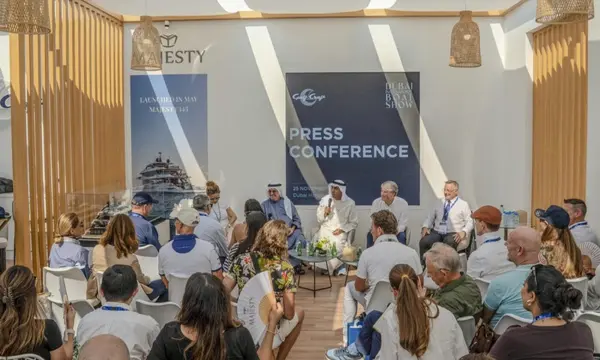
Gulf Craft Brings Majesty 120 and Three SilverCat Debuts to Dubai
Gulf Craft's 25 November show briefing combines its Majesty 100 Terrace and 120 superyachts with three SilverCat premieres and a dedicated SYSC yacht-service presence.
Illustrative coral habitat photo © Zhen Yao / Unsplash (Unsplash License); not the Ocean Reef Marina or 2026 forum.
New discussions at The Superyacht Forum explored reef-supporting marina construction, environmental data at sea and emergency freshwater aid from superyachts.
A discussion reported by METSTRADE on 26 November 2026 has challenged superyacht businesses to consider a harder question than how to reduce their environmental footprint. Participants at The Superyacht Forum in Amsterdam examined whether large yachts, their crews, their design teams and the marinas they visit could make a demonstrably positive contribution to the ocean and to coastal communities. It is a shift in emphasis, but one that needs careful scrutiny before promising results.
The event report from METSTRADE described a mix of design education, habitat-oriented marina thinking, experimental materials and a practical example involving drinking water supplied after a hurricane. These are not interchangeable environmental achievements. Some are proposals awaiting measurement, while the captain's account concerns an operational response to an emergency rather than a technology trial or a certified environmental programme.
A large yacht has capabilities that can be relevant beyond leisure travel: reliable onboard power, experienced engineering personnel, communications equipment, a supply chain and water-making equipment. None of those assets automatically makes it a relief vessel, and their availability is governed by the owner's wishes, the captain's judgment, safety restrictions and the needs of the location. Nevertheless, the infrastructure is worth examining when a coastal community is under pressure.
Superyacht design also differs from the production-boat discussion because equipment and operations are often arranged around a specific owner and a particular cruising programme. A genuinely beneficial programme would therefore have to be designed into both the vessel and its operating procedures. It would need clear responsibilities, realistic limits, local partners and ways to establish whether the proposed assistance actually improved conditions rather than simply producing an attractive narrative.
METSTRADE reported an account from Captain Glenn Dalby, whose work has included large yachts in the Caribbean. He described taking a yacht to Trinidad following a hurricane and assisting people affected by the disaster. The lesson he drew concerned the demand for safe drinking water when normal services have been disrupted. A yacht fitted with a desalination and purification installation could, in principle, provide an additional source of treated water for distribution on shore.
That possibility should not be confused with a guaranteed emergency supply. Water produced for onboard use must still be checked against suitable public-health standards for its intended distribution, and delivery requires containers, transport and coordination with local authorities or established relief organisations. The capacity of the individual yacht's equipment, its available energy and the crew's workload would determine the actual contribution. The value of the example is its operational specificity, not an unsupported promise of unlimited water.
Most owners commission watermakers primarily to sustain accommodation and domestic services during cruising. The equipment may be capable of making additional quantities of fresh water, but an offer to supply a community would have to account for storage, treatment assurance and the ability to keep the yacht itself safely operational. A captain contemplating such a task should first determine whether the yacht is appropriately positioned and whether access to the shore can be managed without exposing crew or residents to new hazards.
Preparedness would make a significant difference. A vessel could maintain written procedures for contacting local emergency coordinators, recording the production volume and confirming recipient requirements before discharge. It could also identify the fittings needed for transferring water safely. These are potential operational measures rather than requirements announced by the forum, and they would need professional review. The broader editorial point is that existing capability becomes useful only when it is connected to a credible distribution plan.
Another part of the discussion involved the Besign School of Design, based near the French Riviera at Cagnes-sur-Mer. Students presented the ambition of developing design methods that could support environmental improvement instead of focusing exclusively on reducing harm. METSTRADE noted that the school has links to design disciplines beyond yachting, while its marine connections provided an entry point for questioning the way yachts, equipment and waterfront facilities are conceived.
There is a meaningful distinction between a student challenge and a completed engineering solution. A concept that looks promising on stage may have untested questions about maintenance, durability, materials and local ecological conditions. The useful outcome for a shipyard would be a testable brief: identify an environmental problem, specify the intervention, measure outcomes and consider unintended effects. That kind of process can turn a broad ambition into a proposition that naval architects, researchers and owners can debate responsibly.
The event report highlighted Coralliance as an example of an approach using underwater structures and coatings intended to encourage marine growth around marina facilities. It also referred to Ocean Reef Marina, being developed in the Joondalup area north of Perth, Western Australia. For a superyacht audience, this connects an apparently land-based marina project with decisions about berth design, maintenance and the relationship between port infrastructure and the surrounding aquatic environment.
Whether a particular installation restores habitat cannot be established from a project description or a visual rendering alone. Evidence would need to show the condition of the site before work, the species and habitat being supported, and the results after installation over a meaningful period. It would also need to account for local water quality, sediment and the potential for unwanted species. The development's mention at a forum is a newsworthy point of discussion, not a declaration that its ecological results have been independently verified.
Traditional marina planning must contend with navigation, safe berthing, utilities, dredging, wave exposure and the needs of nearby residents. Habitat features, where suitable, add another objective that should be evaluated alongside those responsibilities. A superyacht berth may be physically large, but the environmental effects of a waterfront site extend beyond the dimensions of the vessel. Owners and captains increasingly encounter these choices through the facilities at which they berth and the services those facilities offer.
A marina operator considering reef-supporting designs would need to work with marine scientists, port authorities and environmental regulators rather than assuming a single product can be deployed anywhere. Monitoring can be expensive and long-running, but without it claims of regeneration are difficult to distinguish from ordinary environmental mitigation. The constructive question is not whether a new structure looks natural; it is whether measurable ecological conditions improve without compromising safe maritime operations.
METSTRADE also mentioned Geoversity and work exploring bamboo as a boatbuilding material, including a first canoe project in the Netherlands associated with Roelof van der Werff and Henk Bergsma. Rapidly renewed natural fibres can be interesting to designers who wish to rethink material selection. But the report described an early-stage small-craft initiative, not a proven replacement for the classified structural materials used in a large custom superyacht.
The distinction matters because vessel structures demand reliable performance under fatigue, impact, water exposure and fire conditions, supported by appropriate testing and approval. A promising material in a canoe cannot simply be scaled up to a sixty-metre yacht's hull. The relevance for the superyacht sector lies in disciplined research: identifying where renewable materials might be suitable, specifying the treatment and manufacturing process, and comparing whole-life impacts with established alternatives before making performance claims.
The report raised the possibility of yachts contributing observations from seawater encountered during their voyages. Owners and crews can travel through areas where sustained scientific observation may be difficult or costly. In principle, a voyage could support sampling or instrument readings that become useful to researchers, provided measurements follow agreed procedures and the findings can be placed in context. The yacht's route alone does not turn a data set into reliable research.
A credible programme would have to define what is measured, where and how often, with attention to equipment calibration, metadata and the handling of the results. Scientific partners would also need to specify whether a volunteer vessel can contribute usefully to the research question. This offers a more measurable form of participation than general declarations about loving the ocean. It also allows captains to identify realistic opportunities that do not interfere with navigation or safety.
Participants were divided into eight groups to consider ways the sector could contribute to a positive environmental outcome. According to METSTRADE's account, attendees put forward ideas for reducing pollution, including in fields such as energy management, marinas, refits and equipment. The writer reported that the groups did not produce a convincing proposal showing a yacht itself could regenerate ocean life. That is a revealing result rather than a failure that should be concealed.
The exercise distinguishes two different achievements. Making a yacht cleaner to operate is valuable, but a lower impact is not the same as restoring a damaged habitat or supplying a community's immediate needs. The latter requires additional evidence and a clearly identified beneficiary. Recognising the difference could strengthen environmental reporting by preventing improvements to efficiency or emissions from being presented as proof of ecological regeneration.
For an owner or management company, the most practical response is to choose one narrowly defined project rather than adopting a sweeping environmental pledge. Emergency water support, an approved data-collection programme or participation in a marina habitat study each has a different operational profile. The chosen project should be discussed with the captain, technical managers and local partners, with an explicit account of what the yacht can supply and the conditions under which involvement would not be appropriate.
Reporting should also keep separate the activity performed, the outcome observed and any longer-term environmental benefit. A log stating that water was transferred is not the same as verifying safe distribution to residents. Installing a habitat feature is not the same as demonstrating recovery of biodiversity. These distinctions can be demanding, yet they protect the credibility of an industry trying to show that private maritime resources can occasionally serve a wider public purpose.
The Amsterdam discussion offers no new regulation or universal technical standard for shipyards. It does, however, place the responsibility for evidence in plain view. Designers can develop ideas that invite testing, builders can assess whether suitable equipment is feasible, marinas can consider measured ecological outcomes, and crews can evaluate the safe practical contribution of the vessels in their care. Each role is different, and each can be described without exaggeration.
The strongest illustration in the METSTRADE report is arguably the captain's account of a yacht using an existing resource in response to an immediate human need. The other proposals, from regenerative marina features to natural-fibre experiments, point toward research and future design choices. Together they suggest a useful editorial test for every claimed positive-impact project in yachting: who benefits, what exactly changed, and what evidence supports the answer?
Continue reading
Gulf Craft's 25 November show briefing combines its Majesty 100 Terrace and 120 superyachts with three SilverCat premieres and a dedicated SYSC yacht-service presence.
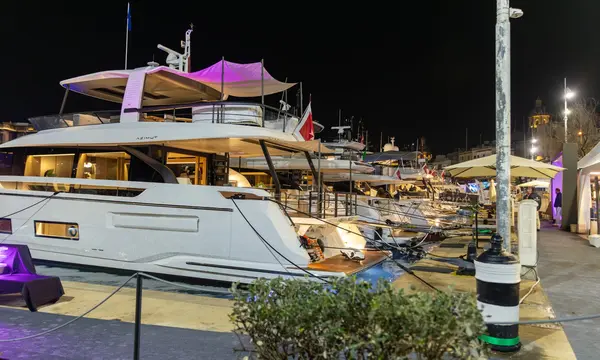
Yachting Malta reports thousands of visitors and more than 70 exhibitors at the third Malta Boat Show, held at Dock 1 in the Three …
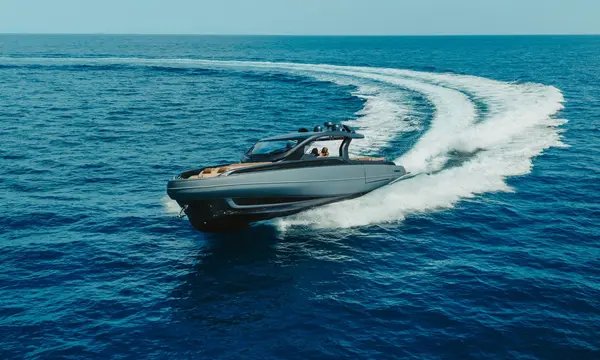
SACS brings the Rebel 55 to the Dubai International Boat Show from 25 to 29 November 2026, giving the luxury performance boat its first …

The 2026 Monaco Yacht Show hosted an expanded Asia-Pacific stand uniting shipyards, regional destination organisations and superyacht service providers.
Superyacht Guide
Continue into the wider Superyacht Guide.
Business opportunities · Superyacht Guide
Companies serving the superyacht market can discuss clearly identified advertising, sponsorship and business-profile opportunities. Commercial activity remains separate from independent editorial coverage.