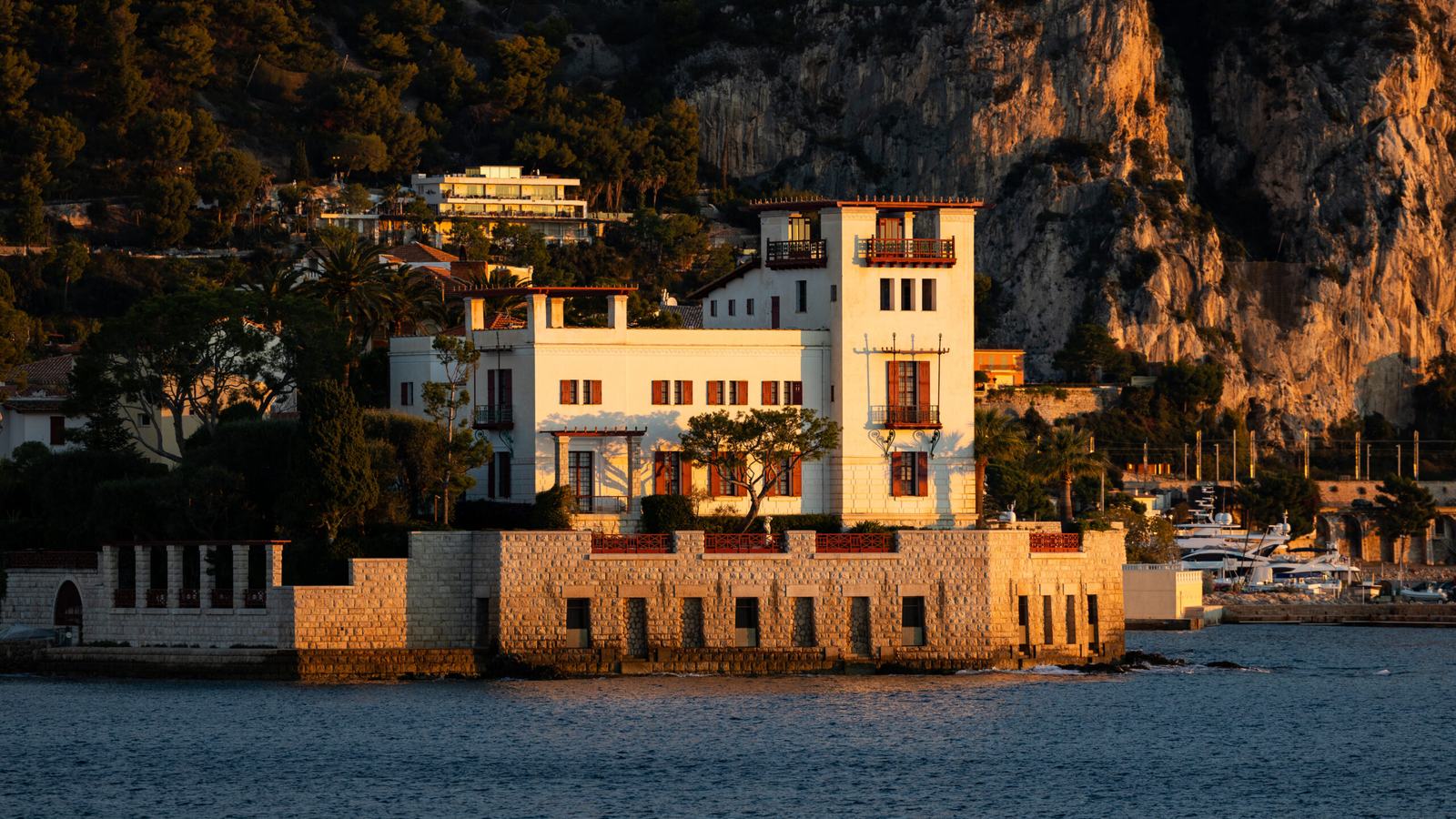
An independently researched Riviera shore guide to Villa Kérylos, its Greek-inspired interiors, design history, Mediterranean gardens and current visitor arrangements.
A Riviera villa with an ancient Greek imagination
Some of the French Riviera’s most interesting shore experiences sit just beyond the marina promenade. In Beaulieu-sur-Mer, Villa Kérylos occupies a rocky Mediterranean setting and invites visitors into a residence conceived as a reimagining of an ancient Greek home. For guests spending time aboard a superyacht between Nice, Saint-Jean-Cap-Ferrat and Monaco, the villa offers a particularly thoughtful cultural diversion: intimate in scale, rich in decorative detail and rooted in the fascination with antiquity that shaped the Riviera a century ago.
The distinction between inspiration and original antiquity matters. Villa Kérylos is an early-twentieth-century creation, not an excavated Greek dwelling, and its sophistication lies in that deliberate act of reconstruction. Its rooms evoke Hellenistic forms through mosaics, marble, painted decoration and specially designed furnishings, yet the building was made for modern life in its own age. A successful visit takes time to observe how historic ideas were adapted for a private residence with a Mediterranean outlook.
Théodore Reinach and Emmanuel Pontremoli's shared project
The official villa history traces the idea to Théodore Reinach, an archaeologist and patron with a deep interest in Greek civilisation. In 1902 he commissioned his friend Emmanuel Pontremoli to create a house inspired by Hellenistic residences of the second and first centuries BCE. Their reference point included archaeological work at Delos, and their intention was more ambitious than attaching Greek-looking details to an ordinary Riviera property. It was a designed environment in which architecture, decoration and everyday life formed one coherent programme.
Pontremoli brought first-hand archaeological experience to the commission, having worked on sites including Pergamon and Didyma. The official account notes that Reinach had admired Pontremoli’s work on the Pergamon acropolis before they met around the 1900 Paris Exposition. Completed in 1908, the villa embodies that conjunction of scholarship and craftsmanship. It also reflects the ambitions of a period when wealthy Riviera patrons could commission buildings of unusually personal cultural meaning.
The project did not end with its owner’s lifetime. Reinach died in 1928 and left the villa to the Institut de France, with a foundation established the following year to support its preservation. The property was classified as a historic monument in 1966, according to its own historical timeline. Present-day visitors therefore encounter both the original early-twentieth-century artistic experiment and the continuing responsibility of conserving a complex interior near the sea.
What to look for inside the house
The peristyle is a useful place to begin because a colonnaded courtyard establishes the relationship between circulation, light and the spaces around it. Rather than racing through rooms, guests can watch how the columns frame views and how the sequence of interiors creates a sense of separation from the coast outside. The official visitor site also highlights an andron, or living room, and a triklinos, the dining space; the names themselves indicate how faithfully the designers pursued the vocabulary of Greek domestic life.
Mosaics and fresco-inspired paintings should be read as parts of an architectural scheme, not isolated ornaments. The villa’s own interpretation describes furnishings created specifically for the property, with scenes of mythology and decoration based on ancient models. Marble and patterned surfaces lend variety from one room to the next, while the craftsmanship rewards close examination. For an owner interested in yacht interiors, Kérylos offers a fascinating case study in how a strong historical idea can inform an entire residential environment without becoming a literal archaeological copy.
Outdoor spaces are equally important. Terraced Mediterranean gardens lead visually towards the shore and complement the architecture’s references to Greek landscape traditions. From the terrace, it is easier to understand why this site appealed to a scholar with a passion for the Aegean world: the interplay of sea, stone and sunlight supports the design narrative. The view is part of the experience, although it should never distract from the subtle interior details.
Planning a refined shore visit from a superyacht
A villa visit begins with a workable arrival plan, not an assumption that a yacht can land directly beside the house. Captains and local agents should first confirm the vessel’s permitted berth or anchorage, passenger transfer and onward ground arrangements. Beaulieu-sur-Mer is a practical town to consider when building a Riviera itinerary, but conditions and yacht dimensions vary; visitors should rely on the local harbour authority rather than treating a sightseeing article as a berthing guide.
Once ashore, the villa’s listed address is Rue Gustave Eiffel, 06310 Beaulieu-sur-Mer. The current official website states that the street is accessible to pedestrians only because of works, a detail worth passing to any driver before departure. The site lists Beaulieu-sur-Mer railway station as another means of access, and its practical page identifies public transport options. Those travelling with mobility needs should check the current accessibility arrangements in advance because a protected historic building presents inherent constraints.
In late October the published opening window is 10:00 to 17:00, part of the October-to-March schedule. The official timetable extends to 18:00 from April through September, with some evening openings in the warmer months, and publishes specific holiday exceptions. A private party should confirm operating hours on the day rather than assuming that an old travel guide or previously printed ticket timetable remains current. This is especially important if the yacht’s departure or tender movements impose a narrow shore window.
Tickets, interpretation and privacy
The villa’s current admissions page lists a standard adult entry of €15 and a reduced rate of €10, with separate annual pass and family pass options. It explicitly says normal admission tickets are sold on site, not through online resellers; anyone attempting to pre-purchase should heed that notice. The published guided-tour times are 11:00, 14:30 and 16:00, subject to existing group bookings, and a supplement applies. These are ordinary visitor arrangements rather than a guarantee of an exclusive guide.
For those who prefer to linger independently, the site describes a complimentary audio guide taking about an hour, available for adults in several languages including English. That makes it possible for a small group to proceed at its own pace and concentrate on particular rooms or decorative techniques. It is prudent to reserve additional time around that hour for gardens, photography where permitted, and unhurried study. Any bespoke tour or private reception should be agreed directly with the venue, which advertises a separate private-events programme.
The wider shore day can be shaped around two distinct architectural visions. Kérylos currently advertises a joint ticket with Villa Ephrussi de Rothschild, priced at €24 for standard admission and valid for eight days after purchase. The two properties are not interchangeable: Reinach’s Greek-inspired ideal contrasts with Béatrice de Rothschild’s more eclectic world of collections and gardens. Our separate guide to Villa Ephrussi de Rothschild covers that different experience; a relaxed itinerary may place them on separate days rather than forcing both into one afternoon.
Why Kérylos belongs on a high-value Riviera itinerary
Luxury travel often concentrates on restaurants, shopping and familiar viewpoints, but the most memorable excursions can emerge from a place’s intellectual history. Villa Kérylos was made by people who wanted to understand another civilisation through buildings, objects and patterns of daily life. Walking through it encourages guests to think about design decisions across centuries: what deserves faithful interpretation, what requires modern adaptation and where craftsmanship can turn historical study into atmosphere.
The residence is also particularly well suited to travellers interested in architecture, fine furniture or the relationship between a house and its coastal landscape. It presents layers of research and artistry without the scale or crowds associated with a large museum. For guests returning to the yacht afterwards, the visit can prompt conversation about materials, decorative schemes and the balance between historic inspiration and contemporary comfort. That is a more lasting souvenir than a hurried photograph at the gate.
All factual visitor arrangements here were checked against the villa’s official website, its current visitor information and its historical account. Opening times, pricing, accessibility and special-event access can change, so the venue remains the authority before travel. The accompanying image is an official Villa Kérylos photograph of the property, not an AI reconstruction or an image of a different Riviera landmark.