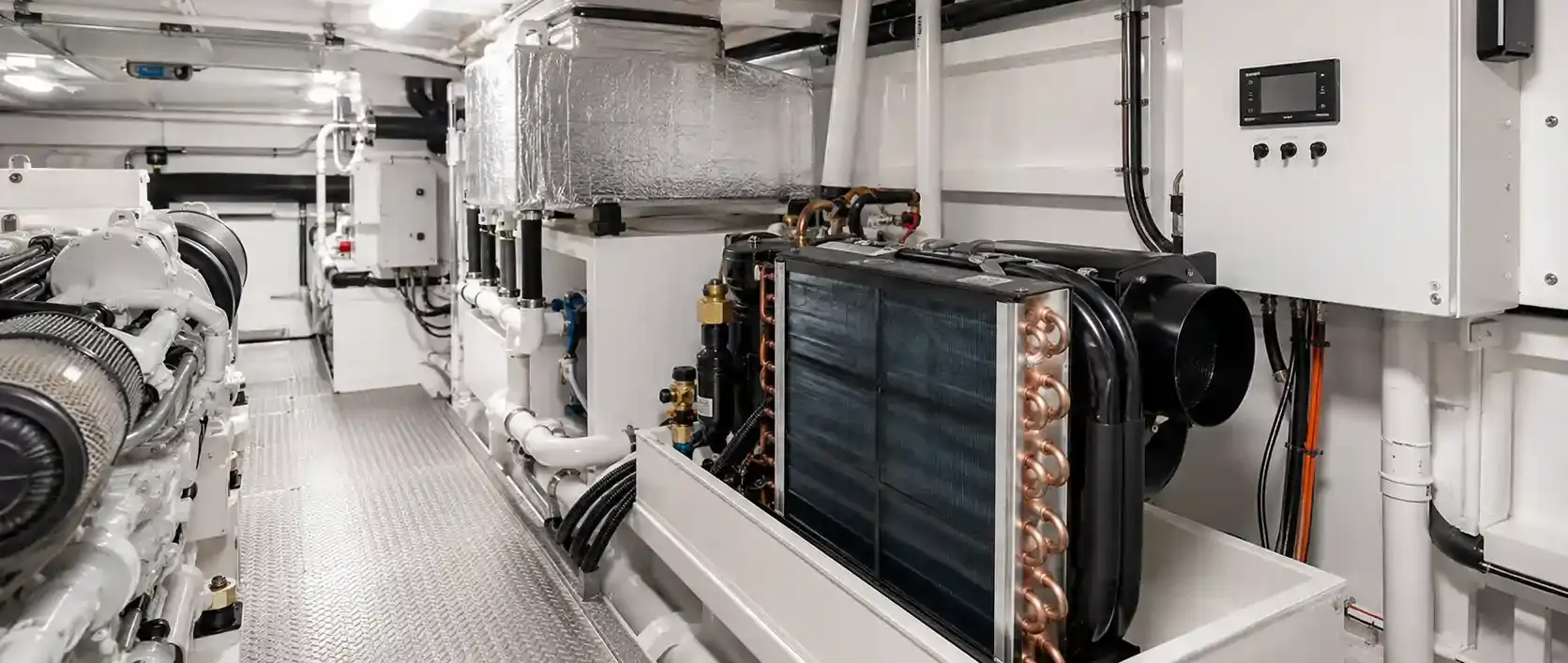
A superyacht’s HVAC system does far more than cool cabins. It controls temperature, humidity, ventilation and air quality while carrying a major hotel load.
A superyacht can have exceptional interiors, flawless service and an impressive cruising programme, but none of it feels luxurious if the owner's cabin is too warm at midnight. Air conditioning is one of those systems that guests rarely notice when it works properly and can think about almost continuously when it does not.
On a large yacht, HVAC means considerably more than producing cold air. Heating, ventilation and air conditioning have to manage temperature, humidity, fresh air, air movement, odours and the different thermal loads created by dozens of spaces while the yacht moves between changing climates and operating conditions.
The challenge is made harder by the environment itself. A yacht may spend one season dealing with Mediterranean heat, strong solar gain and doors repeatedly opening onto exterior decks, then move into a cooler climate where heating and moisture management become equally important.
For owners, the result is simple even if the engineering is not. Climate control is part of the luxury product, and when it is poorly designed, badly maintained or operating close to its limits, an otherwise exceptional yacht can become uncomfortable remarkably quickly.
A building normally remains in one climate and receives relatively stable electricity, water and ventilation. A yacht carries its own power generation, cooling-water systems and machinery while changing heading, location, outside temperature, humidity and occupancy.
Large areas of glass introduce solar heat into saloons and cabins, while galleys, laundries, entertainment systems, lighting and technical equipment generate additional heat internally. Guest numbers can change quickly, exterior doors may remain open during service, and cabins on opposite sides of the yacht can receive dramatically different levels of sun during the same afternoon.
Marine HVAC therefore has to be designed around expected environmental conditions rather than simply the desired cabin temperature. Specialist yacht systems are routinely engineered against defined combinations of outside temperature and relative humidity, with corresponding targets for the interior.
On large yachts, chilled-water systems are common because cooling capacity can be generated centrally and distributed around the vessel to individual air-handling or fan-coil units. The resulting installation may serve owner accommodation, guest areas, crew spaces and service spaces in different ways while remaining part of one integrated climate-control architecture.
A cabin at 22°C does not necessarily feel comfortable if the humidity is wrong. High humidity can make a cooled interior feel clammy, while very dry air can create a different kind of discomfort during extended periods aboard.
Moisture also matters beyond human comfort. Interior materials, wardrobes, soft furnishings, electronics and concealed spaces all benefit from a stable internal environment rather than repeated cycles of heat, humidity and condensation.
The air-conditioning system consequently has to remove latent heat associated with moisture as well as reducing the temperature of the air. In hot and humid destinations, this can be one of the reasons the system works hard even when the temperature difference between inside and outside does not initially appear extreme.
Condensation must also be controlled within the system itself. Cold ducting or pipework exposed to warmer humid air can create unwanted moisture, which is why insulation, drainage and correct installation are fundamental parts of marine climate-control design rather than finishing details.
One of the unusual features of marine air conditioning is that the surrounding water is commonly part of the heat-rejection process. Seawater is drawn through an intake and circulated through equipment that allows heat removed from the yacht's interior to be transferred away from the vessel.
This makes seawater flow critical. A cooling plant can have perfectly functional compressors and controls but still struggle or shut down if the seawater side cannot remove heat effectively.
Strainers can become contaminated, marine growth can develop inside pipework or heat exchangers, pumps can lose performance and an intake can become partially obstructed. Water temperature also changes the conditions under which the plant operates, which means a yacht cannot assume that a system performing comfortably in one cruising ground will experience exactly the same load elsewhere.
Routine inspection of the seawater circuit is therefore part of maintaining reliable air conditioning. Flow at the discharge, strainers, pumps, pipework and heat exchangers all deserve attention because a comparatively simple restriction on the seawater side can affect climate control throughout the yacht.
The owner's suite and engine room may be separated by only a few decks, but their climate-control requirements are fundamentally different. Guest accommodation prioritises stable temperature, low noise, gentle air movement and discreet ventilation, while technical spaces may need large amounts of airflow simply to remove equipment heat.
Galleys add another challenge because cooking produces heat, moisture and odours. Laundries generate substantial heat and humidity, sanitary spaces require effective extraction, and beach clubs or tender garages may require ventilation strategies very different from those used in sleeping accommodation.
Fresh-air supply and exhaust therefore matter alongside cooling capacity. A successful system must introduce enough outside air for people and spaces while removing stale air, odours and unwanted heat without creating noticeable draughts or allowing smells to migrate through the accommodation.
Pressure relationships can help. Carefully controlled slight positive pressure in accommodation can reduce the tendency for unwanted air and odours to enter from adjacent spaces, while dedicated extraction deals with areas where air should deliberately move in the opposite direction.
A system capable of holding every cabin at the correct temperature can still be a poor superyacht HVAC installation if guests can constantly hear it. Air rushing through grilles, fan noise, vibration from pumps and compressors or repeated mechanical cycling can undermine precisely the atmosphere the yacht's interior is intended to create.
Reducing that noise involves more than selecting quiet equipment. Duct dimensions, air velocity, grille placement, resilient mounting, machinery location and the way pipes and equipment connect to the yacht's structure can all affect what eventually reaches the guest.
The difficulty is that quieter air distribution often requires space. Larger ducts can move the required volume of air at lower velocity, but yacht designers are simultaneously trying to preserve headroom, ceiling details, storage and interior volume.
This creates one of the recurring conflicts in yacht design. HVAC machinery and ductwork are mostly invisible when the yacht is finished, yet reducing the space allocated to them during construction can produce problems that remain audible and uncomfortable for the life of the vessel.
Good climate control feels effortless. A guest should be able to adjust a cabin temperature without understanding chilled-water temperatures, fan-coil valves, compressor stages or whether the yacht is operating from shore power or generators.
Behind that simplicity can sit a complex zoning strategy. Different cabins may require individual control while public spaces need enough capacity to cope with changing occupancy, large glazed areas and doors opening to the exterior.
The owner's suite can create particularly demanding expectations because temperature preference is highly personal. One owner may want a cool sleeping environment while another guest only metres away prefers a considerably warmer cabin, and the system must accommodate both without creating noise or unstable temperatures elsewhere.
Crew areas matter as well. Climate control that prioritises guest accommodation while leaving working or sleeping spaces uncomfortable can affect fatigue and morale, particularly during long seasons in hot climates when crew remain aboard continuously.
Cooling does not happen for free. Chillers, compressors, pumps, fans and air-handling equipment require electrical power, making climate control an important component of the yacht's hotel load.
The effect becomes particularly apparent at anchor, where propulsion demand may be minimal while the yacht continues behaving like a floating hotel. Air conditioning can continue operating around the clock alongside refrigeration, lighting, stabilisers, water production, galley equipment, AV systems and other domestic services.
Reducing HVAC demand can therefore produce benefits beyond comfort. Better insulation, appropriate glazing, effective shading, efficient compressors, variable-speed equipment and intelligent control can reduce the electrical load that generators, batteries or shore power must support.
Some yacht installations also recover otherwise wasted heat for heating functions rather than producing all required heat electrically. The broader lesson is that HVAC efficiency should be considered as part of the yacht's complete energy system rather than treated as an isolated domestic appliance.
An HVAC system is often most heavily loaded at exactly the moment when failure would be most disruptive. The owner arrives during the hottest part of the season, every guest cabin is occupied, the galley is working hard and exterior doors are opening repeatedly throughout the day.
A system with dirty filters, restricted seawater flow or deteriorating heat-exchanger performance may still appear satisfactory during a quiet spring commissioning period. Once the ambient temperature, humidity and occupancy rise together, the lost capacity becomes much more obvious.
Manufacturers consequently specify routine attention to filters and seawater circuits rather than waiting for the yacht to become warm. Functional checks, strainer cleaning, inspection for leaks and periodic cleaning of seawater heat-transfer components are basic maintenance tasks with consequences far beyond the machinery space.
Condensate drainage also deserves attention. An air-conditioning unit is deliberately removing moisture from the air, and that water has to travel safely away from the accommodation without leaks, blockages or unwanted smells.
Preventive maintenance is particularly valuable because many HVAC failures develop gradually. A guest may notice that one cabin takes longer to cool weeks before a component finally produces an alarm, giving an attentive engineering team an opportunity to investigate before the problem becomes an owner-facing failure.
Older yachts frequently receive HVAC upgrades because compressor technology, controls and energy efficiency have improved while owner expectations have risen. Replacing the central machinery, however, does not automatically correct weaknesses elsewhere in the original installation.
Ductwork may be undersized, access to fan-coil units may be poor, insulation may be deteriorating or air grilles may have been positioned for the aesthetics of an earlier interior rather than optimum circulation. A refit can also change thermal loads if larger windows, new lighting, enclosed deck spaces or additional AV equipment are introduced.
This is why climate-control modernisation needs to consider the complete system. Installing a more efficient chiller while leaving restricted seawater circuits, poor air distribution or inaccessible equipment untouched may improve one part of the installation without solving the problem experienced by guests.
Access should be considered with unusual seriousness. Filters, valves, fan coils, pumps and drain systems all require maintenance, and an installation hidden behind expensive joinery can become unnecessarily costly every time engineers need to reach it.
A propulsion problem is obviously serious, but owners understand that machinery can occasionally require repair. HVAC occupies a different psychological position because guests experience its performance continuously while sleeping, dressing, dining and relaxing.
One warm cabin can therefore become disproportionately important. If engineers need to remove ceiling panels during an owner trip, install temporary cooling equipment or repeatedly enter accommodation to diagnose a fault, a hidden technical problem has suddenly become part of the guest experience.
The same is true of smell, condensation and noise. None necessarily stops the yacht from navigating safely, but each can make an expensive interior feel significantly less luxurious.
That is why engineers tend to regard successful HVAC operation as an invisible service. The best outcome is not that guests admire the climate-control system, but that they never have a reason to discuss it.
HVAC is easy to underestimate because most of the equipment disappears behind panels, beneath floors and inside technical spaces. Yet it connects architecture, electrical generation, seawater systems, insulation, ventilation, acoustics, automation, maintenance and the everyday experience of everyone aboard.
A well-designed system has sufficient capacity without being unnecessarily wasteful, distributes air without noise or draughts, manages humidity, maintains fresh-air quality and remains accessible enough for engineers to service it properly. It also has to achieve those things while the yacht moves between climates that may place completely different demands on the same machinery.
For owners, HVAC deserves the same attention during specification, purchase survey and refit planning as many far more visible features. A beautiful yacht can survive without the latest cinema or an elaborate beach club, but it cannot deliver convincing luxury for long if the accommodation cannot remain comfortable.
At sea, air conditioning is not simply another hotel system. It is part of what turns a technically capable vessel into somewhere people actually want to live.
Explore
Go deeper into the yachts, companies, events and destinations directly connected to this article.
Continue reading

Heinen & Hopman is using Monaco Yacht Show 2026 to focus on superyacht HVAC technology and energy-saving climate-control solutions for new-build and refit projects.
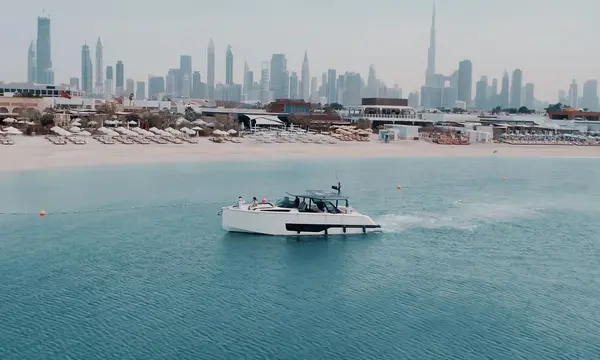
D-Marin's October guidance explains how visiting yachts use a permitted offshore anchorage and dedicated tender service to reach Dubai's J1 Beach restaurants.
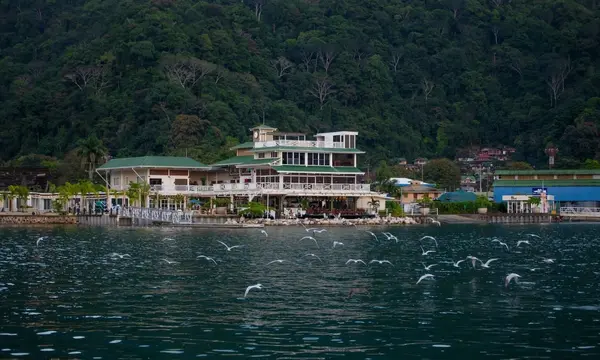
Marina Bahía Golfito highlights prospective customs, port services, road access and research facilities in Costa Rica before FLIBS 2026.
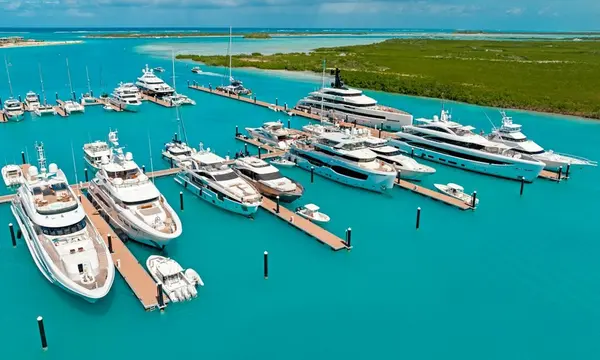
IGY explains how its Trident programme supports eligible superyacht captains seeking short-notice berths during busy events and sudden itinerary changes.
Superyacht Guide
Continue into the wider Superyacht Guide.
Business opportunities · Superyacht Guide
Companies serving the superyacht market can discuss clearly identified advertising, sponsorship and business-profile opportunities. Commercial activity remains separate from independent editorial coverage.