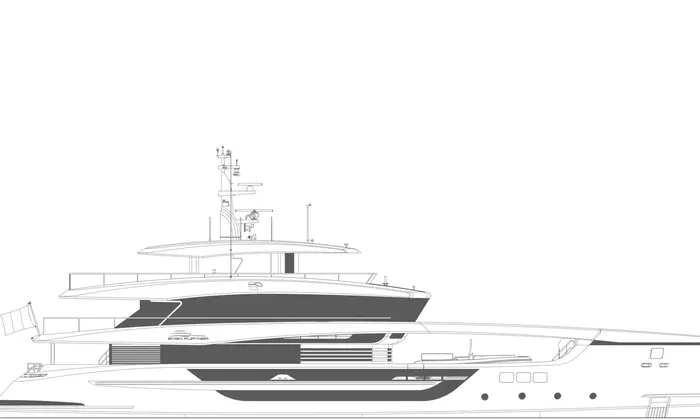
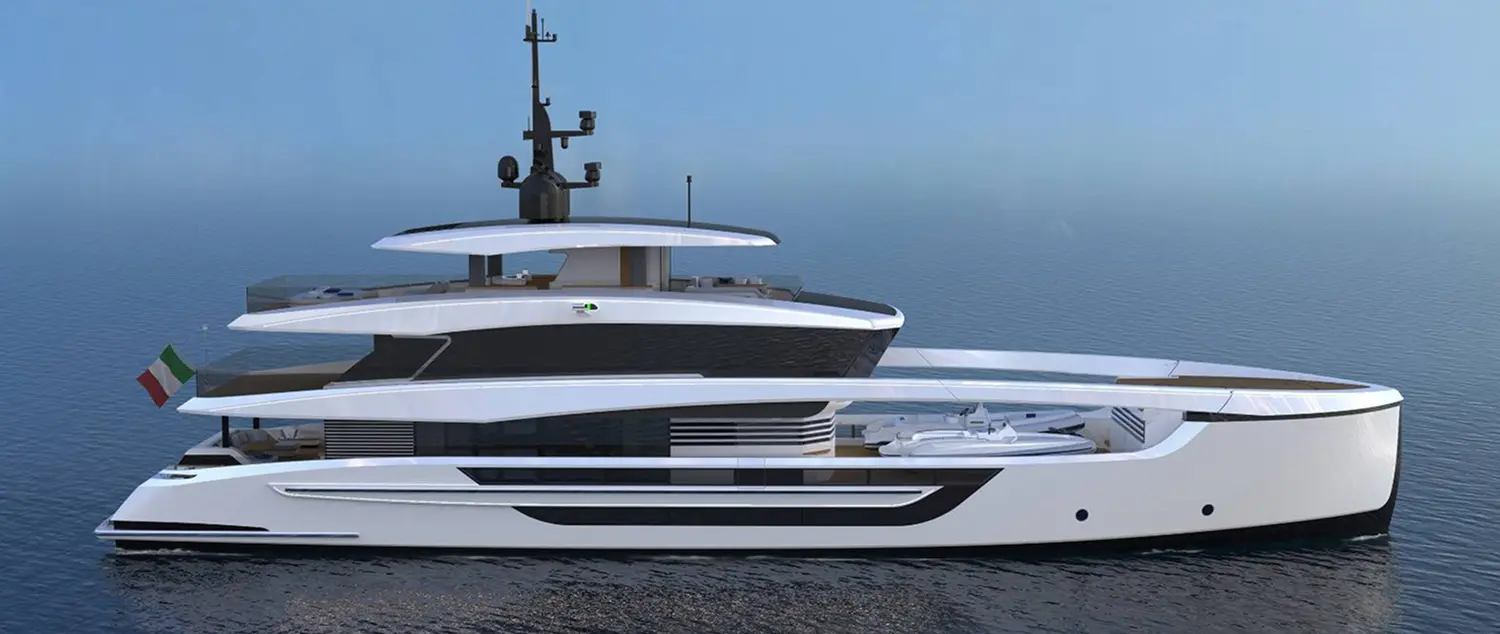
Amer Yachts has delivered Even Further, the first yacht in its new Amer 42 Explorer programme and the Italian builder’s first completed steel-hulled vessel.
The 41.45-metre explorer has reportedly begun her first Mediterranean cruising programme and has been seen operating off Corsica following delivery to her owner. Her handover moves the project beyond the fuel-consumption figures and long-range claims recorded during sea trials, allowing Amer’s new explorer platform to begin proving itself in normal operation.
Even Further is more significant than a single custom delivery. The yacht establishes a new steel-construction direction for Amer, a company more closely associated with composite performance yachts and its long-running development of Volvo Penta IPS propulsion.
Amer launched Even Further in June 2026 after completing initial open-water trials. Delivery followed within weeks, allowing the yacht to enter service during the Mediterranean summer rather than remaining at the yard for an extended post-launch programme.
Although conceived for genuinely long-distance cruising, her first reported movements off Corsica place the yacht in a very different operating environment: short passages, crowded anchorages and regular changes between harbour and open water.
That should provide an early test of the qualities Amer has emphasised throughout the project, including manoeuvrability, low-speed efficiency, reduced vibration and the ability to operate a comparatively large steel yacht using pod propulsion.
The yacht accommodates 12 guests in five cabins, supported by accommodation for nine crew. Her interior and exterior design are by Luiz de Basto, while Optima Design Italy was responsible for naval engineering.
Even Further has a steel hull and aluminium superstructure, with a gross tonnage of 486 GT, as confirmed by Amer Yachts. She was developed to Ice Class requirements and carries 56,300 litres of fuel.
Her most closely watched feature is the propulsion arrangement.
Four Volvo Penta D13 engines are connected to two IPS40 pod drives using the Volvo Penta IPS Professional Platform. The system allows the yacht to operate on only two engines at lower speeds, while the remaining pair is kept ready to join as power demand increases. Even Further is the first displacement superyacht to use this professional IPS platform.
During trials, Amer recorded fuel consumption of approximately 60 litres per hour at 9.5 knots in Eco Mode. The builder calculates that this configuration could provide a range of around 8,900 nautical miles, although real-world endurance will inevitably depend on weather, loading, generators, hotel demand and operating conditions.
At 12.5 knots, Amer reported combined consumption of approximately 150 litres per hour. The yacht recorded a cruising speed of 14 knots and a maximum speed of 16.3 knots.
Those figures are important because steel explorers of this displacement have traditionally relied on shaft-driven propulsion. Amer’s decision to build the hull around IPS rather than fitting pods to an otherwise conventional design allowed the yard, its naval architects and Volvo Penta to treat propulsion efficiency as a fundamental part of the yacht’s architecture.
The yacht was developed for an experienced repeat owner whose requirements focused on practical long-range use rather than simply following current explorer-yacht fashion.
A high forward deck incorporates a touch-and-go helicopter area that can also function as an entertainment space. The foredeck is arranged to carry tenders and personal watercraft, while two substantial cranes are integrated into the superstructure for launching and recovery. Each crane is reported to have an eight-tonne lifting capacity.
Instead of creating a large conventional beach club at the stern, the design places greater emphasis on the yacht’s upper outdoor spaces. A 17-metre flybridge extends across more than 40 per cent of the yacht’s overall length, providing a substantial private exterior area when the yacht is moored stern-to.
Inside, the arrangement is intended for family cruising rather than highly formal entertaining. The main saloon and dining area connect with the exterior through broad glazed openings, while a glass staircase links the yacht’s decks and helps bring natural light into the centre of the accommodation.
The wheelhouse features a wide, angled windscreen intended to provide extensive forward visibility, together with a suspended navigation console built around the yacht’s integrated control systems.
The delivery expands Amer into a different part of the market.
The yard has spent more than a decade developing IPS-powered yachts, but applying the system to a 41.45-metre steel displacement explorer required a much broader engineering exercise than its previous composite models.
Even Further therefore serves as both an owner’s yacht and a technical demonstrator. She allows Amer to show that its efficiency strategy can be extended into steel construction, long-range endurance and heavier custom yachts.
The builder describes the Amer 42 Explorer as the founding model of a new custom steel line. Amer has also been developing larger custom projects, including steel yachts beyond 60 metres, indicating an ambition to compete for commissions well above the yard’s traditional size range.
The project also strengthens the argument that explorer capability does not have to be defined only by fuel capacity, commercial-looking exterior styling or oversized machinery. Hull efficiency, propulsion integration, redundancy and the ability to operate economically at passage speeds can be equally important.
Sea-trial figures create attention, but delivery begins the more meaningful phase of the project.
Even Further must now demonstrate whether her unusual propulsion arrangement can deliver the expected economy, reliability and comfort through repeated passages, seasonal cruising and the practical demands of owner operation.
Her first Mediterranean miles will not test the full extent of an 8,900-nautical-mile theoretical range, but they will begin to show whether Amer has successfully combined the mass and capability of a steel explorer with the responsiveness and efficiency normally associated with much smaller IPS-powered yachts.
For Amer Yachts, the significance of Even Further is therefore contained in her name. The yacht is intended to travel farther, but her delivery may also carry the shipyard further into the international custom-explorer market.
Explore
Go deeper into the yachts, companies, events and destinations directly connected to this article.
Continue reading
The first McConaghy GT86 has launched after almost two years of development. The 25.54-metre power catamaran has a 9.24-metre beam, twin Volvo IPS 1350 …
Antonini Navi's 31.2-metre Evo31 explorer, reportedly named Hanaa, has entered the water at La Spezia, with Hydro Tec naval architecture, Hot Lab interiors and …
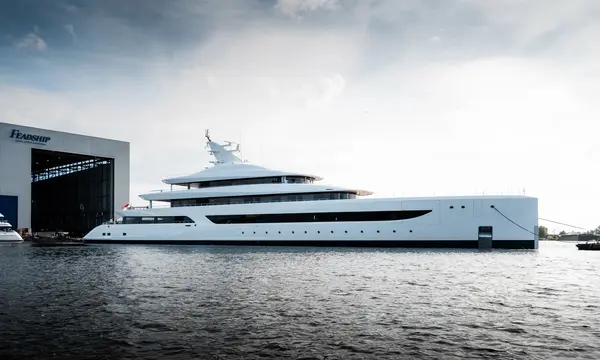
Feadship's 2026 Project 828 launch shows how a privately commissioned yacht can use bow proportion, strong horizontal styling and purposeful circulation to support flexible …
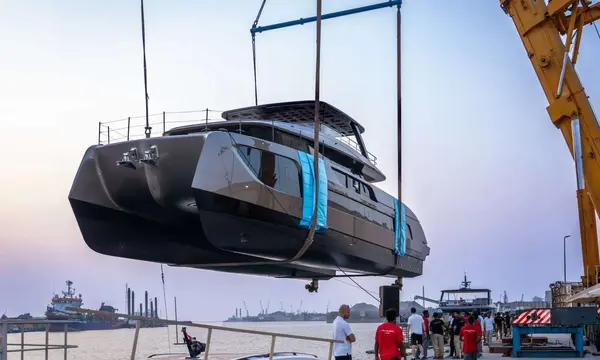
Sunreef Yachts' July 2026 launch of SUE ROSSO adds another 26.8-metre ULTIMA 88 to its UAE-built fleet. The official release details twin 1,000hp engines, …
Superyacht Guide
Continue into the wider Superyacht Guide.
Business opportunities · Superyacht Guide
Companies serving the superyacht market can discuss clearly identified advertising, sponsorship and business-profile opportunities. Commercial activity remains separate from independent editorial coverage.