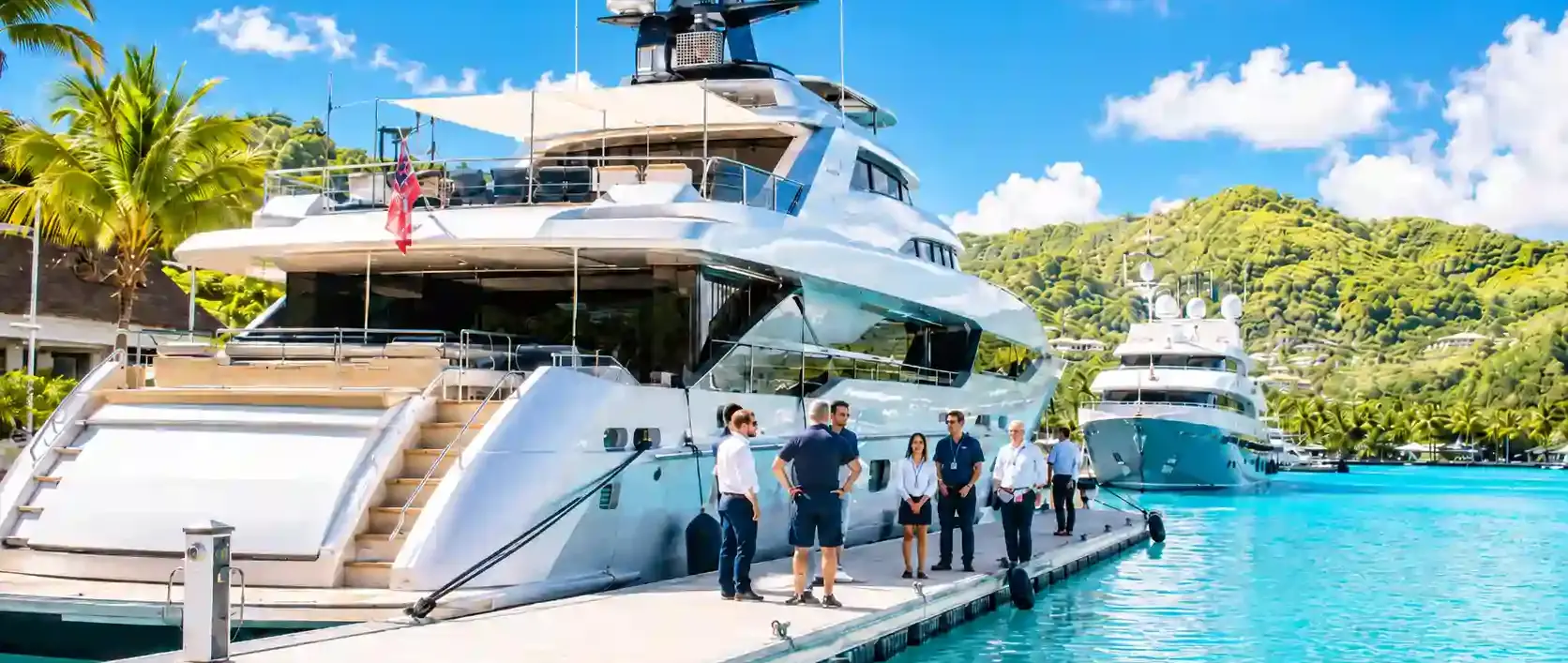
The 2026 Australia–Fiji Rendezvous brought captains, crew and marine businesses together at Nawi Island and Port Denarau Marina. The event highlights a growing regional strategy that pairs Fiji’s cruising appeal with Australia’s refit, marina and technical capability.
The 2026 Australia–Fiji Rendezvous has brought captains, crew and marine-industry representatives together at Nawi Island and Port Denarau Marina, reinforcing a commercial relationship that is becoming increasingly important to South Pacific superyacht cruising. The event ran from 12 to 14 August and was designed around a simple proposition: Fiji provides exceptional cruising, while Australia offers an increasingly deep network of refit, repair, marina and technical capability that can support yachts moving through the wider region.
Organised by Superyacht Australia, the Rendezvous began with a day at Nawi Island before moving to Port Denarau for two further days of industry and crew events. The programme included a captains’ lunch, a crew cocktail competition and networking functions intended to connect visiting yachts directly with Australian marine businesses and regional stakeholders.
The significance of the event is therefore greater than the social programme around it. For Australia and Fiji, the commercial opportunity lies in persuading more yachts to view the South Pacific as a connected cruising and service region rather than a collection of isolated destinations.
The South Pacific has never lacked reasons to visit, but operating a large yacht across the region requires more than attractive anchorages. Captains must think about fuel, provisioning, customs and immigration, engineering support, spare parts, crew movements, weather windows and the availability of suitable berths as the yacht moves between island groups and major service centres.
The Australia–Fiji Rendezvous is designed to address that practical gap by putting captains and crew in direct contact with businesses that can support later stages of a yacht’s programme. Superyacht Australia describes the event as a platform for connecting the Australian marine industry with vessels cruising the Pacific, while promoting cruising opportunities and stronger collaboration between Australia and South Pacific destinations.
That relationship works in both directions. Fiji benefits when yachts have confidence that they can cruise remotely and still reach established technical support when required, while Australian yards, marinas and suppliers gain access to yachts that may otherwise remain on traditional Mediterranean, Caribbean or American service circuits.
The 2026 programme reflected that operational focus rather than functioning simply as a destination showcase. Superyacht Australia’s event material placed captains and crew at the centre of the programme, with the Captain’s Lunch specifically creating an environment for discussions around cruising plans, refit scheduling and the support available across Australia and the wider region.
The timing of the Rendezvous is significant because Fiji’s superyacht infrastructure is developing alongside its cruising appeal. Nawi Marina in Savusavu now states that it has 132 berths, including capacity for superyachts up to 85 metres, and is constructed to Australian standards with infrastructure certified to withstand Category 5 cyclone conditions.
Nawi is also a clearance port for superyachts and provides support including inward and outward clearance assistance, cruising permits, provisioning, freight forwarding and concierge services. Those capabilities matter for yachts venturing beyond western Fiji because they create another operational node in a cruising ground where distance and logistics can otherwise restrict itinerary choices.
Port Denarau has been making an even larger infrastructure move at the western end of Fiji’s main island. The marina completed a FJ$6 million expansion that delivered seven new berths and Fiji’s first dedicated mega-yacht berth, capable of accommodating vessels up to 115 metres.
The project also included a 208-metre jetty extension, dredging of approach channels and turning areas, upgraded utilities and improved fuel infrastructure. For an event whose purpose is to strengthen the route between Pacific cruising and Australian marine capability, holding two days of the Rendezvous at a marina making that level of investment is commercially significant.
Fiji’s wider yachting economy is already showing why this infrastructure matters. The country’s yachting sector contributed a record FJ$57.4 million to the economy in 2025, while the latest Fiji International Yachting Visitors Survey recorded 62 superyachts and a sharp increase in average length of stay.
Superyacht Guide covered those economic figures separately in July, so the 2026 Rendezvous represents the next part of the story rather than a repetition of it. The question now is how Fiji and its regional partners convert longer stays and increasing expenditure into a durable South Pacific superyacht economy with enough infrastructure and technical depth to support continued growth.
For Australian marine businesses, the attraction of the Rendezvous is direct access to yachts already operating within reach of Australian waters. A captain considering a maintenance period, paint programme, engineering package or seasonal repositioning can discuss those requirements with yards and suppliers before the yacht has committed to its next long-distance movement.
That is particularly important in a region where geography changes purchasing decisions. Moving a large yacht purely for maintenance is expensive, so yards and service providers benefit when planned technical work can be integrated into a wider cruising itinerary rather than requiring a dedicated repositioning voyage.
Superyacht Australia’s promotion of the 2026 Rendezvous included Australian facilities such as The Yard Brisbane and Southport Yacht Club, while Echo Yachts supported the Captain’s Lunch. The organisations represent different parts of the Australian offering, from large-yacht construction and refit through to deep-water berthing and shore support, which is precisely the range of capability visiting captains need to understand before committing a yacht to the region.
The commercial objective does not need to be pulling yachts away from Fiji as quickly as possible. A stronger model is complementary, with yachts spending longer cruising or chartering among Pacific destinations before routing through Australia when substantial technical work, logistics or maintenance make an Australian stop advantageous.
That gives the wider region a proposition that individual destinations would struggle to create alone. Fiji can offer island cruising and a growing marina network, while Australia can add major refit facilities, specialist trades, international transport links and increasingly capable large-yacht berthing.
The Australia–Fiji connection also fits directly into Superyacht Australia’s much larger Brisbane 2032 Marine Project. The programme is intended to prepare Australia and neighbouring Pacific destinations for a possible influx of large foreign-flagged yachts around the Olympic and Paralympic Games, while attempting to convert event-driven traffic into longer-term visitation.
Superyacht Australia’s economic modelling projects that Brisbane 2032 could attract more than 200 foreign-flagged superyachts to Australia and potentially generate A$1.8 billion in national business output. The organisation is consequently treating regional cruising routes, marina capacity, technical support, logistics and regulatory readiness as connected issues rather than simply planning where visiting yachts might berth during the Games.
Fiji has an obvious role in that picture because yachts arriving from the Americas, Asia or other parts of the Pacific may incorporate island cruising before or after visiting Australia. A credible network of Pacific destinations gives owners more reason to commit a yacht to the substantial repositioning voyage required to reach the region in the first place.
Events such as the Australia–Fiji Rendezvous are small in scale compared with the infrastructure programmes and economic projections surrounding Brisbane 2032, but they perform a practical function that large strategies cannot replace. Captains, crew, marina operators, yacht agents, builders and refit businesses make routing and purchasing decisions through relationships built over time, and direct contact remains important in an industry where operational trust carries considerable weight.
The 2026 Rendezvous illustrates a broader change in how the South Pacific is presenting itself to the international fleet. Rather than asking owners to choose between Fiji and Australia, the stronger proposition is to make both destinations part of the same extended cruising and service programme.
That requires continuing investment because the distances remain substantial and the infrastructure is still less dense than in the Mediterranean or Caribbean. The recent expansion at Port Denarau, Nawi’s growing superyacht capability and Australia’s investment in large-yacht yards and berthing show, however, that the operational network is becoming more credible.
For captains, that can gradually change the risk calculation behind a Pacific itinerary. Remote cruising becomes more practical when there are dependable places to clear in, provision, berth, obtain parts and schedule major work along the broader route.
The Australia–Fiji Rendezvous is therefore best understood as part of that infrastructure story rather than simply as an annual networking event. If Australia and Fiji can continue linking cruising appeal with technical capability, the South Pacific has a stronger chance of turning occasional long-distance visitors into a more consistent superyacht fleet.
Explore
Go deeper into the yachts, companies, events and destinations directly connected to this article.
Continue reading
Yacht Chef Salary 2026: Pay, Tips and Charter Earnings Yacht-chef pay depends on yacht size, private or charter use, professional background, qualifications, rotation and …
Superyacht Crew Tips: How Much Can Crew Earn on Charter? Charter-yacht crew often receive discretionary guest tips, but tips are not guaranteed salary and …
During a charter, the captain has to balance guest expectations with crew capability, rest requirements and a weather picture that can change by the …

Guests may experience the first day of a superyacht charter as a seamless transition from airport to anchorage. For the crew, it is a …
Superyacht Guide
Continue into the wider Superyacht Guide.
Business opportunities · Superyacht Guide
Companies serving the superyacht market can discuss clearly identified advertising, sponsorship and business-profile opportunities. Commercial activity remains separate from independent editorial coverage.