SeaKeepers Founders 2026 Draws 240 Guests and 30 Yacht Crews
SeaKeepers has published attendance and fleet participation figures for its completed Fort Lauderdale Founders gala, recognising conservation leaders and yacht crews who support marine …
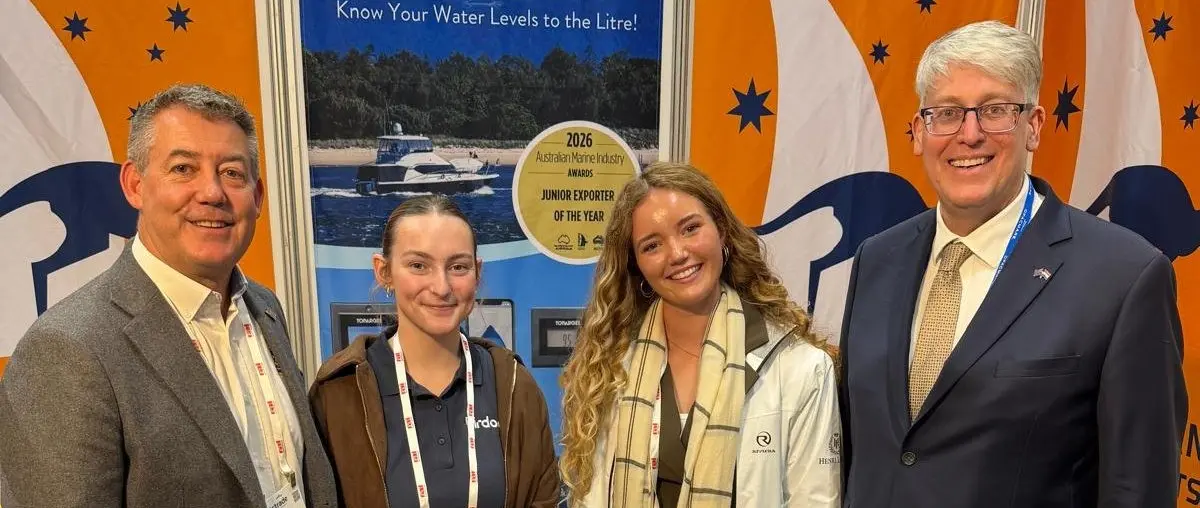
© Australian Marine / AIMEX. Official November 2026 delegation photograph at METSTRADE; apprentices and national pavilion participants.
AIMEX has reported Australia's first dedicated Superyacht Pavilion at METSTRADE 2026 in Amsterdam, with Echo Yachts, Muir Engineering and new industry talent in the delegation.
Australian marine industry groups have reported the first dedicated Australian Superyacht Pavilion at METSTRADE 2026, placing builders and technical suppliers in the exhibition's expanded Superyacht Zone. The 38th edition of the equipment trade show took place at RAI Amsterdam on 17–19 November, and Australian Marine published its detailed report on 25 November. The new pavilion in Hall 7 showcased Echo Yachts and Muir Engineering, while a separate national pavilion in Hall 3 featured a broader group of companies serving recreational and commercial marine markets. The development is more substantial than a rearrangement of stands. It signals a decision to address superyacht shipyards, project managers and captains as a distinct international buying audience, rather than presenting every Australian exhibitor through a single general export display.
Superyacht construction differs from the wider recreational boating market in its project cycles, technical expectations and procurement arrangements. A custom newbuild or a major refit may involve representatives from the owner, builder, designers, classification bodies and specialised equipment manufacturers. A dedicated hall provides an environment in which a supplier can discuss that kind of project directly with relevant decision-makers. The inaugural Australian Superyacht Pavilion placed national capability inside this particular part of the show. That does not mean every exhibitor obtained a contract or that every visitor was a qualified purchaser. The evidence supports the launch of a targeted international presence and the intention to build commercial relationships through it.
Echo Yachts was among the businesses identified for the Australian Superyacht Pavilion. Based in Western Australia, the yard is known for work in large custom vessels and complex multihull projects. Its presence matters because national export promotion can otherwise be associated mainly with equipment, accessories and smaller craft. A builder capable of discussing entire large-yacht projects gives the pavilion a direct connection to the decisions made by superyacht owners, naval architects and management teams. The official Australian Marine report does not announce a new Echo Yachts contract or a specific newbuild order arising from Amsterdam. Presenting the company at a trade show is a platform for conversations, not an independently verified delivery milestone.
Muir Engineering, represented through its anchoring systems, was the other named company in the new superyacht area. Anchoring equipment is a good example of a product whose visual profile may be comparatively modest while its operational importance is high. A superyacht's anchoring arrangements need to be selected for the vessel, the loads involved and the relevant standards. A trade exhibition gives equipment makers an opportunity to show new technology and discuss integration with engineers and builders. The company described METSTRADE as an effective place to present its latest systems alongside Australian manufacturers. The announcement does not publish technical ratings for a newly launched Muir product, and those should not be inferred from the general exhibitor report.
Australia's presence extended beyond the superyacht section. The national pavilion in the recreational hall brought together Greencorp Marine, HyDrive Engineering, Control Point Group, GME and Rainman Desalination. Group-stand participants included Topargee, Globatech, Marine Protection Systems and Palm Outdoor Australia. These companies work in different parts of the supply chain, which is why a national pavilion can be useful: a visitor may encounter equipment that addresses unrelated onboard requirements without travelling between separate supplier countries. Yet the individual capabilities of the companies must still be verified. A listed exhibitor's presence at the fair is not a certificate that its products suit every superyacht class or operating environment.
The Hall 3 exhibitor group illustrates how diverse yacht operation can be. Watermakers and desalination systems address an essential service, while marine electronics and steering equipment deal with different technical needs. Other exhibitors contribute specialised products, coatings or protection systems. A buyer selecting a single component cannot treat these categories as interchangeable or assume that an attractive new device is compatible with existing onboard infrastructure. What the pavilion offered was a way to discover suppliers and begin the necessary conversations. Technical specifications, maintenance support, service coverage and certification remain the responsibility of the relevant provider and the professionals integrating the equipment into a vessel.
The Australian Marine account says Invest Gold Coast led a separate regional delegation within the Hall 3 pavilion. Businesses represented included DockPro, Stella Marine Group, Rib Force, Adit Marine, Safiery, Southern Seas Marine, Marine Solutions Australia and Mulpha Sanctuary Cove Marina. This adds a regional dimension to the national programme. Australia is not one homogeneous manufacturing or service market; capabilities are distributed among coastal industrial centres with different specialisations. A Gold Coast group can present the local network while benefiting from the visibility of the national pavilion. The fair report does not provide project-specific quotes or verified sales results for these participants, and it should not be interpreted as evidence that their attendance immediately created a given level of export revenue.
AIMEX used a group exhibitors package to reduce the expense of participating for some smaller or first-time exporters. The association said junior members could exhibit on the national pavilion at no cost, and named Topargee and Globatech among those making use of the opportunity. Such programmes can matter because international exhibitions involve stand costs, travel, shipping and staff time that may be prohibitive for a smaller specialist business. Reducing the cost of access may allow a capable company to begin conversations with global distribution partners earlier than it otherwise could. The commercial outcome still needs to be earned through credible products and follow-up. Attendance is an opportunity to be evaluated, not an automatic export success.
The association also identified companies appearing on their own stands elsewhere at METSTRADE, including Ronstan, Zhik, CST Composites Australia, Foildrive Australia, SAINT Products Australia, Sea it Australia, Safiery and Stella Marine. This distinction helps clarify the size of the national presence: the two official pavilions were important, but they did not contain every Australian exhibitor. Ronstan's rigging and sailing products, for example, serve different market segments from a superyacht anchoring supplier. A reader assessing Australia's trade-show involvement should therefore distinguish the national delegation, individual exhibitors and the wider show totals. That produces a more accurate picture than counting only the logos attached to a single pavilion.
Australian Marine reports that METSTRADE 2026 attracted 1,763 exhibitors and visitors from more than 135 countries. These are organiser-reported scale indicators, not direct measurements of the commercial value of the Australian pavilion. The exhibition's concentration of international companies nevertheless helps explain why national associations consider it worthwhile. A supplier can discuss product requirements with customers and distributors from multiple markets within a short period, something difficult to achieve through separate country visits. The challenge is to convert that access into useful relationships and appropriately qualified opportunities. A strong booth conversation may lead to a demonstration, a product test or a later tender, rather than an immediate signed contract.
Newbuild and refit procurement involves different timescales and levels of technical risk. A newbuild specification may be revised before steel cutting or equipment installation, while a refit may face a narrow availability window. Both can benefit from early supplier discussions. The new superyacht pavilion was intended to make Australian companies visible to people responsible for such projects, including captains, designers and yard representatives. It would be a mistake to claim that the programme guarantees short lead times or that every supplier offers worldwide technical support. Those matters must be examined individually. The fair provides the first introduction; the actual engineering and commercial decisions follow later.
A notable part of the 2026 delegation was the participation of Laura Hillman from Riviera and Charlotte Anderson from Birdon. Australian Marine identifies Hillman as the 2026 National Apprentice of the Year and Anderson as the 2026 New South Wales Apprentice of the Year. They visited a Dutch shipyard before the show and met equipment makers, exhibitors and other industry participants in Amsterdam. Their involvement is a meaningful investment in the next generation of technical expertise rather than merely a ceremonial photograph. The report does not say they were offered permanent overseas positions or that they completed specific new qualifications during the visit. Its documented value is exposure to a global industry and the chance to see the people and products behind future marine projects.
Complex marine manufacturing depends on skilled workers who can interpret drawings, work with advanced materials, maintain quality systems and understand how equipment fits together. Export competitiveness cannot be sustained through marketing alone if the production and service workforce is not developing alongside the sales network. Taking apprentices to an international show can help demonstrate how work at an Australian yard connects with suppliers and end users around the world. This does not replace domestic technical education, supervised experience or appropriate certifications. It can complement those pathways by broadening professional awareness and helping emerging tradespeople understand why their work matters beyond the immediate workshop.
The Australian pavilion also hosted trade and diplomatic visitors, according to the association's account. Representatives associated with the Australian Embassy in the Netherlands, Austrade and Trade and Investment Queensland were involved in the programme, while an Estonian government delegation toured the pavilion. These encounters reflect the role of national trade exhibitions as spaces for policy and commercial dialogue. They should not be overstated as formal agreements or new trade-law outcomes. The original report discusses possible opportunities linked with a prospective EU–Australia free-trade agreement, but a pavilion visit does not itself change tariffs or market-access rules. Businesses need to monitor authoritative government announcements rather than relying on the atmosphere of a networking event.
An owner may never walk the aisles of METSTRADE, yet equipment choices made there can influence future yachts. Decisions about anchoring, desalination, electronics, steering and construction materials shape the cost, comfort and resilience of a vessel long after it leaves the shipyard. A broader network of suppliers can give project teams alternatives, but each alternative needs appropriate evaluation. For an owner representative, the lesson from the new Australian pavilion is to ask which systems are supported internationally and how technical suitability is being assessed. A supplier's country of origin is relevant to logistics and service, but is not on its own a measure of quality. Professional procurement is about evidence, documentation and long-term support.
AIMEX says preparations for METSTRADE 2027 are already underway and invites Australian companies considering exhibition participation to contact the association. That is an indication of continuity, not a statement that next year's pavilion size, visitor totals or sales pipeline have been fixed. The 2026 debut of the Superyacht Pavilion provides a reference point against which future representation could be evaluated. Useful measures would include qualified business conversations, international distribution arrangements and the longer-term experience of participating companies, rather than booth photographs alone. Whether those data will be made public is not established in the launch report.
The primary source is Australian Marine's 25 November 2026 report on the national delegation at METSTRADE. It identifies the new Australian Superyacht Pavilion in Hall 7, Echo Yachts, Muir Engineering, the Hall 3 exhibitors, Gold Coast delegation, apprentices and reported show scale. The accompanying official photograph documents the Australian participants at the 2026 event; it is not a rendering of a future pavilion or a generic marina image. No unverified sales contracts, builder orders or technical certifications are asserted. For the superyacht sector, the main development is a more targeted international platform through which Australian builders and equipment specialists can meet the professionals responsible for large yacht projects.
Continue reading
SeaKeepers has published attendance and fleet participation figures for its completed Fort Lauderdale Founders gala, recognising conservation leaders and yacht crews who support marine …
STELLAMAR's 35-metre RJ 115 design shows how expedition-grade engineering and Italian interior architecture can share one coherent owner-focused superyacht.
Fraser has published its October 23 Fort Lauderdale Forum programme for yacht captains, with sessions on crew welfare, regulation, insurance and safety.

Captain Whitney Reiter and Bosun Martin Dawson from 55m NEXT CHAPTER won the Northrop & Johnson crew tournament near Fort Lauderdale after more than …
Superyacht Guide
Continue into the wider Superyacht Guide.
Business opportunities · Superyacht Guide
Companies serving the superyacht market can discuss clearly identified advertising, sponsorship and business-profile opportunities. Commercial activity remains separate from independent editorial coverage.