
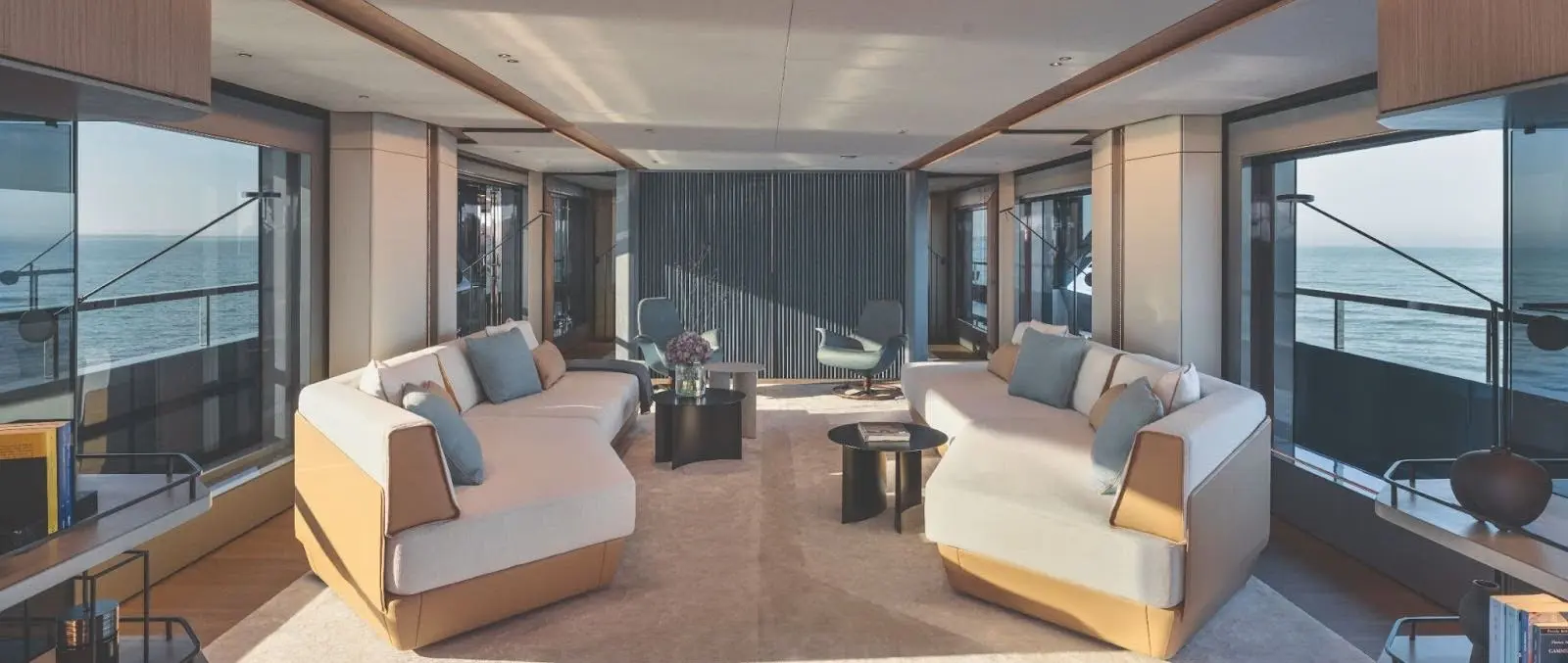
© Azimut Yachts official original marketing email 1674, 8 August 2025. Distinct newsletter section verified visually and in HTML DOM; source original SHA and URL in media audit. Subject: Azimut Grande Trideck m2atelier redesigned interior salon, Augu
Azimut revised its 38.22m Grande Trideck with a new m2atelier interior in 2025, while retaining Alberto Mancini exterior design. A source-dated examination with original press photography.
Azimut's Grande Trideck entered a new design chapter in 2025 when the Italian builder introduced a substantially reinterpreted interior by Milan-based m2atelier. The development did not create a different vessel called Grande 30M or announce an additional unrecorded hull: it refreshed the living experience of the established 38.22-metre Grande Trideck model. An original Azimut newsletter received in August 2025 accompanies the builder's 28 July announcement, with manufacturer-hosted photographs showing the new approach. The story is noteworthy because it illustrates a deliberate change in superyacht design priorities. Rather than simply adding decorative richness to a flagship, Azimut and m2atelier concentrated on spatial flow, carefully chosen materials and a less formal way of using life at sea.
The official Azimut model range lists the Grande Trideck at 38.22 metres overall, with a maximum beam of 7.98 metres and a five- or six-cabin configuration depending on arrangement. That places the vessel firmly within the superyacht sector. It is important not to confuse the Trideck with the separate Grande 30M, a 28.69-metre model in the same family. They have different dimensions, product identities and public development timelines. The August 2025 original email is explicitly titled Discover the new Grande Trideck and describes a redesigned interior. Any connected yacht database or article should therefore refer to the Trideck model, not treat the mailing as a 30M launch notice. Similarly, a model-level design announcement does not identify a specific owner or individual hull for which a new private fleet record should automatically be created.
Azimut credited Alberto Mancini with the Grande Trideck's existing exterior language when presenting the new edition. The model's sculptural outward identity remained an important element of continuity as its interior was reinterpreted. That pairing explains a common tension in the evolution of a successful yacht range: an exterior can establish a recognisable market identity while interior expectations shift considerably between generations of owners. The decision to retain the exterior authorship while changing the onboard design vocabulary gives the model a revised personality without disguising the established platform. It also supports accurate recordkeeping. A 2025 interior redesign does not make the original exterior designer disappear from the yacht's design history, and there is no basis in the source for attributing a wholly new external hull design to m2atelier.
The Milan-based studio m2atelier is led by Marijana Radovic and Marco Bonelli. Azimut presented their work as the beginning of a wider interior direction for the Grande family rather than a one-off decorative exercise. The studio describes an environment composed through straightforward geometry, tactile materials and the disciplined use of light. In effect, the apparent simplicity of a space becomes the result of many precise decisions rather than the absence of detail. Horizontal and vertical lines organise views, while occasional diagonals give transitions a softer character. That design vocabulary is relevant to superyacht buyers because it seeks to make complex accommodation more intuitive. It positions the interior as a setting for daily life, not only for formal entertaining or a carefully staged marina photograph.
Azimut called the new philosophy Barefoot Luxury, an attempt to connect high-end craftsmanship with a more spontaneous atmosphere aboard. The phrase is marketing language, but it points to a specific departure from a traditionally ceremonial interpretation of yacht interiors. Softer visual transitions, comparatively limited material palettes and adaptable living areas invite use without requiring guests to behave as though every room were a formal salon. The technical difficulty of such restraint should not be underestimated. Where an elaborate decorative scheme can accommodate many competing elements, a quiet interior depends heavily on precise alignment, convincing proportions and the finishing quality of the surfaces that remain visible. The builder's original release makes craftsmanship a central part of the result, not merely a promotional afterthought.
One prominent detail described in Azimut's official announcement is the Unveiling Wall, a custom feature that uses vertical elements and a sliding mechanism to reveal a television. Its purpose is more complex than hiding a screen behind cabinetry. By integrating media technology into the architecture, the room can shift character without exposing equipment when it is not in use. The feature also illustrates the designers' preference for components that have both practical and visual functions. A carefully executed reveal can create visual interest, but in daily operation the greater advantage is flexibility. It allows the salon to serve different activities while maintaining a composed appearance. Azimut indicated that related feature-wall ideas would form part of its wider design collaboration with m2atelier.
The official release gives particular attention to layered perspectives across the yacht, describing views that connect internal spaces and, where openings allow, the sea beyond. The effect is not merely to make a room look larger in a photograph. Sightlines influence how occupants understand adjacent spaces, navigate through accommodation and experience privacy. The Grande Trideck's redesign aims for a feeling of visual openness while still maintaining distinct areas for different activities. In this approach, glass, partitions and carefully placed furnishings become elements of architectural planning. A bright room need not sacrifice intimacy, just as a private space need not feel enclosed. Those are design intentions described by the builder; they should not be confused with a claim that every production yacht will have an identical interior arrangement.
Marijana Radovic and Marco Bonelli placed the behaviour of light at the heart of their interior concept. In practice, reflected and filtered light can determine how the same material looks at different times of day, making the selection of surfaces inseparable from the planning of windows and partitions. Natural illumination gives materials depth, while artificial lighting must remain effective for evening use without flattening the yacht's atmosphere. The builder's emphasis on lighting is significant because a yacht is a moving environment: orientations, reflections and the view beyond the glass constantly change. An interior designed to respond to those conditions can feel more coherent underway than one conceived solely for fixed viewing angles. The public release describes that ambition but does not supply a technical lighting schedule or specific control-system products.
The revised owner's accommodation uses transparent and partially open visual relationships to draw daylight deeper into the layout. Azimut described the suite as a sequence of spaces in which partitions and glass extend sightlines while preserving the sense of a private domain. For a superyacht of this size, the balance is especially important: owners expect meaningful personal space, yet an entirely segmented plan can produce rooms that feel smaller than the overall yacht suggests. The design intent is to keep the accommodation connected without turning it into one undifferentiated area. Any discussion of this suite must remain at the level supported by the official design announcement. The public material does not justify statements about the possessions, identity or personal habits of a specific customer.
Azimut also highlighted changes to the foredeck, including a recessed pool, integrated chaise longue and adaptable sunpad backrest. On a large multideck motor yacht, the foredeck need not be treated only as a place to move around the vessel or reach equipment. When carefully planned, it can become a distinct leisure setting that offers a different outlook and atmosphere from the main aft decks. The feature is an example of the range's broader effort to create varied options for outdoor living. It is not evidence that the yacht has unlimited deck space; every feature still competes with circulation, safety and servicing requirements. The source confirms the design arrangement, not an individual yacht's use schedule or the precise water volume of the pool.
The sky lounge illustrates another principle running through the redesign: a single space can accommodate different kinds of gathering without feeling permanently organised around one activity. Azimut describes a configuration that can shift between an informal lounge, media use and indoor dining, supported by an adaptable hi-lo table. This reflects a practical insight into life aboard. Even on a large yacht, the most valued room is not always the one with the most formal furniture; it may be the room that comfortably absorbs an unplanned change in the day. Transformable spaces carry technical demands in their own right, from ergonomic reach to furniture stability and safe operation, but the announcement does not disclose the hardware specification. The verified story is the design purpose and the broad arrangement.
Azimut's presentation identifies custom-designed furniture made by Italian brand Giorgetti to m2atelier specifications. The collaboration belongs to the builder's stated Integral Design approach, in which fitted architecture and loose furnishings are considered together. This matters because furniture can either reinforce or disrupt the geometry of a space. On a yacht, proportions are particularly sensitive: walkways, viewpoints, comfortable seating positions and practical movement between decks all have to work within the same envelope. Designing the furnishings alongside the architecture creates an opportunity to resolve those relationships early. The source indicates a bespoke design and manufacturing relationship; it does not establish a price for each piece or confirm that every future production unit will be outfitted with precisely the same selections.
Azimut's July 2025 announcement said the Grande Trideck marked the beginning of a new collaboration whose influence would extend to further Grande models due at the Cannes Yachting Festival that September. That places the Trideck within a broader product strategy rather than treating the redesign as an isolated showroom event. For owners comparing models, this context can help explain why a familiar exterior range may develop a distinctly different interior character over time. It also affects the interpretation of official photographs: an image from the redesigned 2025 Trideck should not be presented as proof of an earlier interior edition. The model's identity remains stable while the design generation changes, and those facts can coexist in a well-maintained production-yacht database.
The original source email belongs to August 2025 and the official builder announcement was dated 28 July 2025. They are useful historical primary sources, but neither is evidence that the design was first announced in November 2026. The correct editorial treatment is therefore a source-dated examination of how the Grande Trideck evolved, rather than a headline implying a fresh launch. Likewise, the three photographs recovered from the company's original marketing distribution are associated with this 2025 Trideck story and not with another Azimut model. They were checked and recorded separately from email-tracking graphics. Proper provenance preserves both the relevance of the images and the distinction between official public design information and unverified assertions about the particular yacht photographed.
The Grande Trideck's 2025 interior update tells a wider story about the contemporary superyacht market. Designers are working to combine the precision and cost of exceptional craftsmanship with spaces that feel easy to inhabit, flexible enough for family use and visually responsive to the sea outside. Azimut retained its established 38.22-metre flagship identity and Mancini exterior while giving m2atelier a different interior brief. The most persuasive elements of the result are not simply luxury-brand names or decorative flourishes, but the way the Unveiling Wall, variable lighting, open sightlines, owner's suite, foredeck and adaptable sky lounge are presented as parts of one experience. For future reporting, the historical announcement, model dimensions and official press photographs provide a defined foundation against which actual later deliveries and owner-specific specifications can be checked.
Sources and provenance: Azimut's original 28 July 2025 Grande Trideck design announcement; original Azimut marketing newsletter of 8 August 2025, correspondence ID 1674, with three original official source images retained and individually checksum-verified in the Superyacht Guide Management System.
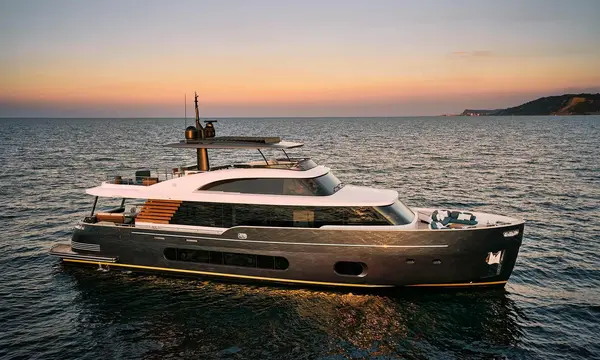
© Azimut Yachts — 2025 original Grande Trideck interior press image from email 1674
Explore
Go deeper into the yachts, companies, events and destinations directly connected to this article.
Continue reading
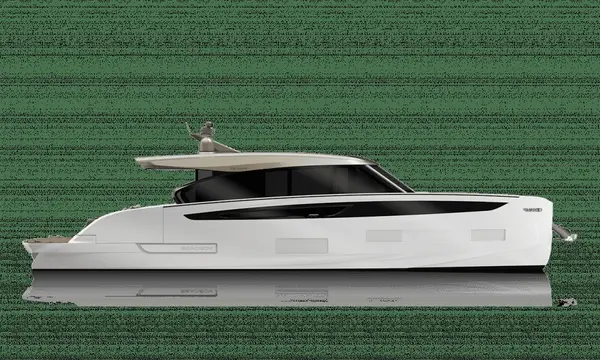
The Azimut Magellano 27M has won the 2026 Design Innovation Award in the superyachts over 24 metres category at the Genoa International Boat Show.
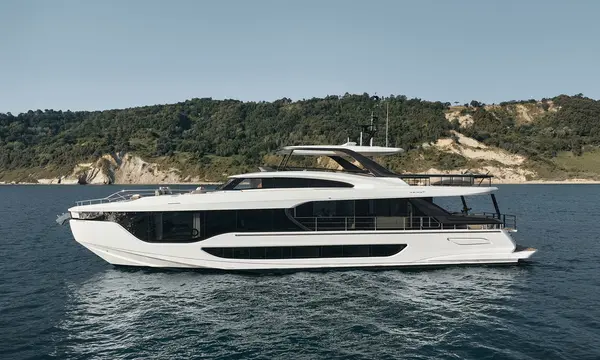
The 26.36-metre Azimut Grande 26M features in the builder’s 2026 Fort Lauderdale lineup, with five guest cabins and a multi-level outdoor layout.
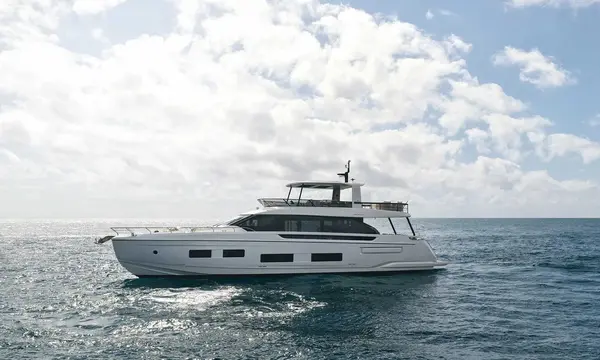
Azimut is displaying the 24.79-metre Fly 82 at the 2026 Fort Lauderdale show, with a Deck2Deck stern terrace and a four-cabin guest arrangement.
Azimut’s 25.22-metre Magellano 25M is in the yard’s Fort Lauderdale 2026 display, offering a crossover approach to efficient, comfortable passage-making.
Superyacht Guide
Continue into the wider Superyacht Guide.
Business opportunities · Superyacht Guide
Companies serving the superyacht market can discuss clearly identified advertising, sponsorship and business-profile opportunities. Commercial activity remains separate from independent editorial coverage.