Cantiere Rossini Reports 25% Female Workforce After Audit
By Stephen Yardley · Edited by Stephen Yardley
Cantiere Rossini renewed gender-equality certification in April 2026 and reported women in a quarter of its workforce and 40% of operational leadership.
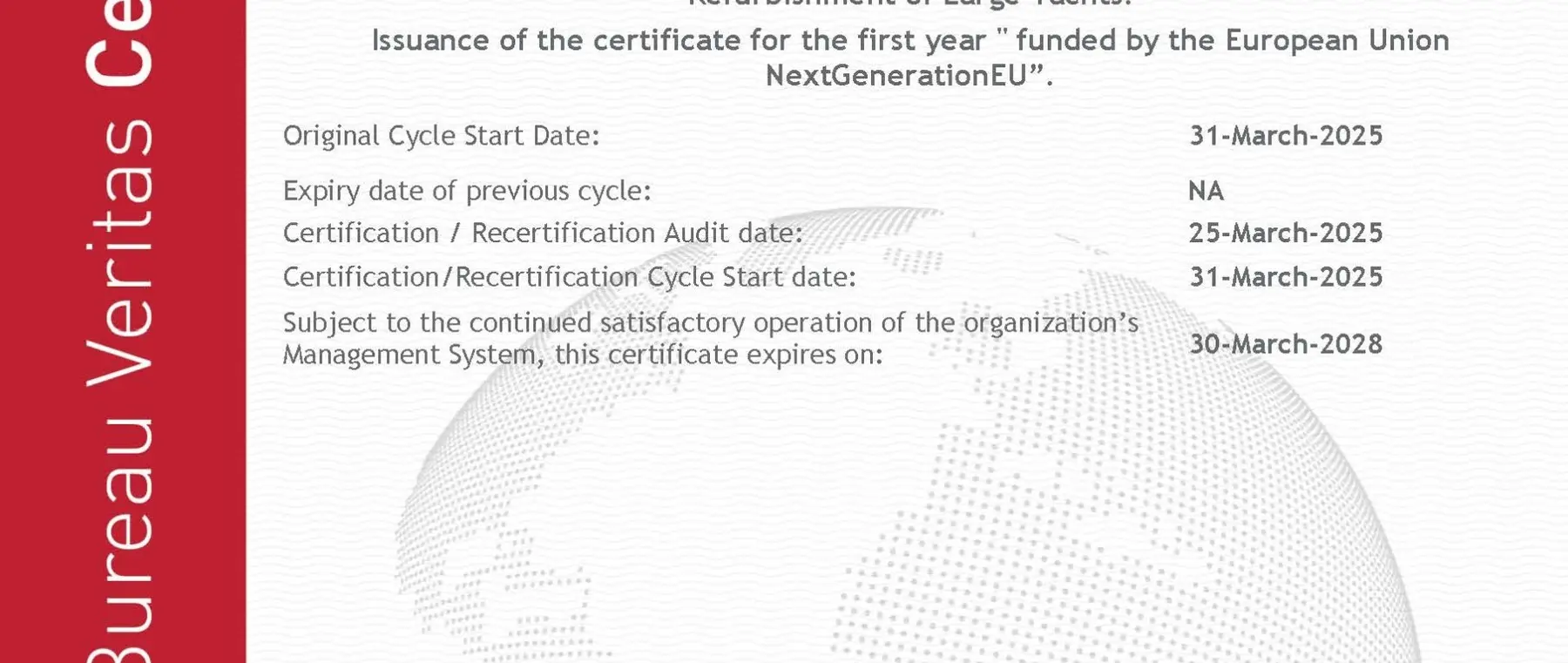
Cantiere Rossini, a superyacht refit yard in Pesaro on Italy's Adriatic coast, renewed its UNI/PdR 125:2022 gender-equality certification after an audit in March 2026. The company's announcement, published on 20 April, says the certificate covers the 2025–2028 period. The renewal provides a measurable workplace development to consider alongside the yard's more visible infrastructure and service investments.
The recognition relates to employment policies, monitoring and organisational practice rather than certification of a particular yacht or repair process. UNI/PdR 125:2022 establishes a framework for improving gender balance and reviewing the conditions in which people work. Cantiere Rossini says it has used the framework to formalise internal objectives, maintain feedback channels and introduce further employee training. The information comes from the company's own disclosure.
The yard reports that women represented 25 percent of its workforce as of December 2025. It compares that figure with a 10.2 percent sector reference average, making its reported proportion higher than the comparison used in its announcement. Those numbers are useful indicators of the business's composition, but the source does not publish its overall employee count or a breakdown by each technical trade.
Without headcounts, the percentages cannot reliably be converted into numbers of workers or individual job categories. A shipyard includes engineering, project coordination, fabrication, administration and many other functions, so workforce diversity can look different across departments. The reported figures should therefore be attributed to Cantiere Rossini rather than presented as the result of an independently surveyed national shipbuilding census.
Cantiere Rossini states that women hold 40 percent of its operational leadership positions. This suggests representation in day-to-day management that is stronger than the overall workforce percentage, although it does not identify the number or titles of those positions. The company's public statement is also explicit that its board of directors remains entirely male, identifying a difference between operational leadership and the highest governance level.
The contrast matters because one metric cannot capture an organisation's complete decision-making structure. A yard may have women managing important programmes while senior corporate appointments remain less balanced. Cantiere Rossini treats the renewed certificate as a basis for further work rather than claiming that every objective has been achieved. Any later improvement will require updated figures on appointments, progression and representation.
The yard reports no recorded discrimination or harassment complaints during 2025. It says employees have access to direct dialogue, internal surveys and a whistleblowing platform, and that its internal workplace-climate survey returned 93 percent positive responses. These numbers describe the company's records and survey results for the period reported, rather than a guarantee that no workplace problems exist.
Interpreting such evidence requires care because reporting systems only capture concerns that are actually raised. The company has not supplied detailed survey participation or independent complaint statistics in the April release. Even so, structured channels for feedback are relevant to how an organisation identifies weaknesses and follows up on employee concerns. Regular and confidential procedures matter as much as public statements of intent.
Cantiere Rossini says it has established a Gender Equality Steering Committee to review progress, collect feedback and guide future measures. The committee provides an identifiable mechanism for maintaining the goals associated with certification between audits. Its work is intended to help move equality from a policy document into the way recruitment, management and training take place within the organisation.
The effectiveness of such a group depends on whether employees can raise concerns and whether decisions lead to practical changes. The April announcement does not disclose its membership, meeting schedule or a separate published action plan. Those details would be helpful for evaluating outcomes over a longer period. The confirmed development is the company's establishment of the committee and its commitment to regular internal review.
The yard also outlined a forthcoming programme of internal sessions to cover gender equality and the sharing of expertise across departments. It said these sessions would be held during working hours, rather than requiring staff to take part outside their normal schedules. The approach places training within regular operations and makes the programme easier to accommodate for different teams.
Cross-department learning can be particularly relevant in a refit yard because the successful completion of a project depends on coordination among engineers, trades, suppliers and administrative staff. Better communication may support employee development, although the company has not published measures linking its proposed sessions to productivity or safety outcomes. They should be regarded as planned workplace initiatives, not completed improvements with quantified financial returns.
Cantiere Rossini operates in Pesaro, roughly fifty kilometres north of Ancona, serving yachts requiring repair, maintenance and refit work. The yard's trade involves a combination of technical skills and customer-facing project management, often performed against demanding vessel schedules. Companies in this segment compete for qualified workers who can integrate specialised tasks without delaying the owner's sailing programme.
Workplace development is relevant to that competition because retaining and developing capable employees supports continuity between projects. However, no claim that certification alone has increased turnover, recruitment or yacht capacity can be justified from the April statement. Those outcomes would require operational data. The report is best understood as a workforce milestone within the broader evolution of a specialist superyacht-service business.
The 2026 renewal gives the marine industry a documented example of a shipyard reporting workforce and management indicators under a recognised equality framework. Its 25 percent female workforce and 40 percent representation in operational leadership sit alongside the openly acknowledged all-male board. Together they provide a more informative picture than an award or certificate headline by itself.
The accompanying illustration is the certification document displayed with Cantiere Rossini's own announcement, not a photograph of a yacht or the shipyard workforce. The reported figures refer to December 2025 and the renewal was announced in April 2026; neither is presented as newly measured in October. The useful test of progress will be whether later audits and disclosures show sustained improvement in both workplace experience and access to responsibility.
Explore
Go deeper into the yachts, companies, events and destinations directly connected to this article.
Continue reading
Cantiere Rossini has appointed Gianluca Gabellini as Shipyard Director from 1 September 2026, while Alfonso Postorino moves into the new Shipyard Ambassador role.

Arcadia Yachts says it signed new orders at Cannes and registered commercial results at Monaco in 2026, while preparing the 38m A125 flagship.

METSTRADE confirms the 31 October free visitor-registration deadline ahead of its November programme for marine and superyacht professionals in Amsterdam.

Yachting Ventures confirms eight exhibitors for November's METSTRADE Superyacht Startups Area, spanning AI, safety, tracking, interiors and crew careers.
Superyacht Guide
Continue into the wider Superyacht Guide.
Business opportunities · Superyacht Guide
Companies serving the superyacht market can discuss clearly identified advertising, sponsorship and business-profile opportunities. Commercial activity remains separate from independent editorial coverage.