
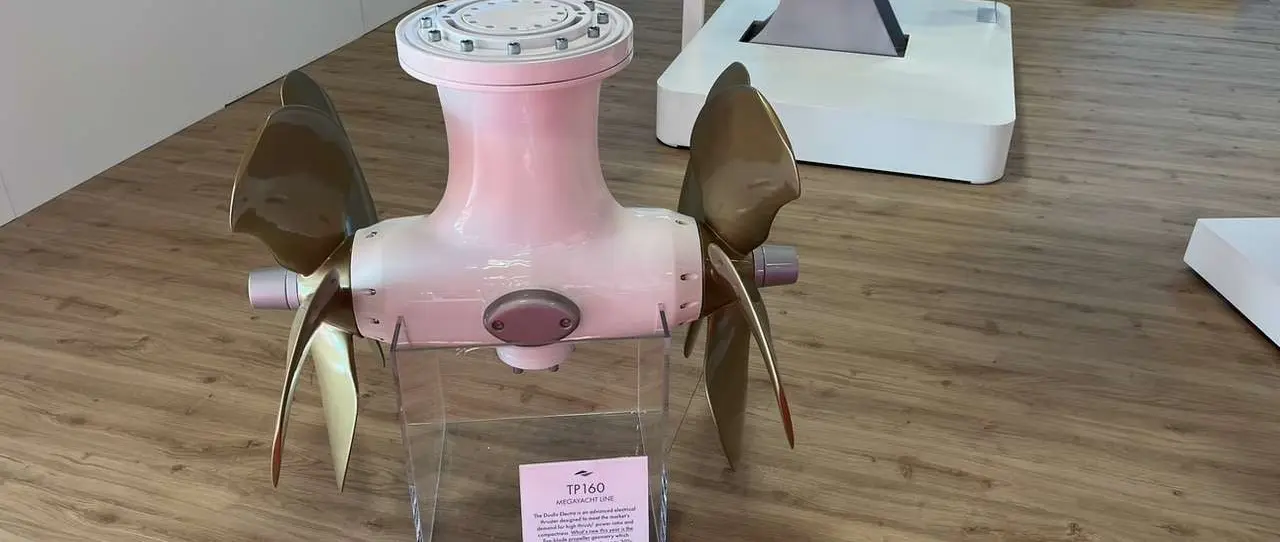
CMC Marine Details Capacitor Energy Recovery and New Thruster Engineering
By Stephen Yardley · Edited by Stephen Yardley
CMC Marine has provided new technical detail on the energy-management architecture behind its electric stabilisers and thrusters, explaining how capacitor storage can reduce abrupt demands on yacht generators. Vice presi
CMC Marine has provided new technical detail on the energy-management architecture behind its electric stabilisers and thrusters, explaining how capacitor storage can reduce abrupt demands on yacht generators. Vice president Pietro Cappiello discussed the technology during the 2026 Cannes Yachting Festival, linking engineering decisions to the wider shift towards more efficient onboard electrical systems.
The company has previously presented its Energy Recovery System, but the latest interview clarifies why peak-load control matters as builders consider smaller generators. Stabiliser fins can demand power rapidly during acceleration, placing short-duration stress on the electrical system despite moderate overall energy use.
CMC's approach positions an energy-storage stage between generating equipment and the fin actuators. When demand briefly exceeds a chosen limit, stored energy supplies part of the load, reducing the immediate burden placed on the generator.
A capacitor is not interchangeable with a large conventional battery. Its advantage in this application is the speed with which it can accept and return energy, making it useful for rapid cyclical movements. Project engineers still need to calculate operating limits, protection requirements and physical integration.
During fin deceleration an electric motor can act as a generator. Conventional electrical braking may dissipate this energy in resistors, whereas recovery equipment seeks to store some of it for a subsequent acceleration.
CMC compares the idea with kinetic-energy recovery in other industries, but performance cannot be inferred from the analogy alone. The actual benefit depends on fin movements, vessel behaviour, generator sizing and the proportion of recovered energy that can be used again.
The supplier also discussed the five-blade propeller geometry developed for its Dualis Electra thrusters. Reducing cavitation and uneven thrust can improve acoustic comfort, an important concern for large yachts when manoeuvring near guests or operating in confined anchorages.
CMC says it brings computational fluid dynamics, mechatronics and naval engineering together internally, with three-dimensional scanning used to inspect propeller geometry after manufacture. Such checks can identify departures from intended pitch or blade shape before the equipment is installed.
Stabiliser design must account for displacement, draft, hull shape, appendage spacing and expected operating profile. Fitting a standard product without studying the complete hull can compromise effectiveness or create unwanted interactions.
CMC's project approach involves simulations and examination of the individual yacht before the final equipment configuration is established. That work can be especially important during refits when structural alterations and available machinery space limit the options.
Optimising peak demand could allow electrical systems to operate more consistently, but the company acknowledges that long-term financial returns require assessment over real operating profiles. No universally applicable fuel-saving or payback figure follows from the announcement.
The wider significance is a shift from treating stabilisers and thrusters as isolated accessories towards evaluating them as part of a yacht's energy architecture. This technical explanation adds operational context to earlier CMC product announcements rather than repeating a launch.
Explore
Go deeper into the yachts, companies, events and destinations directly connected to this article.
Continue reading
Yacht Chef Salary 2026: Pay, Tips and Charter Earnings Yacht-chef pay depends on yacht size, private or charter use, professional background, qualifications, rotation and …
Superyacht Crew Tips: How Much Can Crew Earn on Charter? Charter-yacht crew often receive discretionary guest tips, but tips are not guaranteed salary and …
During a charter, the captain has to balance guest expectations with crew capability, rest requirements and a weather picture that can change by the …
Guests may experience the first day of a superyacht charter as a seamless transition from airport to anchorage. For the crew, it is a …
Superyacht Guide
Continue into the wider Superyacht Guide.
Business opportunities · Superyacht Guide
Companies serving the superyacht market can discuss clearly identified advertising, sponsorship and business-profile opportunities. Commercial activity remains separate from independent editorial coverage.