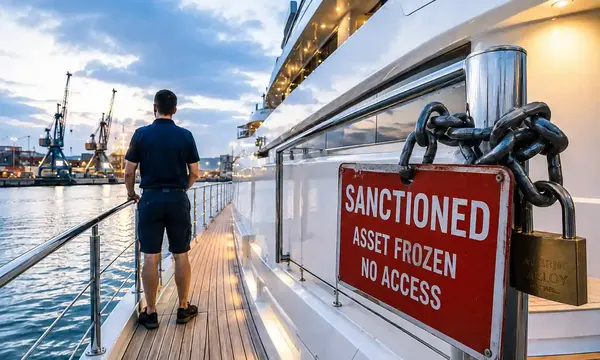
When Crew Are Caught in Sanctions: Life Aboard a Frozen Yacht
A sanctions freeze can immobilise a superyacht without making its crew sanctioned, leaving wages, contracts and daily operations caught between employment law and financial …
Image: Gard
Gard’s 2026 Crew Claims Report draws on about 3,000 P&I crew claims and finds elevated injury risk early in a crew member’s time on board.
Gard's 2026 Crew Claims Report draws on around 3,000 P&I crew claims from 2025 and an in-depth review of roughly 400 injury cases. The insurer found that the first months on board carry elevated injury risk and that many accidents happen during routine work rather than during unusual emergency operations.
The dataset covers seafarers across Gard's insured fleet and should not be described as a superyacht-only study. Even so, the patterns are relevant to yacht captains, managers and safety officers because large yachts share many of the same onboarding, deck-work, machinery and human-factor risks found elsewhere at sea.
Gard identifies the first three months of a crew member's time on board as an elevated-risk period, with the first month particularly important. New joiners may be experienced seafarers but still unfamiliar with a specific vessel's layout, procedures, equipment and working culture.
On a superyacht, that transition can be intensified by guest operations and short turnaround periods. A crew member may need to learn tender procedures, mooring arrangements, watertight boundaries, machinery access, safety equipment and service routines quickly while the yacht continues operating.
One of Gard's central findings is that serious attention should not be reserved only for obviously hazardous jobs. Repetitive and familiar tasks can produce injuries because crews perform them frequently, increasing exposure even when the perceived risk of each individual task seems low.
This matters for yacht departments where line handling, lifting, cleaning, maintenance, tender work and movement on deck happen every day. Familiarity can improve skill, but it can also reduce the mental pause that often accompanies a job everyone recognises as dangerous.
Gard notes that experienced crew members also appear in injury cases, which challenges the assumption that competence alone is enough to prevent accidents. Fatigue, distraction, time pressure, changing conditions and communication failures can affect people who understand the task perfectly well.
The report also identifies a concentration of injuries between 08:00 and 10:00, a period when many vessels are moving into full daytime activity. For yacht operations, that finding supports careful planning around morning maintenance, guest preparation, deck work and handovers rather than treating the start of the day as inherently low risk.
The practical lesson is to treat onboarding as an operational safety process, not simply an administrative induction. Vessel-specific familiarisation, supervised first tasks and clear limits on what a new joiner can do independently may reduce risk during the period Gard identifies as most vulnerable.
The report also supports continued use of toolbox talks and dynamic risk assessment for everyday jobs. A task does not become safe merely because it is performed often, and the strongest safety culture is one that keeps routine work visible before familiarity turns into complacency.
Continue reading
A sanctions freeze can immobilise a superyacht without making its crew sanctioned, leaving wages, contracts and daily operations caught between employment law and financial …
Yacht Chef Salary 2026: Pay, Tips and Charter Earnings Yacht-chef pay depends on yacht size, private or charter use, professional background, qualifications, rotation and …
Superyacht Customs and Immigration: How Border Clearance Works International yacht clearance normally combines vessel declarations, crew and passenger information, customs formalities, immigration and health …

Crew fatigue on superyachts affects safety, judgement, service, maintenance, crew welfare and compliance, making rest management essential on board.
Superyacht Guide
Continue into the wider Superyacht Guide.