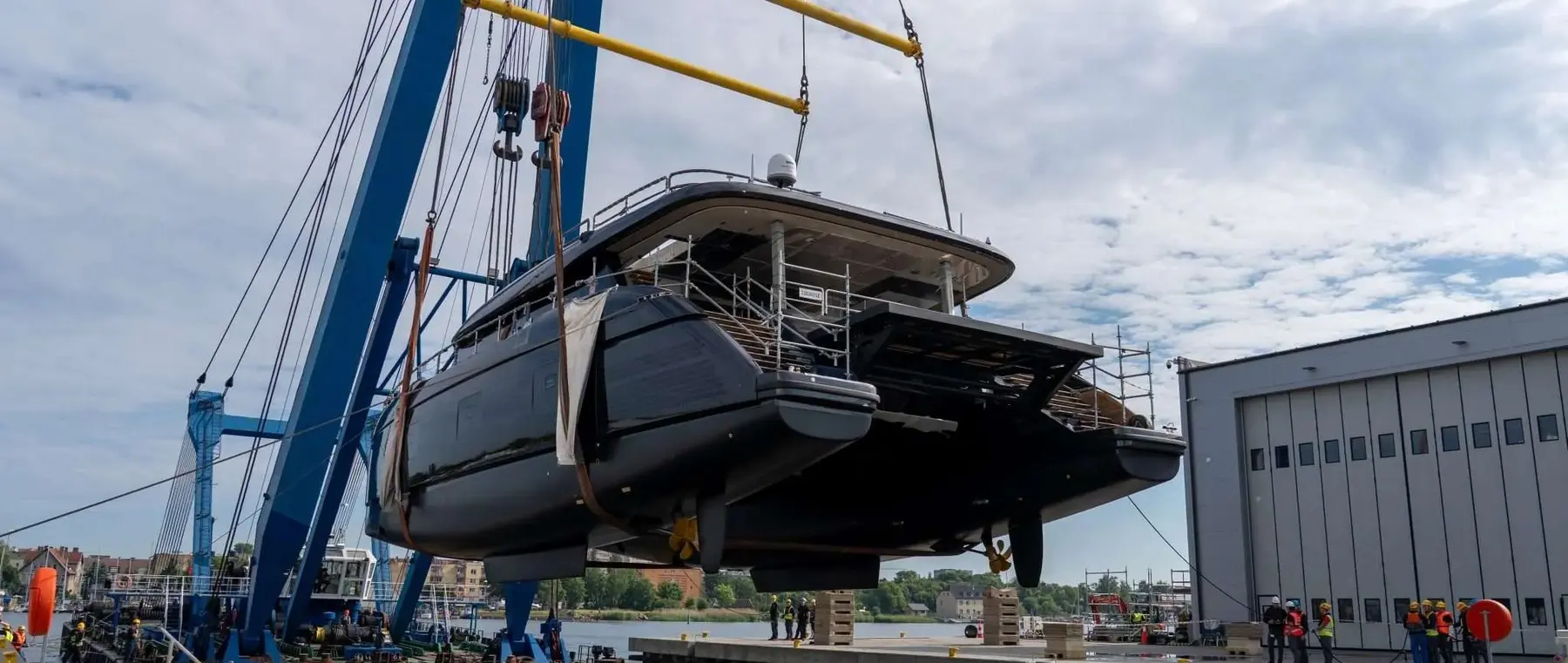
Source: https://sunreef-yachts.com/en/news/the-first-sunreef-100-eco-launched/ | Copyright Sunreef Yachts | official PR editorial photograph | SHA256 0dd5bf8f93ec32b4d106fada7d23274c2d66d0acc1032abbf2b49c71cdb7070d
The first Sunreef 100 Eco launched in June 2026 with twin 360kW electric motors, 770kWh batteries and solar panels integrated into the sailing catamaran.
Sunreef Yachts' June 2026 announcement of the first Sunreef 100 Eco introduced a large sailing catamaran built around electric propulsion, substantial battery storage and solar panels integrated into the yacht itself. The original launch marked a physical construction milestone in Poland; a later Monaco Yacht Show presentation established the finished yacht's public debut. Those are different events in the history of the same project, and neither should be mistaken for a fresh launch in November. The technical questions raised by the yacht are more enduring than the immediate news of her first appearance.
The builder's 26 June 2026 release announced that the first Sunreef 100 Eco had been launched and would proceed through final outfitting and sea trials before its planned world premiere in Monaco. At that date, the announcement did not provide a verified individual owner name or the yacht's private operating schedule. It did confirm a sailing catamaran whose energy and propulsion systems were central to the design, rather than a conventional vessel retrofitted with a small solar array.
This distinction is important for yacht databases. A model name can refer to more than one hull or even to a family of future projects. The first launched Sunreef 100 Eco is a specific physical vessel, but later references to her public name and length need to be reconciled against the builder's own statements and reputable specialist reporting. The original launch email should be retained as part of that identity history, not used as an excuse to create an additional yacht whenever the name changes.
The Sunreef 100 Eco occupies the upper end of the builder's sailing-catamaran portfolio, with a broad central deck supported by two hulls. That architecture creates generous internal volume relative to overall length and provides room for living spaces separated from the machinery and accommodation within the hulls. The platform also offers a distinct relationship with the sea, particularly through its aft leisure areas and wide exterior decks.
A catamaran this size is not simply an enlarged small sailing boat. Structural loads across the bridge deck, the movement of the two hulls in waves, the rig forces and the weight of major batteries all require careful engineering. Maintaining the right weight distribution is especially important when a design integrates substantial new systems alongside large guest spaces and an extensive sailing rig.
Sunreef's original release lists twin electric propulsion units rated at 360 kW each. That gives 720 kW of total installed electric motor capacity, although the power available in a particular operating mode depends on the yacht's management system and electrical supply. The motors can support propulsion when the sails are not providing enough drive, including manoeuvring and passage-making in unsuitable wind conditions.
An electric motor has advantages in controllability and reduced direct local emissions compared with an operating diesel engine. Yet the overall system still needs an energy source. The presence of electric drive should not be confused with an unlimited ability to motor without charging. The real measure of the installation is how electrical demand is balanced across propulsion, domestic loads and the yacht's available generation and storage options.
The manufacturer specifies a 770 kWh battery installation. Stored electrical energy can help the yacht run propulsion and onboard services without continuously operating conventional generators, depending on the load and operating conditions. This can be valuable during quiet anchoring periods and when guests prefer a more tranquil atmosphere. It may also give the crew more flexibility in how electrical generation is scheduled.
A single capacity figure does not reveal how long the system will power a particular voyage. At high power demand, energy is consumed faster; at a lower demand, it may support a longer period of operation. Battery-management systems also protect reserves and operate within limits that depend on temperature, charge state and equipment configuration. The builder's capacity should therefore be reported precisely without inventing a universal electric range.
Sunreef's integrated solar system forms part of the exterior rather than being installed solely on a rack over the deck. The builder says panels are incorporated into the hulls, superstructure and bimini, allowing a larger portion of the available surface to contribute to generation. This is an architectural decision as much as an electrical one, because the panels need suitable shape, exposure, cooling, wiring and protection.
The later October 2026 Monaco release provides more precise figures: more than 250 square metres of integrated Solar Skin, with a potential installed peak output around 49 kWp. Peak electrical rating is not a promise of sustained production at sea. Sun angle, shadows, weather, latitude and temperature all affect what the system actually generates. A credible account distinguishes capacity from verified daily energy yield.
The defining characteristic of an electric sailing yacht is that propulsion can come from wind rather than solely from onboard electrical storage. Under suitable conditions, the sails provide the main driving force while the electrical system supplies domestic loads and other functions. This can make the energy challenge fundamentally different from that of a large all-electric motor yacht operating continuously under power.
The actual benefit depends on passage planning, route, rig handling and the weather. A prolonged calm may require electrical or other propulsion, while strong adverse conditions can change the safest operating choices. Good seamanship remains central. The technology should be seen as giving the crew more ways to manage a voyage, not replacing the need to understand wind, sea state and the yacht's operating limits.
Sunreef's official material places substantial emphasis on guest spaces. A large main salon benefits from panoramic glazing, while the broad layout supports shared dining and conversation without the feeling of a narrow passageway. The October presentation describes a ten-person dining table, coffee bar and retractable projector screen, demonstrating how technical sophistication can be integrated into a guest-oriented living environment.
The builder also describes an owner's suite with private access to a foredeck area, as well as additional cabins distributed through the hulls. Such arrangements require careful separation between guest circulation, service movement and the structural spaces needed for the sailing and electrical systems. The result is an example of the common challenge in superyacht design: the engineering needs to be accessible and robust without dominating the experience of the people aboard.
The first Sunreef 100 Eco incorporates the builder's characteristic Ocean Lounge concept, connecting the yacht's aft accommodation to the water. Fold-down areas and storage for toys or smaller craft can make the stern a focal point for activity when the yacht is stationary and conditions permit. Such facilities are a valuable part of the guest experience but also create practical demands around waterproofing, structure and safe access.
A watersports area on a sailing yacht must coexist with rigging, tender handling and the movement of the crew. Equipment needs to be secured for passages and maintained in a marine environment. The presence of a garage or storage zone in a builder's specification does not demonstrate that every advertised toy is aboard at all times, nor establish the equipment available to charter guests on a particular week.
The chronological record is especially important. In June the first yacht entered the water and moved toward further outfitting. At the September 2026 Monaco Yacht Show, the finished Sunreef 100 Eco received a world-premiere presentation; the builder's October retrospective describes her as recently delivered to the returning owner. Those later statements should be used to update the earlier launch-stage story rather than preserving the idea that the yacht was still awaiting completion months later.
Specialist reporting identifies the vessel with the Ipharra name, while an existing internal draft fleet record contains the name Ipharra II. Those identities warrant careful hull-level confirmation before a public record is renamed. The official June release itself does not use the name, so the safest formulation in this article is the builder's precise construction identity: first Sunreef 100 Eco, launched in June 2026.
The builder presents the yacht as an example of more responsible luxury cruising. Electric propulsion, substantial storage and solar panels can all contribute to operating flexibility and reducing reliance on conventional onboard generation in some conditions. However, a vessel's full environmental impact also involves materials, construction, replacement parts, shore charging, maintenance and the way it is actually used.
It would be inaccurate to announce zero lifetime emissions or unlimited autonomy on the evidence available. The engineering story is more interesting when stated with precision: Sunreef has built a large sailing catamaran with 720 kW of installed electric motor power, 770 kWh of storage and extensive integrated solar generation. Those are verifiable features; the ultimate environmental result depends on actual operations and energy sources.
The hero photograph belongs to Sunreef's official June launch coverage. It shows the yacht at a documented construction milestone rather than during an invented private passage or a later Monaco appearance. The original image was retrieved from the builder's media page, and its URL and checksum recorded before being added to the website library. It is credited to Sunreef Yachts and not treated as stock imagery.
The original Sunreef June newsletter remains in the company CRM, along with later messages referring to the Monaco debut. Linking those records preserves the change in project status and prevents an editor from treating the same yacht as two separate launches. A careful editorial account can remain readable while still making these provenance distinctions visible.
The first Sunreef 100 Eco demonstrates how a builder can integrate energy management into the initial architecture of a large sailing multihull. It shows a mature attempt to combine practical sailing, electric motors, substantial battery capacity, wide outdoor spaces and a luxurious interior. The significance is not that every figure proves unprecedented performance, but that the technical and residential elements have been brought together in one launched yacht.
The June 2026 launch and later Monaco presentation form a single progression. As more verified information becomes available, the vessel's public name, hull references and actual cruising history can be documented without altering those established milestones. For Superyacht Guide the responsible result is a source-led technical article that acknowledges the promise of the design, records what has actually been built and resists exaggeration.
Original sources and editorial note: Original Sunreef Yachts June 2026 newsletter SYMS email 1359; Sunreef 100 Eco launch, 26 June 2026 and official Monaco Yacht Show 2026 retrospective. Original hero photo © Sunreef Yachts, from the shipyard's June launch release. No unverified owner identity or current position stated.
Explore
Go deeper into the yachts, companies, events and destinations directly connected to this article.
Continue reading
The fully electric Sunreef 100 Eco is set for its Monaco world premiere with twin 360kW electric engines, a 770kWh battery bank and integrated …
Sunreef Yachts has launched the first ULTIMA 88, bringing the largest completed model in its performance-focused ULTIMA range into the water. The 26-knot catamaran …
Paramount Yachts has announced its first US sale of a Sunreef ULTIMA 88 to a Florida family. The in-build 26.8-metre power catamaran is scheduled …

Sunreef Yachts has announced an ULTIMA 88 order for Lionel Messi, with the yacht under construction in the UAE and intended for the MIM …
Superyacht Guide
Continue into the wider Superyacht Guide.
Business opportunities · Superyacht Guide
Companies serving the superyacht market can discuss clearly identified advertising, sponsorship and business-profile opportunities. Commercial activity remains separate from independent editorial coverage.