
Foglizzo Brings Recovered Leather Fibre to Superyacht Design
By Stephen Yardley · Edited by Stephen Yardley
Foglizzo's post-Monaco Yacht Show update highlights live atelier demonstrations and its Raether recovered-leather-fibre material for luxury marine interiors.
Italian specialist Foglizzo has reported on its participation in the 2026 Monaco Yacht Show, using the 23–26 September exhibition to demonstrate bespoke leather applications and present a renewed stand designed around the role of materials in luxury yacht interiors. The company's 2 October update highlights live work by its atelier and particular attention to Raether, an approach using recovered leather fibres.
The announcement is relevant to the superyacht sector because upholstery and decorative surfaces must meet the aesthetic expectations of owners while surviving the conditions of a moving, humid and heavily serviced vessel. Foglizzo's report describes a completed presentation at Monaco, not a newly contracted yacht project or a claim that any particular vessel has now installed its materials.
Foglizzo says its 2026 exhibition space was substantially renewed to help designers and shipyard teams consider leather as a project material rather than merely a choice of colour. The stand offered an opportunity to view samples, discuss potential uses and see examples of the processes behind the finished surfaces.
An exhibition can introduce a material concept, but a superyacht project still needs detailed specifications, drawings and samples approved for the intended application. A panel lining installed on a curved bulkhead faces different engineering constraints from upholstery on a removable armchair, and the same finish may not be appropriate in both locations.
Members of Atelier Foglizzo showed visitors selected leather treatments and production techniques during the four-day event. The supplier describes this as a way to connect the finished surface with the specialist knowledge involved in creating it, including choices about texture and hand-finishing.
Such demonstrations help explain why some yacht interiors take significant time to develop and install. Bespoke work relies on consistency across batches, coordination with the fit-out contractor and the ability to repair or replace individual elements in the future, rather than simply ordering a decorative material by the square metre.
Foglizzo draws attention to Raether, a material exploring the recovery and reuse of leather fibres. The company presents the product as part of a wider effort to examine more responsible material practices for luxury interiors, alongside ongoing research and manufacturing development.
Recovery of a material component does not itself establish the full environmental impact of a finished product. Designers evaluating recycled-content materials should seek transparent information about sourcing, coatings, backing substrates, expected lifetime and eventual repair or disposal, together with the fire and smoke performance needed for the proposed installation.
The manufacturer says it took part in Blue Wake for a second consecutive year during Monaco Yacht Show 2026. That programme is intended to bring attention to environmental improvements and scrutiny within superyacht products and services, although the company announcement does not specify a new certification awarded to Raether itself.
An owner or technical manager should distinguish participation in an industry initiative from verified environmental performance of a particular material. The most useful supplier discussion covers measurable attributes, relevant testing and the practical implications for installation and later maintenance, not unsupported claims that a decorative choice makes a yacht environmentally neutral.
Foglizzo also says it contributed to the Water Revolution Foundation stand during the show. That involvement places the company's material work alongside other industry efforts to discuss environmental considerations during the design and operation of large yachts.
Yacht interiors involve many products with different supply chains, so no single supplier can establish the overall impact of a refit. Choosing longer-lasting finishes, reducing unnecessary replacement and maintaining usable documentation can support a more disciplined purchasing process, provided those claims can be backed by project-specific evidence.
Leather may appear on seating, headboards, decorative panels and other elements of a large yacht. Locations differ in their exposure to humidity, cleaning products, sunlight and repeated handling, while commercial-vessel installations can involve additional statutory and class considerations.
Specifications therefore need to address surface durability, adhesion, treatment and relevant fire performance rather than appearance alone. The installer should also assess how the finish can be inspected or repaired without dismantling major structural panels, because access for maintenance has an operational cost after the yacht is delivered. In the design office, product-sample approval should be linked to a controlled reference number and the particular treatment and colour approved by the owner. That makes it easier to trace the material selected during construction and establish whether replacement stock is still obtainable after the yacht has entered service. The process is especially important for bespoke finishes that cannot be substituted without a visible difference.
According to the manufacturer, visitors included clients, architects, designers, yards and other yachting professionals. Their requirements can differ sharply: an owner may focus on visual character, while a shipyard fit-out manager needs accurate lead times, installation instructions and a predictable approval process.
Structured coordination helps prevent late changes to materials that conflict with the programme or with adjacent joinery and electrical systems. For a complex newbuild or refit, design decisions should be recorded and verified against the contract specification, so specialist craftsmanship is integrated with the yacht's broader construction and quality-assurance procedures.
Foglizzo's October report closes a period of face-to-face discussions rather than announcing a new vessel or a list of confirmed orders. The company has not disclosed a contract value or delivered-project schedule arising from the show, and neither should be inferred from its participation or the presence of visitors.
The notable development is the supplier's emphasis on live atelier work, a revised presentation of leather as an architectural material and exploration of recovered fibres through Raether. Future installations or technical assessments should be covered individually when the company and the relevant shipyard release verified information.
Explore
Go deeper into the yachts, companies, events and destinations directly connected to this article.
Continue reading

Frigomar has introduced its CU210VFDT chiller with 210,000 BTU/h capacity, a titanium seawater exchanger and the same compact dimensions as its 180,000 BTU unit.

IDEA Data Solutions details release 2026.4.1 for yacht operations, including limited CLIVE AI testing and improvements to purchasing, maintenance and fleet views.

Videoworks explains AVIT Panel, an overlay system that connects existing onboard digital equipment to configurable views for captains and technical teams.
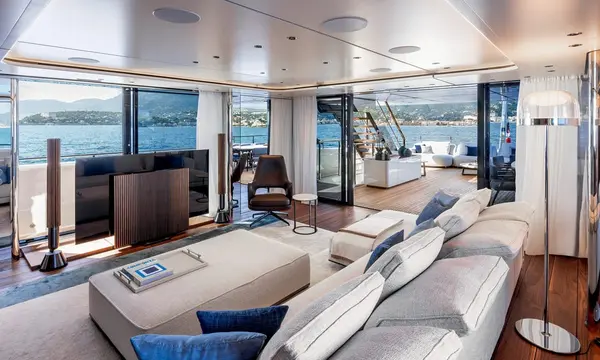
Videoworks explains its bespoke Bang & Olufsen systems on two Custom Line superyachts, naming the hardware used and the integration work carried out.
Superyacht Guide
Continue into the wider Superyacht Guide.
Business opportunities · Superyacht Guide
Companies serving the superyacht market can discuss clearly identified advertising, sponsorship and business-profile opportunities. Commercial activity remains separate from independent editorial coverage.