Gianetti Delivers 38m ONeiro I After Extended Build
By Stephen Yardley · Edited by Stephen Yardley
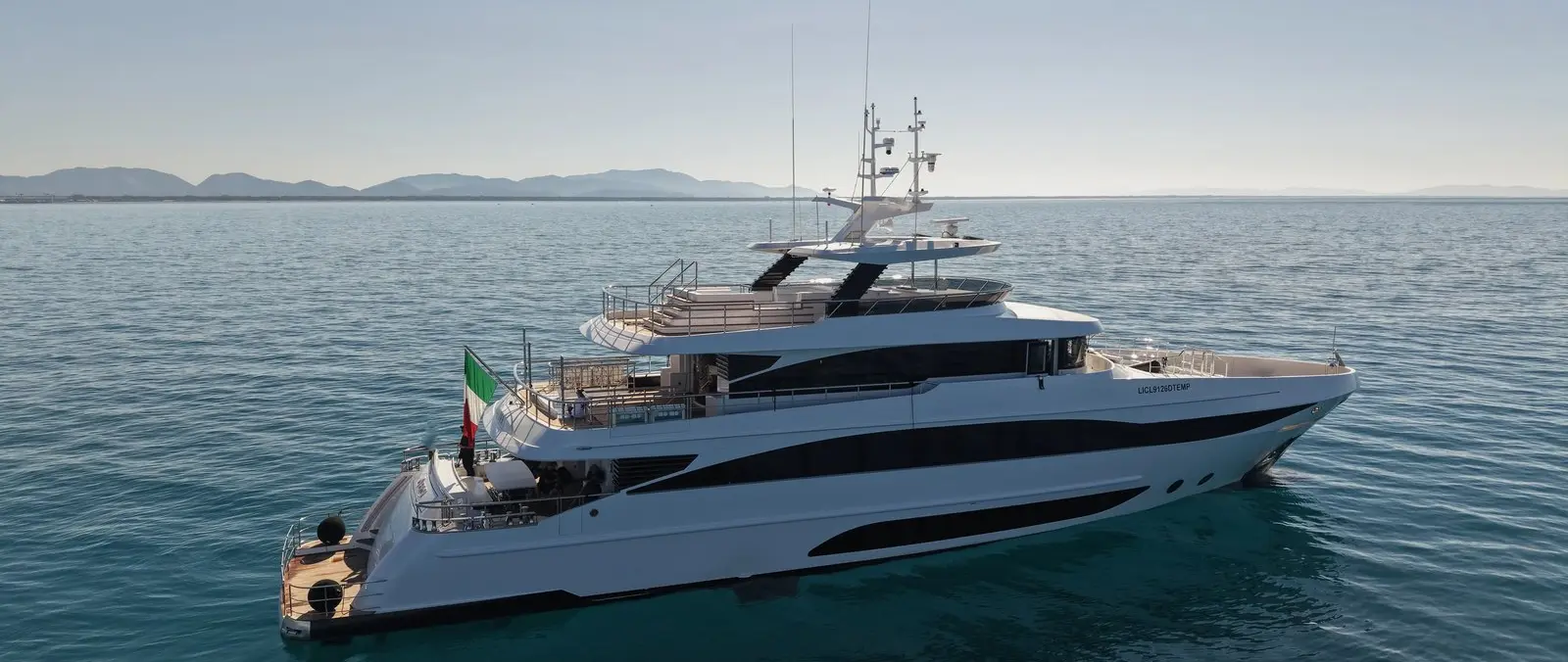
Gianetti Custom Yachts has delivered ONeiro I, a 38.35-metre aluminium superyacht. The yard details her Caterpillar propulsion, sun-deck pool and emerging sister build, Project 402.
Italian shipbuilder Gianetti Custom Yachts has completed and delivered the 38.35-metre aluminium motor yacht ONeiro I, a milestone that brings the Viareggio yard back into the spotlight for fully bespoke superyacht construction. The delivery was described by yard principal Fabrizio Gianetti in an interview published on 5 November 2026. Unlike a concept announcement or a proposed production range, this concerns a named vessel that has reached handover after an unusually extended construction history. The official shipyard specification still identifies the design as Project 401, providing the technical reference against which newer delivery reports can be assessed.
The distinction between a completed yacht and a planned design matters because the yard has also begun promoting an unfinished sister project. Gianetti's own project page had continued to carry an earlier summer 2026 delivery forecast, while the subsequent interview describes the handover as having occurred in recent days. That is a normal timing discrepancy between a static project brochure and a later interview, rather than evidence of two separate yachts. The specific completion date has not been independently supplied in a signed delivery notice, so the most defensible description is that delivery was reported in early November.
Founded in 1978, the family-run Gianetti operation has a longer history than the present wave of Italian custom-yacht brands. Fabrizio Gianetti described a progression from relatively small craft through larger builds before the financial disruption of 2008 and 2009 changed the shipyard's commercial environment. He recalled delivery of a 32-metre steel-and-aluminium charter-compliant yacht in 2010, an important experience for the more demanding engineering and certification work later associated with Project 401. This background helps explain why a 38-metre delivery represents a return to an established capability rather than entry into an unfamiliar business.
The company has been explicit about its preferred production model. Gianetti told SuperYacht24 that it intends to focus on individual metal yachts tailored for owners, without chasing the output of a serial manufacturer. From a business perspective, such work can tie up yard resources for years and makes dependable project management as important as annual order volume. ONeiro I's handover therefore carries weight beyond her size: it provides a completed reference for a workshop seeking more commissions in a segment dominated by builders with considerably larger portfolios.
The owner relationship is central to the vessel's story, although personal details warrant care. According to Fabrizio Gianetti's account, the contract grew out of the yard's work on a major refit and the trust established with the foreign yacht owner. He dated the start of the new-build relationship to around 2015 or 2016. Construction was then suspended for an extended period because of private circumstances involving the owner's family. The yard continued refit activity during the interruption, and the same family and contracting company later returned to see the yacht finished.
That chronology is reported from the shipyard executive's first-hand recollection, not from a published sequence of construction certificates. It would be inappropriate to infer the identity of the owner, the cost of the delay or a financial dispute from a gap in the programme. What can be said is that the final handover required continuity of technical knowledge and a design that remained worth completing despite changed market tastes. It also illustrates why delivery dates advertised early in custom construction should be treated as targets rather than immutable commitments.
Gianetti's published Project 401 data puts overall length at 38.35 metres, waterline length at 33.15 metres, beam at 8.1 metres and draft at 2.6 metres. The yard lists aluminium for both hull and superstructure, a displacement of 210 tonnes and gross tonnage of 340 GT. These are the manufacturer's specification figures; other databases may publish slightly different tonnages, so they should not be confused with a fresh independent measurement following handover. At this length, the comparatively broad beam provides substantial internal volume for owner accommodation and service spaces.
The official description refers to Bureau Veritas charter-yacht classification and limited-navigation notation, although the public page itself is not a substitute for an up-to-date class certificate. Aluminium construction is particularly consequential for a vessel carrying substantial upper-deck amenities because weight distribution influences stability, trim and structural design. The shipyard says it optimised the hull for the speeds most likely to be used in ordinary cruising. Judging a vessel by her quoted maximum speed alone would miss the engineering trade-offs that determine day-to-day fuel use, comfort and range.
The machinery specification identifies two Caterpillar C32 ACER diesel engines, each rated by the builder at 1,300 horsepower at 1,800 revolutions per minute. Power is delivered through conventional fixed-pitch, five-bladed propellers. The published maximum speed is 16 knots, while the more practically relevant range figures are 1,700 nautical miles at 12 knots and 2,400 nautical miles at 10 knots. Those figures are declared design or builder specifications, and actual endurance will depend on sea state, load, maintenance and operating decisions.
With 29,000 litres of fuel listed in the tanks, the 10-knot endurance figure implies an economical cruising programme rather than repeated high-speed passages. Fabrizio Gianetti characterised the relatively conservative engine rating as a deliberate preference for robustness over peak horsepower. The vessel also has electrically driven bow and stern thrusters, each listed at 75 kilowatts, and CMC electric stabilisers. These choices reflect an owner-oriented engineering brief: manoeuvrability and comfort at anchor are likely to matter more on most voyages than a small improvement in headline top speed.
Two Kohler generators rated at 80 kilowatts apiece are specified, with parallel operation available when hotel demand rises. The distinction between propulsion power and hotel power is important on a modern yacht. Air conditioning, refrigeration, galley equipment, pumps, navigation systems and guest services continue consuming electricity even when the main engines are stopped. The manufacturer's equipment list also gives an air-conditioning capacity of 270,000 British thermal units and a watermaker rated at 250 litres per hour, alongside sewage and bilge-water treatment equipment.
In the interview, Gianetti argued in favour of familiar diesel machinery and questioned the usefulness of large battery-hybrid installations for this particular operating profile. Those comments should be understood as one builder's engineering judgement, not as a universal finding that hybrid propulsion cannot work in this size class. Hotel loads, battery chemistry, shore-power availability and actual duty cycle vary substantially between yachts. For ONeiro I, the documented result is a conventional propulsion-and-generation arrangement selected to support the requested guest amenities and the owner's cruising expectations.
The builder lists ten guests in five staterooms. An upper-deck master suite is paired with a main-deck full-beam VIP suite, while the lower deck includes two double guest cabins and a twin. That distribution gives the principal owner space on a separate deck and offers different accommodation categories for family or charter parties. The specification also lists seven crew, an appropriate reminder that sophisticated guest spaces depend on a sizeable professional team to operate safely and consistently over prolonged passages.
Gianetti's interview gave further detail about the crew arrangement: three double crew cabins below and a captain's cabin near the wheelhouse on the upper deck. The captain's proximity to navigation spaces is intended to shorten response time when an overnight alarm is raised at anchor. Separate showers and private facilities for the lower-deck crew cabins were also highlighted. Such details rarely lead a yacht advertisement, but they help determine how comfortably and efficiently a vessel can run during a long season and whether staffing is sustainable.
Among the yacht's most conspicuous amenities is a five-metre swimming pool on the sun deck, equipped with a counter-current feature. Fabrizio Gianetti said that a full pool carries approximately 6,000 litres of water, equivalent to roughly six tonnes before the weight of its structure and fittings is considered. Concentrating that moving mass high above the waterline creates structural and stability questions that must be resolved in the design rather than left for operational procedures. The yard described additional engineering work and steel support columns to manage the load.
An onboard lift was another explicit owner requirement. A lift changes how guests circulate between levels, but it also occupies space and introduces mechanical, electrical and access considerations into an already tightly arranged vessel. The pool and elevator together show that ONeiro I is a genuinely custom specification with requirements that would not automatically suit every 38-metre yacht. Their inclusion is more informative than a generic description of luxury: they reveal the practical engineering choices made to support how this particular family intended to use the boat.
The yard describes the visual character as balanced, with broad glazing and a warm modern-classic interior palette. Fabrizio Gianetti cited the use of leather, natural timber and marble rather than finishes imitating those materials. This is a style statement from the builder, not an independent assessment of every interior space, and public photographs should not be assumed to document each guest room. What is notable is the decision to combine contemporary windows and outdoor access with materials chosen for a more enduring interior identity.
ONeiro I also avoids some increasingly common fold-out balconies and oversized opening side platforms. Gianetti explained that the family accepted his preference for a simpler, more enclosed hull arrangement because large mechanical openings can add cost, maintenance and water-ingress risk. Those are design trade-offs, not a claim that all opening terraces are unsafe. Some buyers will prioritise a direct beach-club connection, while others will value weather integrity and simplicity. The completed yacht offers an example of the latter philosophy within the modern custom-motor-yacht market.
The immediate commercial sequel is Project 402, the separate sister hull already under construction at Gianetti's Viareggio facility. The builder advertises an approximately 38.35-metre platform, with an option to extend the design towards 41 metres, and describes meaningful scope for an eventual owner to influence the interior layout and technical specification. In November's interview, Fabrizio Gianetti said the structure and tanks were sufficiently advanced for the hull to float, while still leaving room for changes because outfitting and painting were not complete.
The yard is advertising a 24-month delivery programme for Project 402, but that should be read as an estimated build schedule linked to future design approvals and customisation, not a firm delivery date for a contracted named yacht. ONeiro I remains the completed named vessel in this story; Project 402 is an unfinished opportunity. For the wider industry, the distinction is significant: a successful handover can substantiate a builder's technical claims, while completing a second vessel on a predictable schedule will be a different demonstration of commercial consistency.
Explore
Go deeper into the yachts, companies, events and destinations directly connected to this article.
Continue reading
In December 2020 Heesen announced the sale of steel-hulled Project Oslo24, a 50-metre hybrid yacht later known as Cinderella Noel IV.
Heesen is delighted to announce the sale of YN 19150 Project Electra, the second hybrid yacht in the 5000 aluminium class.

Northrop & Johnson has profiled StarEDGE's approach to superyacht communications, including multi-orbit satellite links, mobile networks and a dashboard for yacht managers.
The first Pearl 100 Hybrid is scheduled for its world debut at Fort Lauderdale, introducing the company’s largest yacht and its first hybrid propulsion …
Superyacht Guide
Continue into the wider Superyacht Guide.
Business opportunities · Superyacht Guide
Companies serving the superyacht market can discuss clearly identified advertising, sponsorship and business-profile opportunities. Commercial activity remains separate from independent editorial coverage.