HamiltonJet Names Sam Hamilton Fourth-Generation Chairman
By Stephen Yardley · Edited by Stephen Yardley
HamiltonJet appoints Sam Hamilton as fourth-generation board chairman while Mike Hamilton stays as governing director; the supplier's jet technology serves large yachts and commercial craft.
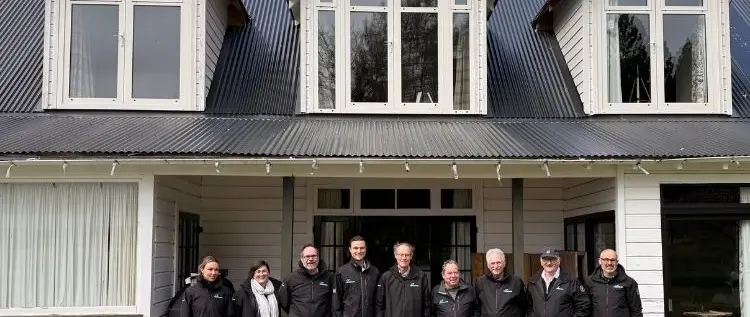
New Zealand propulsion manufacturer HamiltonJet has appointed Sam Hamilton chairman of its board, marking a fourth generation of leadership from the family of waterjet pioneer Sir William Hamilton. The appointment was reported on 13 October 2026 following a board meeting at Irishman Creek Station in the Mackenzie Basin, where the family business began in 1939.
The outgoing chairman, Mike Hamilton, held the role from 2000 and remains on the board as governing director. The transition is significant for a supplier whose waterjets are used across recreational, commercial, passenger and specialist vessels, with company-published application guidance covering installations in vessels up to approximately 80 metres. It is a leadership announcement, not a claim that HamiltonJet has launched a new yacht or changed ownership.
The handover took place at Irishman Creek Station, a historic setting closely associated with HamiltonJet's origins. Sir William Hamilton started the wider enterprise there in 1939 and the company's first annual general meeting was held at the station in 1946. Choosing the location for the contemporary board meeting placed the leadership decision within an unusual continuity of family ownership and engineering work.
Sam Hamilton is the founder's great-grandson and has been on the board since 2019. He also serves as technical director, meaning the new chair comes to the governance role with experience of the business's engineering activity rather than arriving as an unrelated outside appointment. The company has not announced a sale, merger or new shareholder structure as part of the transition.
Mike Hamilton has been chairman since 2000 and has spent approximately five decades in the company, according to the supplied announcement. He moves into a governing-director role that was previously held by his own father, Jon Hamilton, after handing over the chair, creating a precedent for retaining institutional knowledge while transferring responsibility.
For an international marine-equipment supplier, continuity can matter to customers because technical decisions and support arrangements often outlast individual yacht-build programmes. A propulsion system may require maintenance, spare parts and specialist service for many years, so operators look for organisations that sustain engineering expertise through management changes.
HamiltonJet develops waterjet propulsion units and controls for numerous sectors, including recreational craft. Its own corporate information describes installations on vessels typically up to 80 metres long, making its business relevant to large high-performance motor yachts, special-purpose vessels and support craft as well as smaller leisure boats.
A waterjet uses an internal pump and a directed stream of water to propel and manoeuvre a vessel, unlike a conventional exposed propeller and shaft. The arrangement can offer useful manoeuvring characteristics and reduce some underwater appendage exposure, but real-world efficiency depends on hull design, speed, loading, the drive-train specification and correct matching of the unit to the boat.
Sam Hamilton's technical-director experience may be relevant as the company develops newer propulsion hardware and integrated control systems. Technical leadership at board level can influence long-term investment decisions, including facilities, product testing and support capabilities, though the new chairman has not publicly specified a fresh spending commitment connected with his appointment.
HamiltonJet's product range spans propulsion packages for applications that demand different operating speeds and duty cycles. Naval architects and builders require reliable integration among engines or motors, gearboxes, jet units and steering controls, which is why decisions at a propulsion supplier affect the engineering choices available to large-yacht projects.
The company operates manufacturing activities in Christchurch, New Zealand, and reported a 7,500-square-metre factory extension in October 2025, expanding its total manufacturing footprint to 22,500 square metres. That earlier milestone is useful background for understanding the scale of the organisation but is not a new development created by the October 2026 leadership appointment.
HamiltonJet also maintains an international sales and distribution presence. For an owner sailing between countries, access to trained technicians, parts and software support can be just as important as top-speed capability, because unexpected downtime or unplanned repairs may disrupt charter itineraries, owner schedules and marina commitments.
The supplier has described work on hybrid-electric propulsion integration alongside conventional waterjet systems. A hybrid yacht may use different propulsion and power-generation modes according to speed and demand, but any particular advantage depends on the equipment installed and the conditions under which the boat is run.
Owners comparing hybrid options should request reliable fuel-consumption curves, machinery descriptions and maintenance plans from the builder and integrator. It would be misleading to infer that a change of board chairman makes all HamiltonJet-equipped yachts electric, or that every existing system can be converted without substantial new engineering.
The Hamilton family remains associated with the company's ownership and leadership, providing a long horizon for engineering and customer relationships. Managing director Ben Reed has highlighted the company's focus on long-term decisions, a theme consistent with suppliers that must invest in research, machining and testing before new propulsion products reach the market.
Family continuity is neither a substitute for product testing nor an automatic guarantee of service quality. Customers should still assess the reliability of installed equipment, the availability of service personnel and the clarity of warranty obligations when selecting a propulsion supplier for a custom yacht or refit.
For the superyacht sector, the immediate development is leadership succession at a recognised propulsion manufacturer. Yacht builders, designers and captains will be interested in whether the supplier maintains its technical roadmap and support arrangements, but the announcement provides no confirmed change to equipment specifications, prices or delivery commitments.
Any forthcoming new product or major organisational decision should be reported separately when supported by a dated company announcement. For now, the confirmed change is that Sam Hamilton has become board chairman while Mike Hamilton continues as governing director, maintaining a four-generation connection with the HamiltonJet business.
Explore
Go deeper into the yachts, companies, events and destinations directly connected to this article.
Continue reading

Frigomar has introduced its CU210VFDT chiller with 210,000 BTU/h capacity, a titanium seawater exchanger and the same compact dimensions as its 180,000 BTU unit.

IDEA Data Solutions details release 2026.4.1 for yacht operations, including limited CLIVE AI testing and improvements to purchasing, maintenance and fleet views.

Videoworks explains AVIT Panel, an overlay system that connects existing onboard digital equipment to configurable views for captains and technical teams.
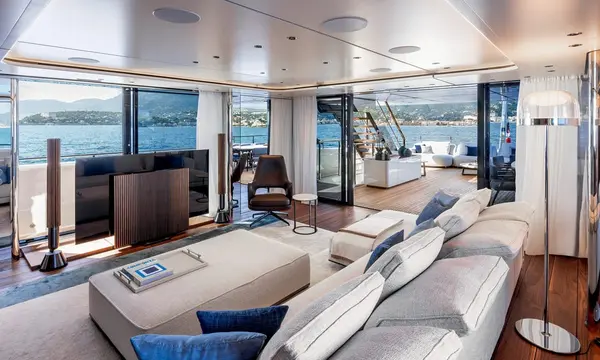
Videoworks explains its bespoke Bang & Olufsen systems on two Custom Line superyachts, naming the hardware used and the integration work carried out.
Superyacht Guide
Continue into the wider Superyacht Guide.
Business opportunities · Superyacht Guide
Companies serving the superyacht market can discuss clearly identified advertising, sponsorship and business-profile opportunities. Commercial activity remains separate from independent editorial coverage.