Heesen Details Blue-Tube Staircase and Interiors on 57m Project Setteesettanta
By Superyacht Guide Newsroom · Edited by Superyacht Guide Newsroom
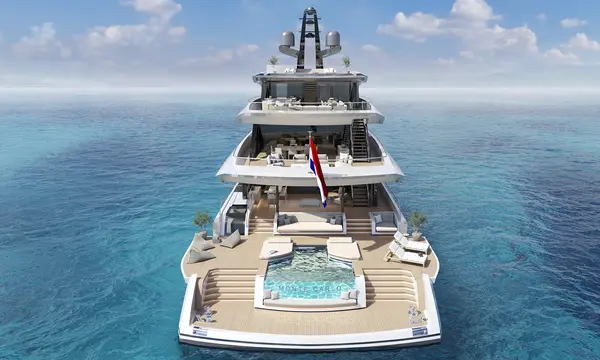
Heesen 57m Setteesettanta official interior visualisation — SYG News 24 Nov 2026 batch09
Heesen has published an unusually detailed November look at the interior of 57-metre Project Setteesettanta, including a four-deck staircase and custom finishes.
Heesen Yachts has provided a new view of the 57-metre full-custom motor yacht Project Setteesettanta, concentrating on the interior programme rather than another construction milestone. Its 19 November 2026 update documents a sculptural blue-tube staircase extending through four decks, a highly individual material palette and the design work behind a custom yacht scheduled for delivery in December. The yacht has been covered previously during construction and launch; the development reported here is the builder's newly published account of spaces, finishes and design decisions. The announcement provides an unusually specific example of how an owner-led concept becomes an engineered, fitted-out environment on a large yacht.
The project carries the design involvement of Cristiano Gatto and Omega Architects, whose respective interior and exterior work has been described by the Dutch builder. Rather than describe the staircase as an isolated decorative object, Heesen's report puts it within a programme of connected spaces and detailed craftwork. A design feature running vertically through several decks can influence structure, service routing, lighting, circulation and installation sequencing. These are practical issues for a 57-metre yacht as well as matters of visual identity.
The timing of the latest Heesen announcement matters. Project Setteesettanta was previously the subject of builder updates covering hull work, construction and launching. The November material is a design-focused editorial release showing work that has evolved inside the vessel. It should not be reported as a new yacht order or newly delivered yacht. The builder identifies the intended December 2026 delivery, but a stated target is not equivalent to a confirmed owner handover. Reporting those distinctions is necessary when several updates about the same vessel appear close together.
An owner following the final months of a build wants to know more than whether the hull is afloat. Interior completion involves hundreds of interfaces between different contractors. A photograph or rendering may communicate atmosphere, while the underlying project needs dimensional checks, finish approval and functional testing. Heesen's source illustrates the design direction; independent completion and commissioning remain separate milestones.
The centrepiece of the November interior story is a staircase formed around blue tubular elements, extending approximately ten metres across four decks according to the builder. This arrangement introduces strong vertical continuity into the accommodation rather than treating each deck as an independent sequence of rooms. Its appearance is striking, but its placement also makes it an architectural feature that people must use repeatedly in a moving vessel. Hand contact, step dimensions, headroom and safe circulation require rigorous design.
A staircase linking several decks occupies space that might otherwise accommodate service zones or separate accommodation. The design team has to understand how the structure is supported, how its decorative surfaces can be maintained and how people will navigate it under way. The release does not publish structural calculations, fire-zone approvals or load specifications. They should not be inferred from an illustration. The important verified fact is the scale and character of the staircase and its prominent role in the yacht's interior identity.
Heesen identifies Cristiano Gatto as the interior designer, a role involving the relationship between owner preferences, visual language and the practical environment aboard. Custom yacht interiors often contain a tension between seamless appearance and access to equipment that will require maintenance. A panel that conceals technology must still be removable safely. A unique finish may need an agreed repair method, spare material and documentation for future custodians. A design programme built around a strong visual motif therefore asks more of its suppliers than a standard decoration package.
The builder's new material shows that the yacht is intended to have an individual personality rather than simply repeat the accommodation formula of a production range. That degree of variation can be one of the attractions of a full-custom order. It also increases the importance of owner sign-off, sample control and accurate records. A decision made late in the programme can affect joinery, electrical works, stone or metal fabrications and the time available for handover.
Heesen's statement describes a broad palette of materials and substantial mock-up work. The builder identifies more than forty materials and over seventy-five mock-ups as part of the design process. Those figures are meaningful because a sample in a designer's studio cannot represent every way a material will behave on a large vessel. Lighting shifts its appearance, vibration affects joints and air-conditioning changes moisture conditions. A sample becomes more valuable when it is examined in the context in which it will ultimately be installed.
Mock-ups also allow owners, designers and the shipyard to resolve conflict before committing to finished components. The interface of timber, metal, glass and stone may look convincing in drawings but prove difficult in installation. Repeated approvals consume time and money, yet they can reduce rework. The number of samples here signals an unusually granular design-development process; it does not independently quantify the project budget or suggest that every material was chosen without revision.
Among the distinctive details described by the builder is a parquet treatment called Kimono, associated with Cadorin and inspired by the Japanese seigaiha wave motif. This is a useful reminder that yacht interior design draws on wider traditions and manufacturing disciplines. Such references can bring texture and narrative into a space while remaining subject to the constraints of marine installation. The finish must work visually alongside furniture, bulkhead panels and the lighting of adjacent rooms.
Cultural inspiration should be described accurately rather than enlarged into a claim that the entire interior follows a particular national style. Heesen's release identifies a specific pattern and supplier treatment, not a complete Japanese theme. The broader interior remains a bespoke work shaped by its owner and designers. A detail can carry a distinctive origin while contributing to an overall language that is not reducible to any one source.
A sculptural stair gains much of its impact from the views through and around it. On a vessel with multiple accommodation levels, the relationships between spaces are carefully considered. Guests may approach a principal lobby from different directions, while crew routes and technical access need to function without disrupting private circulation. A dramatic object can help create continuity through the accommodation, but it also demands attention to light, acoustics and privacy.
The published imagery invites comparison between a conventional stair hidden behind bulkheads and an architectural feature intended to be seen. That comparison belongs to design analysis rather than the builder's confirmed technical specification. No specific acoustic treatment or lighting load should be stated without evidence. The value of the newly released detail is that the designer's architectural intention can now be discussed from an official source.
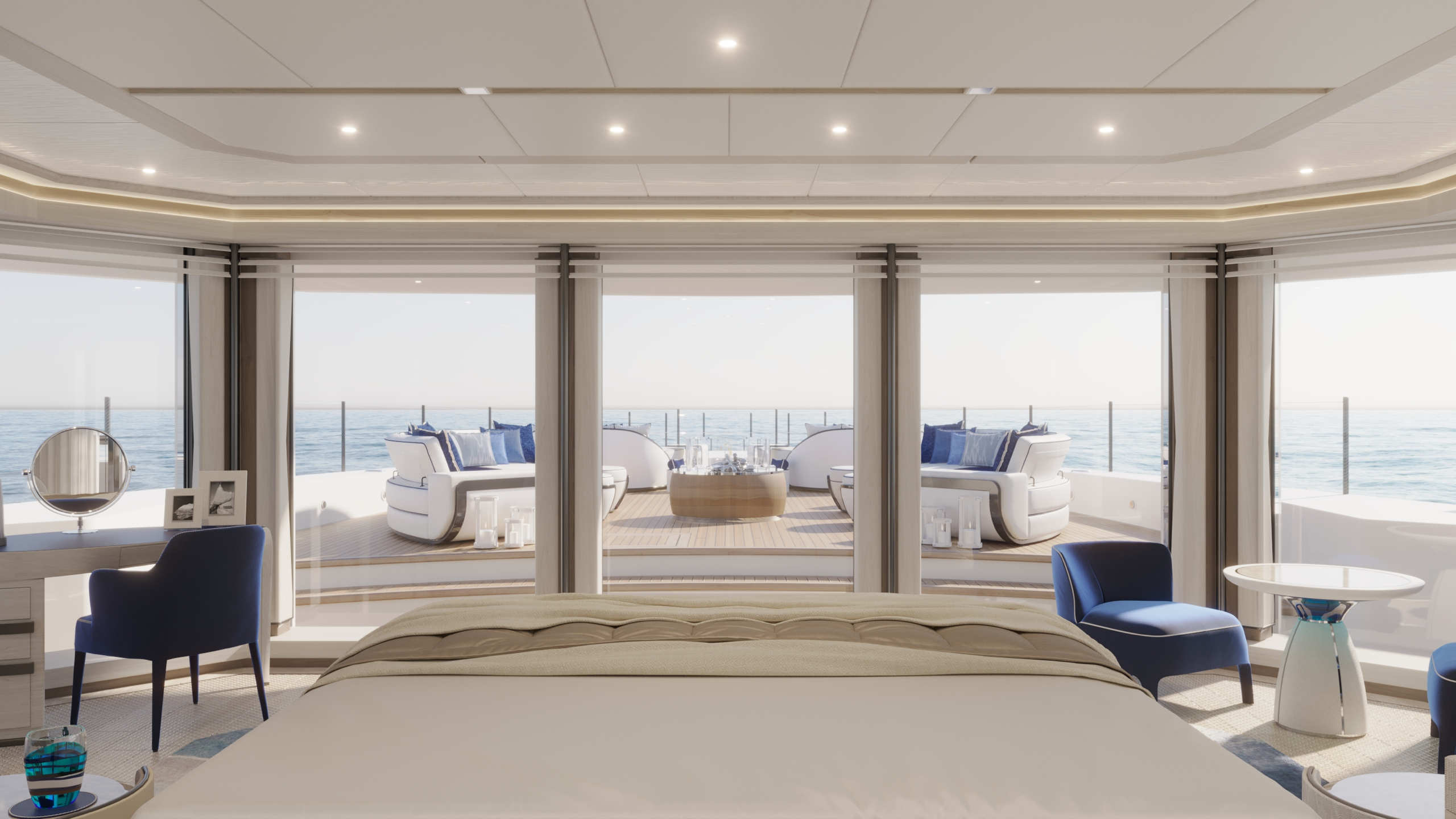
The official report also describes a substantial owner-oriented exterior terrace, a feature that connects interior comfort with outdoor living. At roughly two hundred square metres in the builder's presentation, the space is part of a wider effort to give the owner a private experience at sea. The figure should be read as the builder's described arrangement, not an independently surveyed usable floor area or a guarantee of the precise final furniture layout.
On a superyacht, terraces are more than platforms for photographs. The interface between internal accommodation and exposed decking has implications for door thresholds, drainage, weather protection and guest movement. Furniture has to be secured, and lighting and electrical installations must be appropriate for their environment. The yacht's private exterior programme contributes to the owner's experience only if the technical design supports reliable everyday use.
Omega Architects' work gives Project Setteesettanta its external form. The fact that the yacht is fully custom means the exterior and interior teams cannot work as if each is producing an independent product. Window positions and structural members influence what can be accomplished inside. Conversely, a major internal feature might require coordination with the deck geometry and surrounding spaces. The visible relationship between interior and exterior expresses decisions made long before the final photographs.
The builder's report provides an opportunity to consider that coordination without inventing a new exterior design announcement. Exterior lines, decks and superstructure are already part of earlier public material. The news here concerns how those elements are now reflected in the detailed interior presentation. That is an important difference for an editorial archive that should preserve each genuine stage of a yacht's development.
A full-custom interior is assembled on a vessel whose structure and services already impose fixed constraints. Unlike a building on land, the yacht must operate in a moving marine environment. Joinery panels, metal trims, glass and stone need compatible tolerances, and a staircase spanning multiple decks requires accurate relationships between levels. If one component is delayed, several others may be waiting for access to the same space.
This is an engineering inference about complex yacht outfitting, not a claim that Setteesettanta has encountered such a delay. The manufacturer has not reported defects in the staircase or its finish programme. The relevant point is why an extended mock-up process can be valuable. Decisions taken while details are still in the design office cost less to change than those made after specialist finishes have been installed and connected.
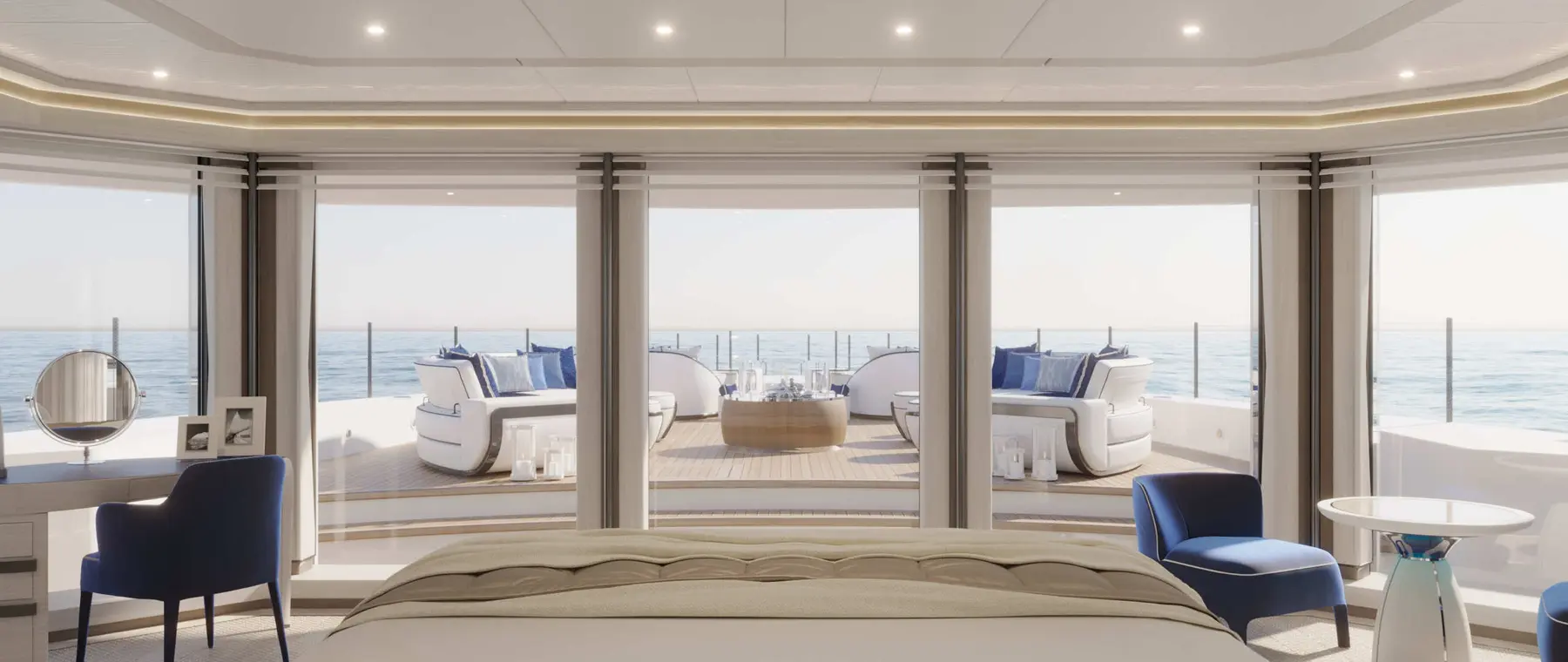
The manufacturer's design images are project-specific visualisations and must not be represented as documentary photographs proving each finished room has been handed over. Renderings are valid editorial evidence of an announced design intention when clearly labelled. They can show materials, proportions and planned circulation, but they cannot independently establish construction quality or the precise final installed result.
For prospective owners and design professionals, the distinction matters. Approved designs often evolve during final engineering, and finishing choices may be adjusted to solve service interfaces or maintenance requirements. It would be misleading to interpret the November presentation as proof of sea-trial readiness or as a verified final survey. Heesen's own release is the authoritative source for the published design programme, and later reporting should track any actual changes.
Heesen states that delivery was planned for December 2026. Between a design presentation and formal handover, a yacht must pass through outstanding inspections, systems verification and owner acceptance processes appropriate to the project. Large yachts also require crew familiarisation so operational teams can manage the environment as intended. A beautiful material scheme has little practical value if the crew cannot maintain it or safely access equipment behind it.
The builder's statement does not supply a comprehensive commissioning checklist or independently verified completion certificate. Those details should be confirmed before any claim that handover has occurred. What can be said now is that the November account puts the interior design much more clearly into public view and establishes the owner's highly individual approach.
The latest Setteesettanta material shows the level of coordinated design development involved in a custom superyacht of this size. A ten-metre multi-deck stair, specialist parquet and dozens of material mock-ups are not just decorative talking points. They demonstrate how many detailed decisions a project team must manage to achieve one coherent owner experience. That complexity influences delivery sequencing and the skill sets needed in a yard's supplier network.
For other owners commissioning large custom yachts, a useful lesson is to ask early how design decisions will be documented, mocked up and accepted. The more intricate the feature, the more important it becomes to define interfaces and maintenance obligations before the final outfitting phase. Those are general project-management considerations rather than suggestions of problems on the Heesen yacht.
The official November 19 release establishes the 57-metre project's interior design direction, the role of Cristiano Gatto, the standout blue-tube staircase and the reported range of finishes and mock-ups. It also reiterates the planned delivery window. It does not establish that the yacht has been delivered, reveal the owner's identity, publish a final build cost or disclose detailed structural approvals. Keeping those items separate is part of accurate superyacht reporting.
Project Setteesettanta will be judged ultimately by the relationship between its intended design and the experience of people aboard after commissioning. For now, Heesen's new interior disclosure is substantial news in its own right: a highly individual architectural feature and a demanding custom fit-out programme have moved from general promise to a detailed official public presentation.
Primary source: Heesen Yachts, official interior design report, 19 November 2026.
Image: Heesen Yachts / Cristiano Gatto Design. Official manufacturer-issued Setteesettanta interior design visualisation; rendering, not a completed-yacht photograph. Official source.
Explore
Go deeper into the yachts, companies, events and destinations directly connected to this article.
Continue reading
Cristiano Gatto Design has revealed new interior details for Heesen's 57-metre Project Setteesettanta, including a private owner's deck and sculptural craftsmanship ahead of the …

At Heesen Yachts, we uphold the tradition of celebrating the Chinese New Year in advance, honouring its rich cultural heritage and symbolism. This occasion …
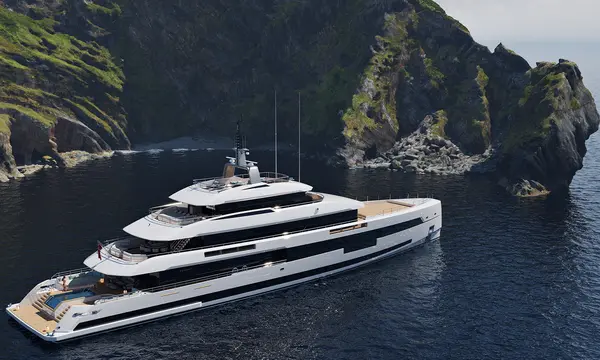
Heesen Yachts proudly announces the joining of the hull and superstructure, alongside the engine placement, of the full custom 57m shallow draft four-deck motor …
World-renowned Dutch superyacht builder Heesen Yachts debuted a daring new Steel FDHF 62-metre superyacht – codenamed Project Monte-Carlo , at their kick-off press conference …
Superyacht Guide
Continue into the wider Superyacht Guide.
Business opportunities · Superyacht Guide
Companies serving the superyacht market can discuss clearly identified advertising, sponsorship and business-profile opportunities. Commercial activity remains separate from independent editorial coverage.