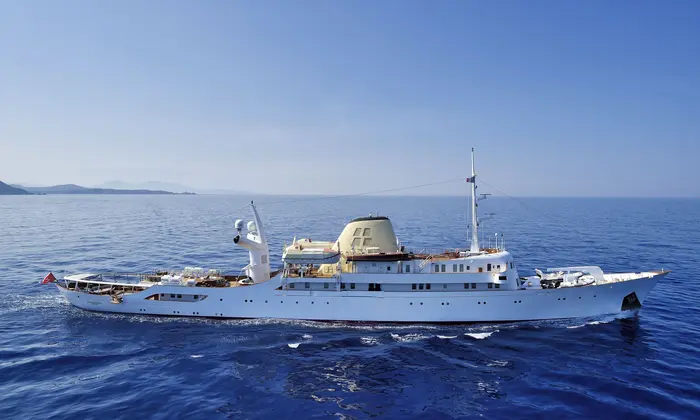
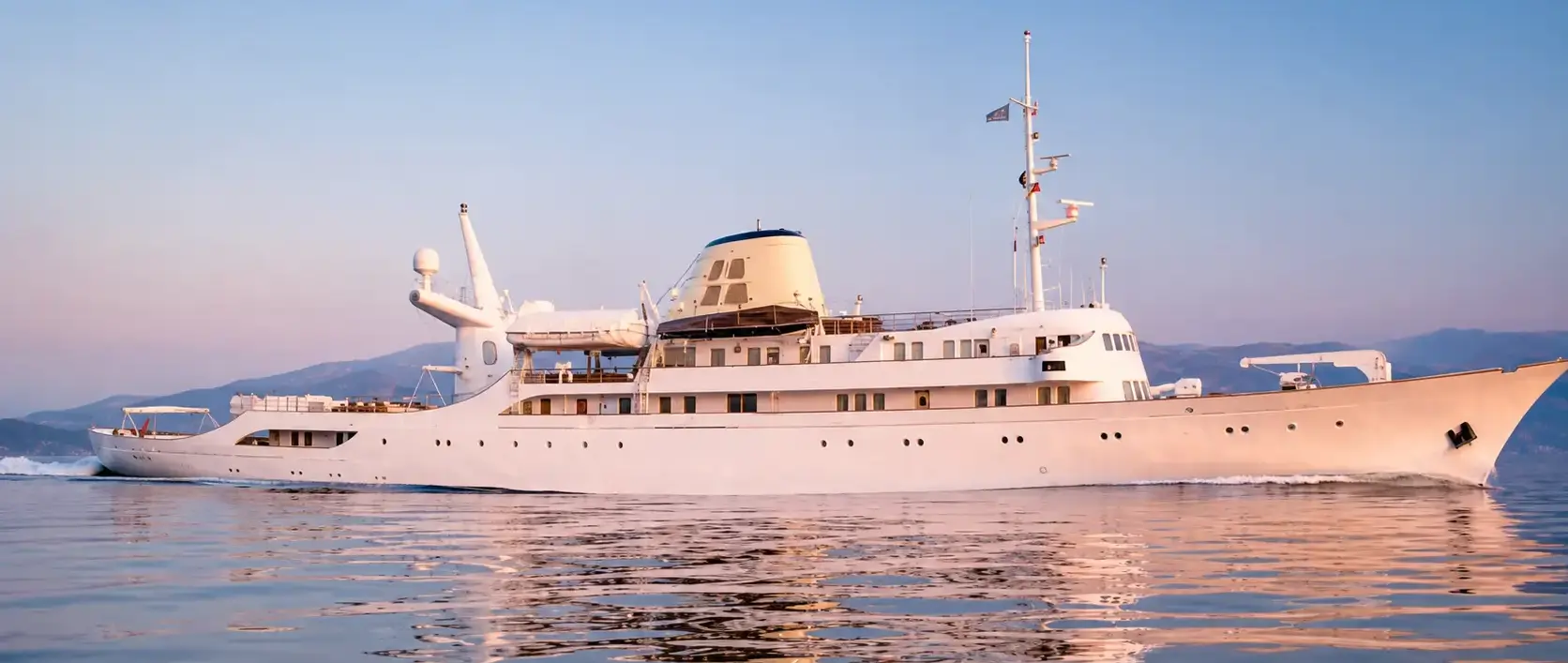
Built for war as HMCS Stormont, Christina O survived Atlantic convoys and D-Day before Aristotle Onassis transformed her into one of history’s most famous private yachts.
Few yachts can claim two lives as dramatically different as those of Christina O. Before she carried statesmen, film stars, royalty and some of the twentieth century’s richest people across the Mediterranean, she was a Canadian naval frigate built to escort wartime convoys across an Atlantic threatened by German U-boats.
That military origin remains fundamental to understanding the yacht today. Christina O was not conceived as an exercise in elegance and later strengthened for the sea; she began as a working warship whose structure, machinery spaces and proportions were created for endurance, protection and naval service, before being transformed into something the post-war yachting world had barely seen before.
The vessel was built by Canadian Vickers in Montreal as the River-class frigate HMCS Stormont (K327). The Royal Canadian Navy’s official history records that she was laid down on 23 December 1942, launched on 14 July 1943 and commissioned on 27 November that year, entering service at one of the most dangerous stages of the Battle of the Atlantic.
After working up in Canadian waters, Stormont crossed the Atlantic and joined Escort Group 9 at Londonderry in Northern Ireland. Her duties placed her firmly within the machinery of Allied convoy protection, where relatively small escort vessels spent long periods shepherding merchant ships through waters in which submarines, mines, weather and mechanical failure could all be lethal.
Her wartime record would later sit in extraordinary contrast to the cocktail parties and celebrity cruises for which the ship became famous. The Royal Canadian Navy records Stormont’s service during the Normandy invasion, Atlantic and Arctic convoy work, assistance to the damaged Canadian frigate HMCS Matane, and battle honours for Arctic 1944, Normandy 1944, English Channel 1944 and Atlantic 1944–1945.
The war ended before a planned tropicalisation programme for Pacific service could be completed. Stormont was paid off on 9 November 1945, bringing to an end a comparatively short naval career whose historical importance would have been considerable even if the vessel had subsequently disappeared into a breakers’ yard.
The former frigate was sold after the war and changed hands before being acquired for conversion by Greek shipping magnate Aristotle Onassis. The Royal Canadian Navy records that the transformation took place at Kiel between 1952 and 1954, after which Onassis named the yacht Christina after his daughter.
The conversion was remarkable not simply because an old warship became a yacht, but because of the scale at which Onassis approached the project. At roughly 99 metres, the former frigate offered volumes and deck areas unavailable on most contemporary private vessels, allowing a combination of accommodation, entertaining space and outdoor living that anticipated the social role of the modern superyacht.
Designer Cäsar Pinnau was associated with the yacht’s transformation, and the result bore little resemblance to the austere escort ship that had crossed the North Atlantic. Current Christina O yacht material from Morley Yachts continues to identify Pinnau with her exterior design, while the vessel’s surviving proportions still reveal the much harder-working naval ship beneath the post-war elegance.
The most famous example was the mosaic swimming pool on the aft deck. The pool floor can rise until it becomes flush with the surrounding deck, converting the swimming area into a dance floor and turning one space from daytime recreation into an evening entertainment venue, a feature that remains distinctive even by modern superyacht standards.
Christina did more than demonstrate Onassis’s wealth. During his ownership she became a meeting place where shipping, politics, entertainment and European high society crossed paths, giving the yacht a historical identity that cannot be explained through her dimensions or specifications alone.
Winston Churchill, John F. Kennedy, Maria Callas, Frank Sinatra and numerous other prominent figures became associated with the vessel. Historical reporting by the International Consortium of Investigative Journalists records that Kennedy and Churchill first met aboard Christina and that the yacht later hosted the reception following Aristotle Onassis’s marriage to Jacqueline Kennedy in 1968.
The same historical record connects the yacht with celebrations surrounding the marriage of Prince Rainier III of Monaco and Grace Kelly. These episodes helped turn Christina into something more than an exceptionally large private yacht: she became part of the visual language of post-war wealth, international society and political influence.
That history also explains why the yacht has retained a cultural value well beyond what might normally be expected from a vessel built in 1943. Many yachts have carried famous passengers, but Christina became a recurring stage on which different worlds met, often far from the more formal environments in which those same people normally appeared.
Among Christina’s most important recurring guests was Winston Churchill. The International Churchill Society records that between 1958 and 1963 Churchill made eight lengthy cruises aboard the yacht, during which his relationship with Onassis turned Christina into a floating salon as much as a holiday vessel.
Churchill was already one of the world’s most recognisable political figures, while Onassis represented an increasingly international form of private commercial power. Their conversations took place against the unusual background of a converted Second World War frigate that had itself participated in the conflict with which Churchill’s career was so closely associated.
During a 1961 voyage, Christina crossed the Atlantic after cruising in the West Indies and arrived in New York, marking Churchill’s final visit to the United States. The symbolism was extraordinary: the former wartime escort had become the private vessel carrying one of the defining political figures of the war across the same ocean she had once helped defend.
These connections are a major reason Christina O occupies a different category from yachts whose importance is principally technical or aesthetic. Her historical significance lies partly in the vessel herself and partly in the events, relationships and conversations that occurred aboard her.
Aristotle Onassis died in 1975, and the yacht subsequently passed out of the private world he had created around her. The Royal Canadian Navy records that in 1978 she was transferred to the Greek Navy, beginning another chapter in the former Canadian frigate’s unusually varied life.
The yacht was renamed Argo, but the change did not result in a productive new career comparable with the Onassis years. Over time the vessel deteriorated, and the once-celebrated interiors and systems faced the familiar problem that confronts almost every large historic ship: preservation becomes increasingly difficult when there is neither a clear operational purpose nor an owner prepared to finance continuing maintenance.
By the 1990s, saving the yacht required considerably more than cosmetic restoration. The challenge was no longer simply to recreate the atmosphere of the Onassis era, but to preserve enough of the original vessel to maintain historical continuity while replacing ageing structure, machinery, piping, cabling and accommodation to modern operating standards.
In 1998, shipowner John Paul Papanicolaou, who had known the yacht during the Onassis era, acquired the vessel and began the project that would ultimately give her the name by which she is known today: Christina O. That acquisition marked the decisive transition between the yacht’s long decline and her eventual return to active service.
The restoration at Viktor Lenac shipyard in Croatia was effectively a reconstruction of a historic ship rather than a conventional yacht refit. The yard’s official project record states that the work was completed in 2001 and describes an extensive refurbishment intended to retain the vessel’s original external appearance and internal character while renewing the underlying ship.
According to Viktor Lenac, more than 600 tonnes of steel and aluminium were renewed along with 40 tonnes of piping and 85 kilometres of electrical cable. The machinery and propulsion arrangements were replaced, a completely new engine room was installed, passenger accommodation was rebuilt and the famous mosaic swimming pool was restored.
The significance of that work is difficult to overstate. Restoring a historic yacht normally involves balancing originality against safety, reliability and commercial usability, but Christina O presented the additional challenge of preserving a vessel whose underlying hull had already been more than half a century old and whose original purpose had been entirely different.
Viktor Lenac states that the project received the Best Refit award at the 2001 Monte Carlo International Boat Show. More importantly for the yacht’s survival, the work returned Christina O to active service rather than leaving her as a static historical object.
The modern Christina O is therefore neither an untouched 1943 frigate nor a perfectly preserved 1950s yacht. She is a layered historical vessel in which wartime structure, Onassis-era identity and later engineering coexist, with successive restorations attempting to preserve the character that made her important.
The pool remains one of the yacht’s defining features, while the Onassis Suite, extensive entertainment spaces and period-inspired interiors continue to connect the present vessel with her most famous ownership period. Modernised accommodation and technical systems allow her to operate commercially without pretending that a 99-metre yacht can survive through historical authenticity alone.
Current charter information lists Christina O at approximately 99.13 metres, with accommodation for up to 34 guests in 17 cabins. Those numbers place her within the scale of a substantial modern superyacht, but her proportions and internal arrangement still betray the fact that her origins lie in a naval vessel designed more than eight decades ago.
Further refit and maintenance work has continued in the decades following the Viktor Lenac reconstruction. That ongoing investment is essential because the preservation of a working historic yacht is never finished; every operating season places new demands on machinery, hull structure, hotel systems and regulatory compliance.
The superyacht industry has produced vessels far larger, faster and technically more sophisticated than Christina O. Yet very few have exercised a comparable influence on the idea of what a private yacht could represent, because Onassis used Christina not merely for travel but as a moving residence, entertainment venue, political salon and highly visible expression of personal power.
Her naval origins make that story even more compelling. The same basic ship that escorted wartime convoys and served during the Normandy campaign later carried some of the twentieth century’s most prominent political, cultural and financial figures through the Mediterranean, an evolution almost impossible to reproduce intentionally.
Christina O also demonstrates that historical significance and continued operation do not have to be mutually exclusive. The 2001 reconstruction involved enormous structural and technical intervention, yet without it the yacht might have disappeared entirely, leaving photographs and stories but no surviving vessel through which those different periods could still be experienced.
Today she remains available for charter rather than confined to a museum berth. More than 80 years after Canadian Vickers launched HMCS Stormont, the former frigate is still operating at sea, carrying passengers instead of sailors and preserving one of the most extraordinary continuous histories in yachting.
Christina O deserves a place among the most important surviving historic yachts because her significance extends far beyond celebrity. She is simultaneously a Second World War veteran, a product of the extraordinary ambitions of Aristotle Onassis, a witness to twentieth-century political and social history, and a major example of large-yacht preservation through reconstruction.
Her story also marks an important point in the development of the modern superyacht. Long before today’s fleets of 100-metre private vessels, helicopter decks and elaborate entertainment spaces became familiar, Onassis had already demonstrated that a large ship could be transformed into a highly personal floating world whose importance came as much from what happened aboard as from the vessel itself.
For Christina O, survival may ultimately be her greatest achievement. Warship, private yacht, state vessel, neglected relic and restored superyacht have all been identities carried by the same hull, making her not merely a yacht with a long history but a vessel through which several different eras of maritime history remain connected.
Explore
Go deeper into the yachts, companies, events and destinations directly connected to this article.
Continue reading

Feadship has collaborated with Assouline on a new Ultimate Collection volume drawing on private archives to document the builder’s heritage and working culture.
Sanlorenzo unveils SHE, a tribute to timeless elegance where heritage meets innovation Sanlorenzo introduces SHE, a unique 25.5-metre project that reinterprets the Maison’s heritage …
Double triumph at the Boat International Design & Innovation Awards 02.02.2026 Double triumph at the Boat International Design & Innovation Awards Double triumph at …
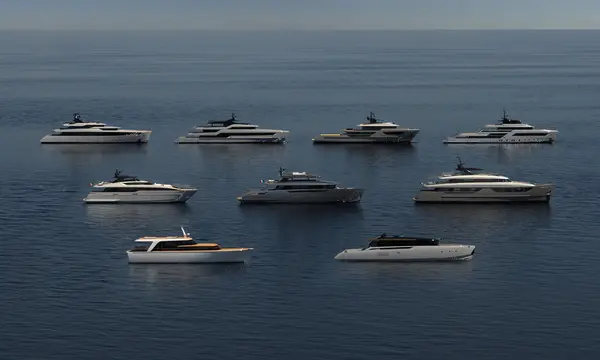
Sanlorenzo’s official news and events area highlights current superyacht innovation, launches and brand activity.
Superyacht Guide
Continue into the wider Superyacht Guide.
Business opportunities · Superyacht Guide
Companies serving the superyacht market can discuss clearly identified advertising, sponsorship and business-profile opportunities. Commercial activity remains separate from independent editorial coverage.