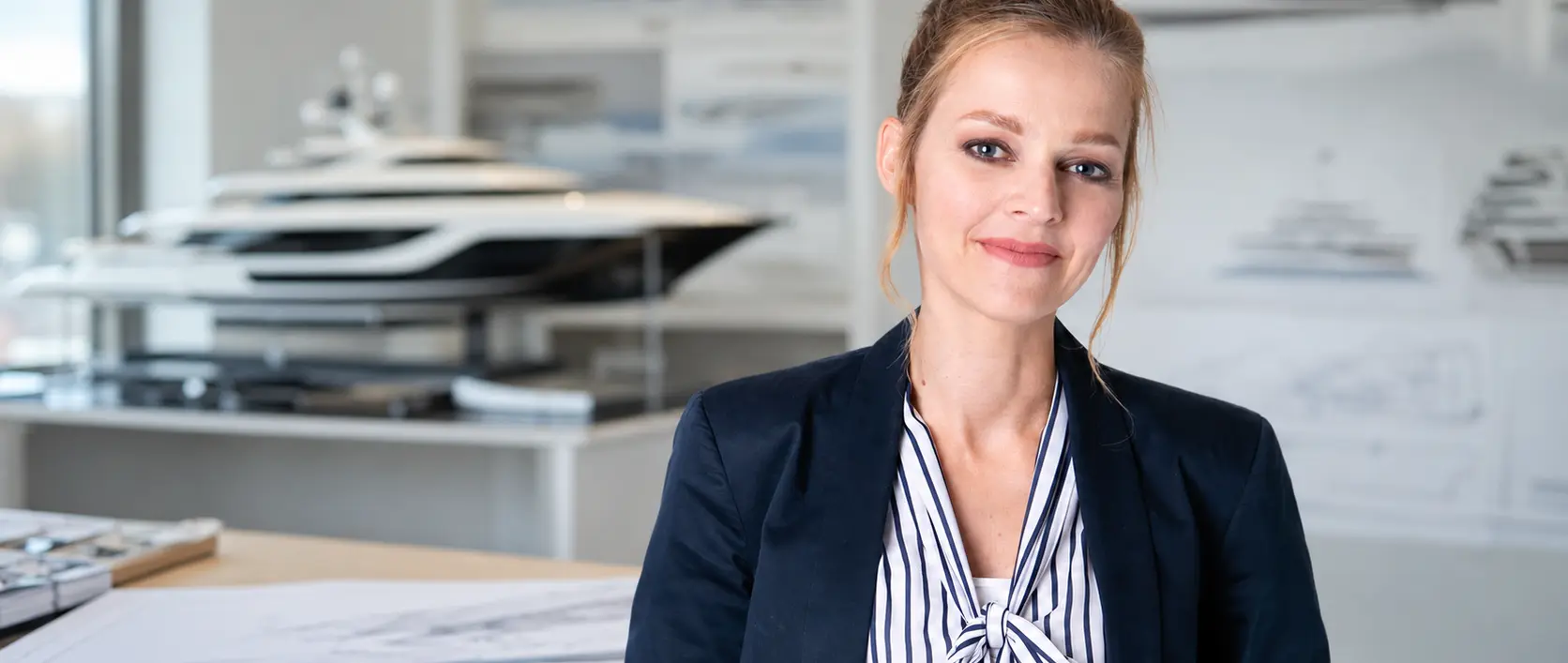
Hydro Tec appoints Myriam Cutolo as Executive Vice President as the Italian yacht-design and engineering company strengthens its leadership structure.
Italian yacht design and engineering company Hydro Tec has appointed Myriam Cutolo as Executive Vice President, continuing a broader restructuring of its management team as the business prepares for further international growth.
The newly created executive role gives Cutolo responsibility for coordinating administration, finance, organisational development and corporate growth. It places her alongside founder and president Sergio Cutolo, Chief Technical Officer Nicola Camuffo and Chief Operating Officer Michele Lauriero within an increasingly formal leadership structure.
Hydro Tec describes the appointment as another stage in its transition from a founder-led professional studio into a structured international company. Founded in 1995 by Sergio Cutolo and Silvia Himsolt, the business has developed from a naval-engineering practice into an integrated yacht-design organisation working across naval architecture, exterior design and technical engineering.
Myriam Cutolo's appointment does not stand alone. It follows the recruitment of Nicola Camuffo as Chief Technical Officer and Michele Lauriero as Chief Operating Officer during 2025.
Camuffo was brought into the leadership team to strengthen Hydro Tec's technical direction, while Lauriero assumed responsibility for operational organisation and project delivery. The addition of an Executive Vice President now extends that structure into administration, finance and corporate development.
Together, the appointments indicate that Hydro Tec is distributing responsibility across a wider executive group rather than continuing to depend primarily upon the direct involvement of its founder.
That distinction matters as design studios grow. A small practice may be able to organise projects through direct founder oversight, informal communication and a relatively narrow internal hierarchy. A company handling multiple international superyacht projects simultaneously requires clearer authority, defined reporting lines and dedicated responsibility for technical, operational and financial management.
Hydro Tec has said that its organisational development is intended to make the company more responsive to clients and partners while preserving the design culture on which its reputation was built. Its corporate material describes an evolution from a professional studio into a structured company with four offices, more than 30 years of activity and involvement in more than 160 yacht builds.
As Executive Vice President, Myriam Cutolo is expected to coordinate several functions that become increasingly important as a design company expands.
Administration and finance provide the controls needed to manage longer project cycles, international contracts and fluctuating workloads. Organisational development concerns the internal systems, teams and reporting structures required to support growth. Corporate development may include strategic partnerships, new markets, commercial positioning and the broader evolution of the business.
These responsibilities sit behind the visible work of designing yachts but have a direct influence on whether projects can be delivered consistently. Design companies must allocate specialist personnel, manage intellectual property, coordinate with shipyards and suppliers, control project changes and maintain continuity across programmes that may last several years.
Hydro Tec's announcement presents Cutolo's appointment as a natural progression within the company's longer-term development rather than a sudden change of direction. The firm said it now has managers, function heads, team leaders and experienced professionals who collectively form the organisation's core strength.
The appointment also introduces a clearer executive role for the next generation of leadership while Sergio Cutolo remains president, founder and the company's principal creative figure.
Hydro Tec began primarily as a naval-engineering business before expanding into yacht design during the early 2000s. The company now offers an integrated service that can include naval architecture, exterior styling, engineering and technical coordination.
That combination has become particularly relevant in the explorer-yacht and custom-superyacht markets, where exterior appearance cannot easily be separated from hull form, stability, machinery arrangements, range, tender storage and operational requirements.
A design studio working only on exterior styling can hand much of the technical responsibility to a shipyard or separate naval architect. Hydro Tec's model places design and engineering within the same organisation, allowing aesthetic decisions to be developed alongside structural, hydrodynamic and systems considerations.
The company's recent portfolio includes explorer yachts and custom projects such as Vagrant, Valiant, Tremenda and Haze². Hydro Tec has also been associated with several yachts recognised in major industry awards and nominations, including projects built by Cantiere delle Marche, Columbus Yachts and Art Shipyard.
This type of work increases the importance of management depth. Each project may involve a different shipyard, owner's team, interior designer, classification society and group of specialist suppliers. Maintaining quality across that network requires more than creative ability alone.
Hydro Tec has explicitly connected its management restructuring with international expansion.
The company operates in a market where clients, shipyards and project teams may be spread across several countries. Technical work can be divided among offices, shipyard engineering departments and external specialists, while construction may take place far from the designer's headquarters.
International growth therefore creates organisational pressures that are not always visible in the finished yacht. Contract management becomes more complex, project reporting must be consistent and senior managers must be able to make decisions without every matter returning to the founder.
Hydro Tec began addressing this issue before the latest appointment. When announcing earlier management changes, it described the move towards a more structured organisation as necessary to respond more quickly and effectively to clients and partners.
Myriam Cutolo's role should reinforce that process by bringing corporate, financial and administrative coordination into the executive structure. The result is a leadership model in which technical direction, operations and company development are handled through separate but connected areas of responsibility.
Formalising management can create concern that a design studio will lose the personality or creative consistency associated with its founder.
Hydro Tec appears to be positioning the restructuring as a way to protect that identity rather than replace it. Sergio Cutolo remains president and founder, while the expanded executive team assumes greater responsibility for the organisational demands surrounding the design work.
The company's team material continues to present Cutolo as its principal design and naval-engineering figure, with more than four decades of industry experience. Silvia Himsolt, who co-founded Hydro Tec, has historically overseen non-technical activities and special initiatives.
A stronger management layer could allow the founder to concentrate more closely on design direction, client relationships and strategic projects while other executives manage the systems required to support the wider organisation.
This is a familiar stage in the development of specialist yacht businesses. Their reputations are often built around one designer, engineer or naval architect, but long-term continuity depends upon turning individual expertise into an organisation capable of operating beyond a single person.
The appointment also raises the question of succession, although Hydro Tec has not described it as a transfer of control.
Myriam Cutolo's position strengthens the next generation's involvement at executive level while leaving the founder's role intact. This creates the possibility of a gradual transition in responsibilities rather than a sudden leadership change.
Such an approach can be particularly valuable in yacht design, where relationships with owners, shipyards and project managers are built over many years. Clients may want the continuity of the founder's involvement while also seeking confidence that the business has the management depth to support future projects.
A staged evolution allows institutional knowledge to be transferred while the company continues operating normally. It also gives newer executives the opportunity to establish their own relationships and authority within the market.
Hydro Tec has not announced a timetable for any further succession process. The immediate purpose of the appointment is presented as strengthening governance and supporting growth, rather than replacing Sergio Cutolo.
For shipyards and yacht owners, the practical importance of the new structure will be measured through project performance.
A stronger executive team should provide clearer responsibility when decisions concern schedules, staffing, technical coordination, contractual matters or project priorities. It may also help Hydro Tec manage a larger number of simultaneous assignments without weakening senior oversight.
The appointment could also improve continuity between design phases. Superyacht projects often move from concept development through naval architecture, engineering, construction support and commissioning. Different teams may become involved at each stage, making coordination essential.
Clients are unlikely to judge the restructuring by job titles alone. They will look for faster decisions, consistent communication, stable project teams and evidence that the company can handle growth without compromising the quality of its work.
Hydro Tec's challenge will therefore be to translate the new executive structure into visible operational improvements while maintaining the creative and technical character that distinguishes the studio.
The appointment reflects a broader change in the superyacht design profession.
Leading studios increasingly operate as substantial international businesses rather than small creative practices. They employ naval architects, structural engineers, exterior designers, project managers, visualisation specialists and administrative teams. Some work across dozens of projects at different stages of development.
As project sizes and technical expectations increase, governance becomes part of design capability. A studio may produce an exceptional concept, but it must also be able to document decisions, coordinate engineering, manage revisions and support construction over an extended period.
Hydro Tec's decision to strengthen its executive structure illustrates this development. The company is not abandoning its founder-led identity, but it is building the organisational framework required to sustain that identity on a larger scale.
The appointment of Myriam Cutolo as Executive Vice President therefore represents more than an internal promotion. It signals that Hydro Tec is preparing for its next stage as a structured, multi-office international design and engineering company.
Whether that structure succeeds will ultimately be judged through the projects it delivers, the relationships it maintains and its ability to combine corporate growth with the technical discipline and creative independence that established its reputation.
This article is based on Hydro Tec's corporate information and reporting by Superyacht24 concerning the appointment of Myriam Cutolo as Executive Vice President. The company's history, services, management development and project portfolio were checked against the official Hydro Tec website, its company profile, its team information and its announcement of earlier management appointments.
Explore
Go deeper into the yachts, companies, events and destinations directly connected to this article.
Continue reading
FHG Marine Engineering has acquired Fort Lauderdale-based Scott Marine Power, combining two South Florida marine-service businesses and expanding FHG’s diesel-engine sales, service and technical …
Junior Yacht Stewardess Salary 2026: Entry-Level Pay and Leave Junior yacht stewardess and steward pay in 2026 is currently benchmarked at about €3,000–€3,500 per …
Yacht Spa Manager Salary 2026: Pay, Rotation and Duties Spa managers with yachting experience on 80m+ yachts are currently benchmarked from about €4,500+ per …
Yacht Head of Housekeeping Salary 2026: Pay by Yacht Size Head of Housekeeping salaries in 2026 are benchmarked at about €4,500–€6,000 on 60–80m yachts, …
Superyacht Guide
Continue into the wider Superyacht Guide.