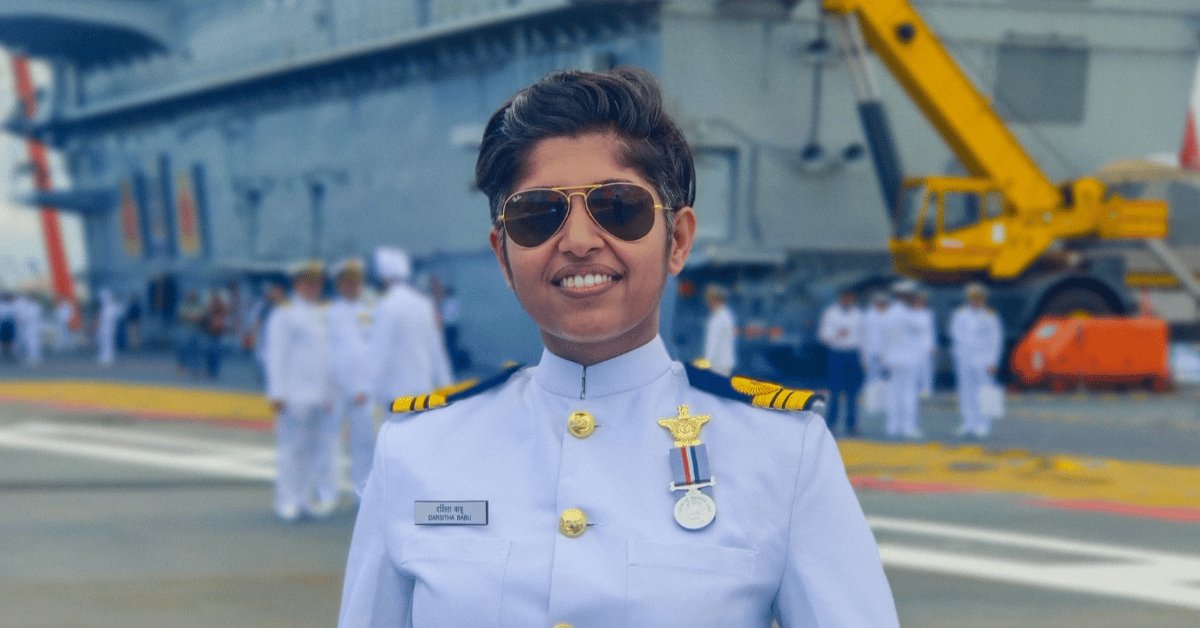
Darsitha Babu — official METSTRADE interview photograph
A METSTRADE interview with former Indian Navy engineer Darsitha Babu examines the transfer of engineering, project leadership and compliance skills to yachting.
In an interview published by METSTRADE on 27 October 2026, former Indian Navy officer Darsitha Babu describes the transition from naval engineering to a prospective career in civilian maritime enterprise. Her experience brings together mechanical engineering, naval architecture, quality assurance, supplier coordination and operational leadership. The interview forms part of the exhibition organiser's Humans of Metstrade series ahead of the Amsterdam show scheduled for 17–19 November.
For superyacht builders, refit yards and management companies, her account offers an opportunity to consider how people with substantial technical experience outside yachting might enter the sector. The skills required to deliver, maintain and operate increasingly complex vessels are not confined to people who began their careers in yacht construction. At the same time, experience of another maritime environment cannot automatically establish competence in every aspect of commercial yachting. Effective career transitions depend on identifying relevant experience, understanding the differences between workplaces and developing the specific knowledge required for new responsibilities.
Babu explains that her interest in uniformed service developed during her youth and led to participation in the National Cadet Corps. Following a bachelor's degree in mechanical engineering at the Indian Institute of Technology in Delhi, she underwent an officer selection process and entered the engineering cadre of the Indian Navy under a short service commission. She subsequently pursued further study in naval architecture during her service.
The combination is particularly relevant in an industry where projects can bring together technical disciplines that are otherwise treated separately. Mechanical systems, vessel structure, electrical equipment and accommodation requirements all interact in the physical space available on a yacht. Naval architects and engineers need to understand how decisions in one area can influence the performance and maintenance requirements of another. A professional who has worked across these boundaries may bring valuable experience to a project team, provided the individual's actual qualifications and experience are assessed against its specific needs. The educational history described in the interview is Babu's own account, rather than a certification of eligibility for a particular civilian post.
Among the significant assignments she describes are work associated with India's first domestically built aircraft carrier, INS Vikrant, and production quality assurance on strategic submarine projects. She also records experience in coordinating international manufacturers and suppliers and managing groups of engineers and other specialists. These undertakings involved organisations of a different scale and purpose from custom superyacht builders, but certain project-management challenges are recognisable across maritime construction.
A quality-assurance function, for example, involves more than identifying faults once equipment has been delivered. It may require clear acceptance criteria, appropriate inspection procedures, documentation of test results and a method for resolving nonconformities. When multiple suppliers are involved, the project team needs to establish who is responsible for each interface and how changes are communicated. In a superyacht project, these considerations become particularly important where equipment has been designed or adapted for an individual vessel. The underlying discipline of clarifying requirements and maintaining traceable evidence can be transferable without assuming that military specifications should be reproduced in a yacht.
After completing her minimum ten-year engagement, Babu decided to explore opportunities outside naval service. She describes an interest in working closer to the manufacturers and technology suppliers whose equipment she had encountered during her career. Her family relocated to the Netherlands, where she pursued an international MBA at TIAS School for Business and Society in Tilburg, with a focus on agentic artificial intelligence. At the time of the interview, she expected to graduate in December.
This stage illustrates an important element of professional transition. Technical experience is valuable, but the commercial setting introduces decisions about customers, contractual commitments and the allocation of limited resources. In a privately commissioned superyacht, the builder and its suppliers must respond to the owner's defined requirements while operating within the relevant technical and regulatory constraints. Managing that relationship requires the ability to explain technical choices to people with different expertise and expectations. Business education can help establish a framework for understanding those choices, although the practical experience of working within a yacht project remains important. The interview does not claim that Babu has already secured a senior superyacht construction appointment.
Babu attended METSTRADE in 2025 after meeting a company founder who encouraged her to visit the show. She describes attending the international Women in the Marine Industry panel and networking breakfast, visiting the Young Professionals Club and meeting people working in different parts of the maritime sector. Among those encounters was a discussion with former Feadship director Henk de Vries about propulsion. She also participated in an ICOMIA discussion concerning data and smart marinas.
An exhibition can be valuable in this context because it brings together equipment suppliers, builders, designers, service organisations and professional associations. Someone considering a career change has the opportunity to understand the relationships between those organisations and identify where their background might be most relevant. That is different from assuming that attendance at a trade show will itself result in a job. A useful professional discussion establishes the nature of the work being undertaken, the skills considered important and any gaps in an applicant's experience. Employers can use the same conversations to understand career paths that may not be immediately apparent from conventional recruitment channels.
The interview refers to a paper Babu wrote during her naval career concerning predictive maintenance using a machine-learning approach. The topic has relevance to superyacht operations because maintenance decisions can involve monitoring multiple interrelated systems over extended periods. The ability to recognise changes in equipment behaviour may help engineers prioritise investigations before a fault causes an operational disruption.
A predictive model is not a replacement for competent engineering judgement or the inspections and services required by manufacturers, flag administrations and classification societies. Its usefulness depends on the reliability and coverage of the data, the characteristics of the equipment and the quality of the assumptions used to interpret results. A system that produces repeated false alarms can impose unnecessary demands on the crew, while a failure to identify an important change may create unwarranted confidence. The development and application of these tools require cooperation between engineers, data specialists and the people responsible for operating the vessel. Babu's research interest illustrates one possible connection between experience aboard naval platforms and future technical work in civilian marine environments.
Babu has established a fledgling engineering and technology consultancy called 51 HQ and expresses an interest in helping other people leaving military service. Her immediate priority, however, is to find a sustained employed role in which she can continue developing her expertise, ideally involving programme or technical project management for new construction. She identifies the lack of previous employment in yachting as a barrier.
Employers can address this type of challenge by separating genuinely necessary sector-specific experience from knowledge that can be acquired through an appropriate induction and supervised work. A job description should distinguish the qualifications required for statutory or safety responsibilities from experience that is desirable because of the organisation's working arrangements. A well-designed transition programme might include exposure to yacht construction practices, applicable standards and the specific ways in which owners' representatives and suppliers interact. This is not an argument for reducing technical standards. It is a means of assessing competence accurately rather than using a previous job title as the sole indicator.
The account published by METSTRADE concerns one professional's experience, but the broader question is relevant to yacht builders and technology suppliers seeking skilled people. The industry needs individuals who can integrate engineering knowledge with coordination across disciplines and organisations. Naval experience can be one source of that expertise, alongside commercial shipbuilding, aviation and other technically demanding sectors.
A successful transition must also recognise differences in organisational culture. The structure and expectations of a military workplace are not necessarily the same as those of a small specialist business or a large commercial group. Babu encourages both employers and former service personnel to consider those differences before committing to a role. The 2026 edition of METSTRADE provides another opportunity for such professional conversations. Her participation and career aspirations are described in the organiser's interview; no employment outcome is claimed. The organiser's published contact is metstrade@rai.nl.
Primary source: METSTRADE official 27 October interview with Darsitha Babu.
Darsitha Babu — official METSTRADE interview photograph. Official source.
Explore
Go deeper into the yachts, companies, events and destinations directly connected to this article.
Continue reading
A sanctions freeze can immobilise a superyacht without making its crew sanctioned, leaving wages, contracts and daily operations caught between employment law and financial …

SeaKeepers has published attendance and fleet participation figures for its completed Fort Lauderdale Founders gala, recognising conservation leaders and yacht crews who support marine …

YachtCloud is highlighting how its ECHO system manages yacht network access, device registration and private casting across guest, crew and operational areas, aiming to …
Somec Group, whose engineered-systems division has major marine glazing operations, establishes Fabbrica Europe for advanced European architectural facades.
Superyacht Guide
Continue into the wider Superyacht Guide.
Business opportunities · Superyacht Guide
Companies serving the superyacht market can discuss clearly identified advertising, sponsorship and business-profile opportunities. Commercial activity remains separate from independent editorial coverage.