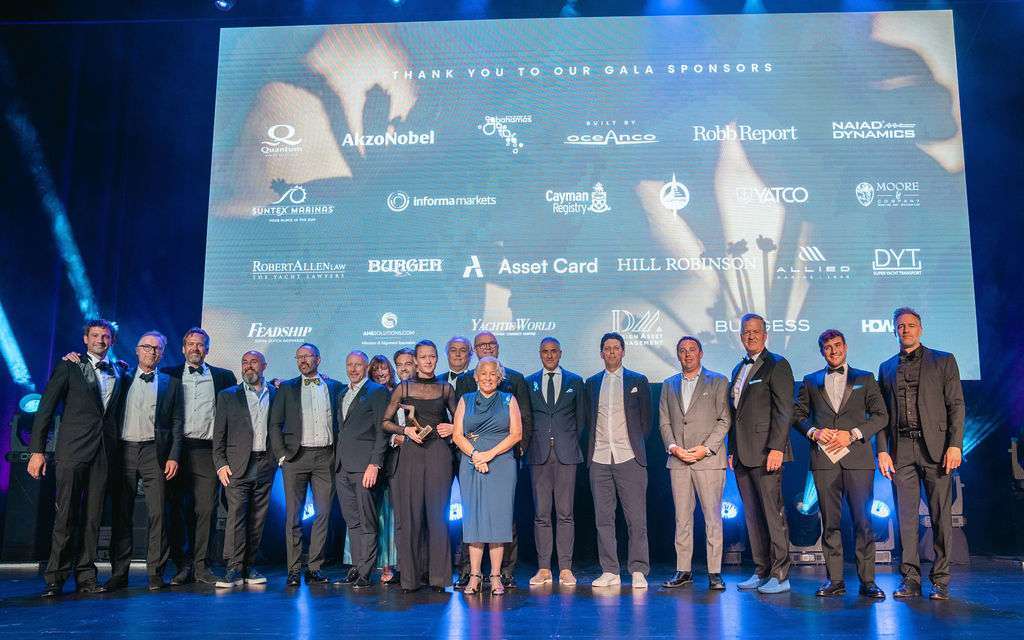

2026 International Superyacht Society awards ceremony, official ISS event photograph

News

ISS Honours Bernard d'Alessandri for Five Decades of Leadership at Yacht Club de Monaco

Nov. 13, 2026 Event

2026 International Superyacht Society awards ceremony, official ISS event photograph

The International Superyacht Society recognises Yacht Club de Monaco's Bernard d'Alessandri with its 2026 Leadership Award for decades of industry work.

An award for the institution-building behind yachting The International Superyacht Society has presented its 2026 Leadership Award to Bernard d'Alessandri of Yacht Club de Monaco, recognising his long involvement in the development of the club and the wider yachting industry. The distinction formed part of the society's Design & Leadership Awards, celebrated in Fort Lauderdale on 28 October after finalists were introduced during the Monaco Yacht Show in September. A detailed review of the awards was published on 11 November. The leadership award differs from a prize given to an individual yacht. It acknowledges work carried out over years through organisations, education, events and partnerships, making it relevant to owners, professionals and the institutions supporting the superyacht sector.

A relationship with Monaco that began in 1976 D'Alessandri joined Yacht Club de Monaco in 1976, according to the ISS award summary. Five decades of involvement have spanned major changes in yacht design, professional standards and the international role of Monaco as a maritime centre. His contribution is often associated with the club's ability to engage both experienced owners and younger participants, while connecting maritime heritage with technical change. It would be inaccurate to present every development in Monaco's yachting industry as the work of one person. The significance of long-term leadership lies in helping establish institutions and partnerships that continue beyond individual events. The award recognises that kind of accumulated involvement rather than a single recent commercial transaction.

The club's role has extended beyond traditional racing Yacht clubs can be understood primarily as venues for regattas and social gatherings, but prominent organisations also engage in training, technical discussion and the promotion of good seamanship. Monaco has developed an international profile in each of these areas, with the club serving as a meeting place for designers, owners, captains and maritime businesses. D'Alessandri's leadership has helped support that wider function, according to the awards coverage. Such an institutional role is important because a sophisticated yacht depends on people and services far beyond its builder. The club can bring those participants into conversation, although it is not itself responsible for the regulation or certification of every yacht associated with Monaco.

Cluster Yachting Monaco connects businesses and expertise One initiative identified in the award account is Cluster Yachting Monaco, intended to strengthen relationships among firms and professionals working in the principality's yachting economy. Clusters can provide a forum for companies that otherwise meet mainly as buyers and suppliers, including designers, shipyards, brokers, service providers and specialist advisers. Their usefulness depends on what the members achieve: exchanging technical knowledge, building partnerships and identifying workforce or infrastructure needs. The award does not offer a quantified economic impact for the cluster or claim that it has created a specific number of new jobs. Any such figures would require independent supporting data, not a general statement of institutional success.

Education is one of the less visible contributions The La Belle Classe Academy is another programme connected to the club's broader development. Education matters in yachting because the sector combines advanced engineering with hospitality, navigation and international regulatory responsibilities. A well-known club can help raise awareness of career paths and professional standards, but a training programme's value depends on its instructors, curriculum and relevance to the people attending. The ISS Leadership Award places this educational work within a larger picture of industry development. It does not establish that attending one academy session gives a participant a statutory maritime qualification. Prospective students should examine the content and recognition of individual courses before enrolling.

The Monaco Energy Boat Challenge offers a testing ground The Monaco Energy Boat Challenge has become a distinctive event within the principality's maritime calendar, bringing students, engineers and companies together around alternative propulsion and efficient marine systems. Although many of the vessels and prototypes involved are smaller than the superyachts covered by this publication, the engineering questions can be relevant to larger designs. Energy storage, electric propulsion, system integration and operational efficiency must all be approached with a clear understanding of safety and performance limits. A prototype performing well in a controlled competition does not establish that the same solution can immediately be installed on an ocean-going superyacht. The event's value lies in encouraging experimentation and technical exchange.

SEA Index makes environmental performance part of the conversation D'Alessandri's award summary also references the SEA Index, associated with efforts to create more structured discussion of environmental performance among large yachts. Environmental metrics can be useful when they are transparent, comparable and tied to well-defined boundaries. Owners and shipyards should examine precisely what an index measures, how data is collected and whether results are independently verified. One score cannot capture every environmental impact, from construction materials to operational emissions or ecological effects at destinations. The significance of such initiatives is their attempt to move the conversation beyond general statements of good intentions. They should not be presented as automatic proof that any yacht is sustainable simply because it participates.

The 2026 awards connected Monaco and Fort Lauderdale The ISS programme introduced finalists at Yacht Club de Monaco on 23 September before announcing the winners at the Broward Center for the Performing Arts in Florida on 28 October. The international structure matters because the superyacht industry spans many regions, with shipyards, design studios and operational teams distributed worldwide. A Monaco-based leadership award announced in Fort Lauderdale illustrates the connections among those communities. It also provides a distinct editorial angle from coverage focused only on yachts winning design categories. The leadership recognition concerned an individual's long service; the design awards assessed particular projects. Conflating the categories would obscure the purpose of each distinction.

Breakthrough took the overall yacht honour The evening also recognised 119-metre Feadship Breakthrough as Yacht of the Year, alongside success in its size category. The yacht's design credits include RWD and Feadship De Voogt Naval Architects. These results give context to the scale of the awards without suggesting that D'Alessandri was responsible for the yacht's construction. An award event with both project and personal categories acknowledges that the industry depends on design achievement and the institutions that support the people behind it. The outcome also reflects the international character of superyacht construction, where a single vessel can draw on design and technical expertise from several organisations.

Awards for craft and crew broaden the picture The 2026 Awards of Distinction also recognised people working in roles often less visible than a superyacht's designer or owner. Lina Heinze of Abeking & Rasmussen received the Artisan Award, while Captain Brendan Emmons of motor yacht Freedom received the Distinguished Crew Award. The accounts highlight practical craftsmanship, crew development and an initiative to donate surplus provisions at ports. These are distinct from D'Alessandri's leadership recognition, but they illustrate why industry awards can be more meaningful when they acknowledge the ongoing work required to build and operate yachts responsibly. The result should not be converted into an unsupported claim that every activity associated with an award winner has been independently audited.

Technology and training were represented as well The ISS programme recognised REGENT Craft for its electric Seaglider concept in the Excellence in Technology category, and Giles Barkley for his contribution to yachting education at Solent University. Captain Michael Dailey received the Bridge Salute Award for mentorship. Such categories demonstrate the breadth of the industry, from new marine transport concepts to the preparation of future naval architects and deck officers. An award is recognition by the society, not necessarily a regulatory certification or proof of commercial viability. A technology that may eventually connect yachts and shore facilities needs its own testing and approval processes. Similarly, teaching and mentoring require sustained commitment rather than one evening of celebration.

Why a leadership prize can matter to owners Owners may focus on designers, builders and brokers when commissioning or buying a yacht, but the reliability of the wider industry also depends on professional communities that encourage training, technical standards and constructive exchange. Institutions can help build continuity across changing markets and generations of yacht owners. Leadership awards are one way to recognise that less visible work. They should not be treated as guarantees of the performance of a particular company or service provider. The practical benefit lies in creating conditions in which professionals can learn from one another and discuss shared challenges, including sustainability, safety and access to specialist skills.

A five-decade career has seen the definition of superyachting change Since the 1970s, superyachts have grown considerably in size, complexity and onboard systems. Advances in materials, communications and comfort have been accompanied by greater expectations for professional management and environmental accountability. Institutions such as Yacht Club de Monaco have had to adapt to those changes while retaining a connection with sailing and maritime heritage. D'Alessandri's long involvement provides a perspective across that period. The award does not claim that his personal career caused every transformation, but it does acknowledge consistent participation in the organisations through which the industry discusses and responds to change.

Recognition does not end the work The ISS honour arrives at a time when the superyacht sector continues to examine energy use, technical training and public expectations of its role. Maintaining a constructive forum for those conversations may be more demanding than staging a successful annual event. Clubs and industry groups must accommodate interests that do not always align, including owners, operators, researchers and businesses. A useful leadership legacy is measured partly by whether organisations can continue to function and adapt after individual leaders move on. The 2026 recognition is therefore best understood as acknowledgement of long service and institution-building, rather than an announcement of retirement or a change in Yacht Club de Monaco's management.

A Monaco connection to the global awards stage The ISS Leadership Award to Bernard d'Alessandri connects the history of Yacht Club de Monaco with the industry's wider international community. The announcement is distinguishable from earlier articles about the specific yachts that won design categories. It concerns the club's influence through Cluster Yachting Monaco, the Energy Boat Challenge, the SEA Index and professional education. Those initiatives address different needs, but together they demonstrate the range of subjects now discussed within contemporary yachting. For owners, crew and the businesses serving them, the award is a reminder that the future of superyachting is shaped not only by striking new vessels but also by the people who build durable institutions around them.

**Primary source:** International Superyacht Society 2026 Design & Leadership Awards report as published by PressMare on 11 November 2026; event held 28 October. Official ISS gala photograph, properly credited. This coverage is focused on leadership rather than duplicating individual yacht award reports.

Primary source: ISS Design & Leadership Awards 2026 via PressMare.

Photo: International Superyacht Society gala photograph, as supplied with 11 November 2026 awards coverage; does not depict only the honouree. Official source image.

Photo licence and source

Photo: International Superyacht Society gala photograph, as supplied with 11 November 2026 awards coverage; does not depict only the honouree.

Continue reading

All news

Superyacht Guide

Explore the superyacht world

Continue into the wider Superyacht Guide.

Business opportunities · Superyacht Guide

Reach the superyacht industry audience

Companies serving the superyacht market can discuss clearly identified advertising, sponsorship and business-profile opportunities. Commercial activity remains separate from independent editorial coverage.