Yachtwerft Meyer Brings Superyacht Tender and Refit Expertise to METSTRADE
By Superyacht Guide Newsroom · Edited by Superyacht Guide Newsroom
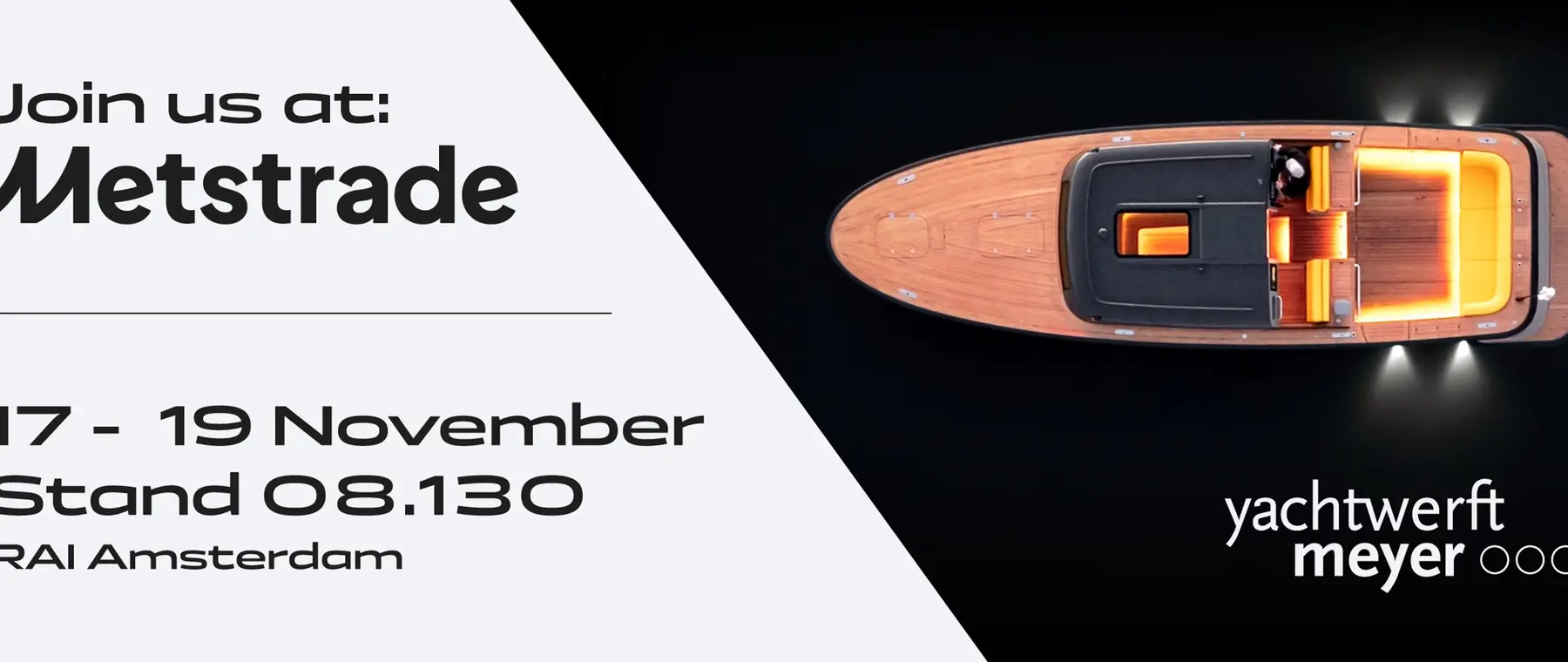
Yachtwerft Meyer official METSTRADE 2026 tender presentation
Yachtwerft Meyer will present custom tender design, refit, composite engineering and specialist marine equipment at METSTRADE in Amsterdam on 17–19 November.
German specialist Yachtwerft Meyer will use METSTRADE 2026 to present its capabilities across custom superyacht tenders, refit, composite engineering and equipment made for individual vessels. The company's advance announcement confirms its participation in the Superyacht Zone at RAI Amsterdam from 17 to 19 November, at stand 08.130. Rather than announcing the delivery of a particular craft, the company is inviting owners' representatives, technical managers, naval architects and shipyards to discuss forthcoming projects and the ways in which its different engineering disciplines can be combined.
For the large yacht sector, this is a useful opportunity to examine the tender as a component of a much larger operational system. A beautifully designed launch must still work within the storage, handling, maintenance and safety arrangements of its mothership. Decisions about a tender and its associated equipment can therefore affect the engineering of the yacht itself, as well as the experience of the people on board.
The company's presence at METSTRADE is particularly relevant to teams that are considering changes to an existing tender fleet or preparing the specification for a new yacht. A specialist exhibition offers a concentrated opportunity to begin technical discussions before formal requests for proposals have been issued. Representatives can compare the practical implications of alternative construction methods, discuss preliminary arrangements and determine what additional engineering information would be required to develop a suitable project.
Yachtwerft Meyer has set out five connected areas of work in its announcement: bespoke tender development, internal design and naval architecture, refit, custom marine equipment and composite manufacturing. The breadth of this offering matters because the interfaces between these disciplines often determine whether a project meets expectations. A hull shape or deck arrangement, for example, cannot be considered independently of the available lifting envelope, access for servicing or the intended duty cycle of the craft.
A tender for a superyacht is often expected to perform several functions that would be treated as separate requirements on a conventional recreational vessel. Guests may need a sheltered transfer between shore and yacht in variable weather, while the crew may use a separate craft to move provisions, support water activities or manage operations at anchor. The design brief must determine which functions are essential rather than assume that one configuration can satisfy every task.
The physical connection to the mothership introduces a second layer of complexity. Overall dimensions must be reconciled with garage openings, cradle positions, lifting points and the movement of equipment through the yacht. Weight estimates should be developed alongside the lifting and securing arrangements, with allowances for fuel, equipment and any later changes. These are matters for the appropriate naval architects, equipment manufacturers and safety specialists to resolve together. At the specification stage, a purchasing team benefits from an explicit record of every interface for which another supplier is responsible.
Yachtwerft Meyer highlights an in-house design studio that can develop styling and naval architecture from the initial concept through production. For an owner commissioning a bespoke tender, the distinction between these two activities is less important than the way in which they inform each other. The external appearance may need to reflect the design language of the parent yacht, but the design should not sacrifice access, visibility, comfort or the appropriate structural arrangements simply to reproduce its visual proportions.
An early design review can bring practical questions into the conversation while changes are still comparatively straightforward. These might include boarding height, circulation around seats, access to mechanical spaces, the position of drainage points and the ease with which removable covers can be handled by the crew. The tender's appearance is then developed as part of a usable package rather than as a separate styling exercise. Prospective clients should ask which elements of the specification are already resolved and which depend on engineering development, testing or approvals.
Among the services promoted for Amsterdam are refinishing, propulsion-system overhaul, replacement or customisation of decking and structural repairs. These capabilities are relevant to owners whose yachts already have a tender that fits the existing garage arrangement and serves its intended purpose but requires substantial attention after years of operation. Replacement is not necessarily the most suitable answer if the existing hull and equipment can be restored to an appropriate condition within a realistic budget and programme.
The first step in evaluating such a project is a condition assessment that distinguishes cosmetic work from technical defects. A refinishing programme, for instance, may reveal underlying problems that should be addressed before the new coating system is applied. A propulsion overhaul requires an understanding of the machinery's service history, the availability of components and the scope of any testing required after reassembly. Structural repairs must be supported by appropriate investigation and design decisions rather than treated as cosmetic improvements. A documented survey gives the owner a much firmer basis for comparing the remaining life of the craft against the cost of purchasing a replacement.
The announcement also emphasises composite engineering throughout the company's manufacturing activities. Composite structures are of particular interest where weight, available volume and the integration of complicated shapes influence the design brief. Their suitability for a given application depends on the materials, structural arrangement, manufacturing process and quality controls, not merely on the fact that a composite has been selected.
For yacht operators, the long-term implications are equally important. An engineering specification should describe the intended service environment, maintenance requirements and approach to future repair. Areas exposed to impact, repeated loading or abrasion may demand different provisions from relatively protected surfaces. At the procurement stage, owners' teams should establish what documentation will be provided, including the information necessary for future inspections and repairs. That record remains valuable long after the initial construction team has moved on to another project.
The company's advertised capabilities also include tailored deck layouts, pool installations and modular marine equipment. This creates potential points of contact with refit yards and yacht builders beyond the conventional tender procurement process. The installation of a new piece of equipment on a large yacht can require consideration of its foundation, operating loads, service connections, drainage, surrounding access and compatibility with the vessel's existing systems.
A successful equipment specification should therefore account for the complete installation and not simply the dimensions of the visible product. Where equipment is movable or removable, the operating procedure should be considered from the perspective of the crew who will handle it. Maintenance access, replacement of components and the safe storage of any detached parts are relevant considerations. Owners' representatives can use preliminary meetings to identify the information each supplier needs from the yard and determine who will coordinate the resulting design.
A manager visiting stand 08.130 with a real project in mind will obtain more value from the meeting if the project brief is already structured. Useful information could include the intended operating regions, the tender fleet's current role, the available space on the mothership, known handling limitations and the owner's priorities for guest experience. For a refit, existing drawings, photographs, maintenance histories and a list of observed defects may help establish the questions that need to be addressed.
It is also sensible to separate fixed requirements from preferences. A limitation imposed by the yacht's garage or lifting equipment may not be negotiable without a wider engineering programme, whereas the upholstery or finish might remain open to revision. Discussions can then focus on unresolved issues rather than producing concepts that are attractive but incompatible with the existing vessel. Estimates arising from such early meetings should be treated as preliminary until the necessary technical information has been assessed and the scope agreed.
Yachtwerft Meyer's programme illustrates the continuing importance of specialist firms that work at the intersection of yacht design and operational engineering. The tender is no longer simply a convenient accessory on many large yachts; it can be central to the way guests move between destinations and crews deliver the service expected of them. Meanwhile, investment in improving an existing tender or other equipment can make a material difference to the usability of an established yacht.
The Amsterdam presentation is scheduled for the coming week, and no new delivery, transaction or product launch is confirmed by the company's announcement. Its significance lies in the opportunity for the industry to discuss projects that connect custom design, engineering, manufacture and later support. For superyacht owners and their professional advisers, the most useful outcome of those conversations will be a clearer definition of the requirements and responsibilities that must be established before any commission proceeds.
Primary source: Yachtwerft Meyer — official METSTRADE 2026 announcement.
Yachtwerft Meyer — official METSTRADE event artwork featuring its tender design. Official source.
Yachtwerft Meyer — official METSTRADE event artwork featuring its tender design.
Explore
Go deeper into the yachts, companies, events and destinations directly connected to this article.
Continue reading
SeaKeepers has published attendance and fleet participation figures for its completed Fort Lauderdale Founders gala, recognising conservation leaders and yacht crews who support marine …
STELLAMAR's 35-metre RJ 115 design shows how expedition-grade engineering and Italian interior architecture can share one coherent owner-focused superyacht.
Fraser has published its October 23 Fort Lauderdale Forum programme for yacht captains, with sessions on crew welfare, regulation, insurance and safety.

Captain Whitney Reiter and Bosun Martin Dawson from 55m NEXT CHAPTER won the Northrop & Johnson crew tournament near Fort Lauderdale after more than …
Superyacht Guide
Continue into the wider Superyacht Guide.
Business opportunities · Superyacht Guide
Companies serving the superyacht market can discuss clearly identified advertising, sponsorship and business-profile opportunities. Commercial activity remains separate from independent editorial coverage.
