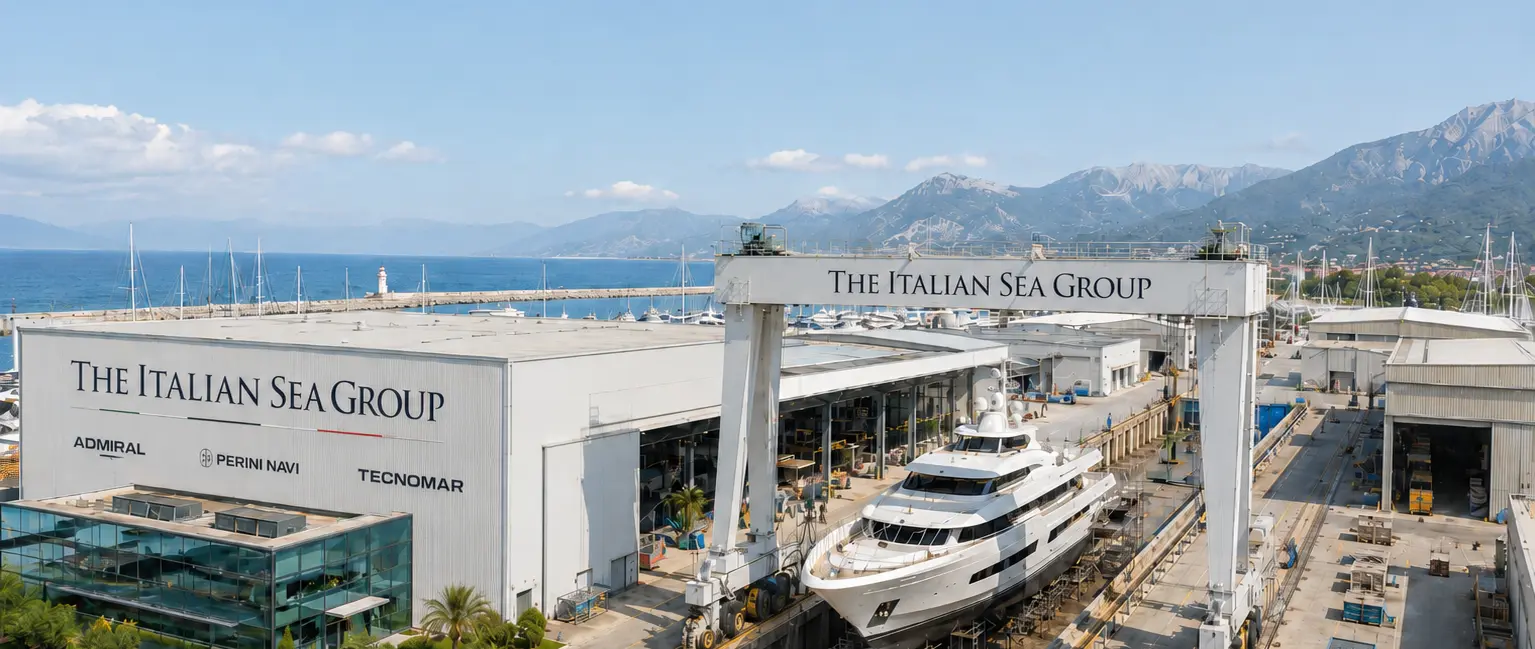
The Italian Sea Group has disclosed €270.084 million of overdue liabilities, €179.590 million of net financial debt and 38 payment injunctions as its restructuring and investor process move into September.
The financial pressure behind The Italian Sea Group's restructuring has become clearer after the Italian yacht builder disclosed €270.084 million of consolidated overdue liabilities at 31 July 2026, alongside net financial debt of €179.590 million. The figures were published in a regulated market update dated 31 August and issued at the request of Consob, giving creditors, investors, owners and suppliers a more detailed view of the group's position as the restructuring enters September.
The filing arrives while the group behind Admiral, Perini Navi, Picchiotti and Tecnomar remains in a court-supervised crisis procedure and simultaneously runs a competitive process for new investors. Those processes are related but distinct: one is intended to establish a restructuring capable of preserving the business, while the other is testing whether new capital, a change of control or asset transactions can provide part of the solution.
The €270.084 million figure should not be read as conventional bank debt alone. It is the group's total of overdue obligations reported in the Consob update, including financial, supplier, factor, tax and social-security positions whose contractual or legal payment dates had passed and which had not been paid, rescheduled or otherwise settled by the reporting date.
At group level, overdue liabilities stood at €270.084 million at 31 July 2026, compared with €257.726 million at 30 June. The increase of about €12.36 million in a single month shows that pressure continued to build even while the company was pursuing its formal restructuring and investor process.
The largest component was €98.413 million owed to factor-related counterparties, followed by €85.749 million of overdue commercial debt to suppliers. A further €48.724 million was classified as overdue financial debt, while overdue tax liabilities amounted to €17.635 million and overdue social-security obligations stood at €19.563 million.
Supplier arrears account for most of the month-on-month deterioration. Overdue commercial liabilities to suppliers increased from €75.487 million at the end of June to €85.749 million at the end of July, a rise of more than €10 million, while the factor-related balance remained broadly stable at just above €98 million.
The company has said that some supplier positions had previously been subject to agreements reducing amounts owed or rescheduling remaining balances during the earlier negotiated crisis procedure. Those arrangements now have to be considered within the wider restructuring process, alongside tax, social-security, financial and trade-creditor claims.
The consolidated net financial position presents a different measure because it focuses on financial indebtedness net of available liquidity rather than every overdue commercial or statutory liability. At 31 July, The Italian Sea Group reported consolidated net financial debt of €179.590 million, slightly below the €181.064 million reported one month earlier.
The group reported €148.870 million of bank debt and cash and cash equivalents of €5.320 million, together with other financial liabilities including the €25 million shareholder financing provided by majority shareholder GC Holding and liabilities arising from IFRS 16 accounting. Cash had increased from €2.910 million at the end of June, helping produce the modest improvement in the net financial position.
That movement does not remove the pressure visible elsewhere in the accounts. The company's bank exposure is classified as short term following missed repayments, and the filing notes that lenders could, as a consequence of missed principal payments, demand repayment of instalments that had not yet reached their original maturity.
The distinction between net financial debt and overdue liabilities is therefore important. Net debt can improve slightly because cash rises or financial balances move, while unpaid supplier, tax, factor and other obligations can continue to increase at the same time.
The regulated filing also provides unusually detailed evidence of how creditor pressure has translated into legal action. The Italian Sea Group said that TISG S.p.A. had received 38 payment injunctions since 16 March, with a stated value of approximately €2.307 million.
Twenty-two of those cases had already been closed, involving a final negotiated amount of €408,000, while several others remained subject to opposition, negotiation or the wider financial restructuring. The disclosure also identifies factor-related claims, supplier claims and claims from former employees, illustrating that creditor pressure is spread across different parts of the company's liability structure.
Separate proceedings have also affected group companies outside the Italian parent. The filing refers to precautionary enforcement action involving TISG Turkey, while Celi had received two payment injunctions with a combined value of €14,000 and had closed both through full payment.
The group's protective measures remain important in this context because they restrict enforcement and precautionary action by creditors during the applicable protected period. Those protections do not eliminate the underlying claims, but they are intended to provide space in which a restructuring proposal can be developed rather than allowing individual enforcement actions to determine the outcome piecemeal.
The numbers matter to the superyacht industry because The Italian Sea Group is an active shipbuilding organisation rather than a passive financial holding company. Its restructuring therefore sits directly alongside yachts under construction, specialist suppliers, owners with contracts in progress and brands whose value depends on preserving industrial continuity.
Cash pressure can move rapidly through a construction programme because suppliers must continue providing equipment and labour, shipyards require working capital, and owners need confidence that the organisation responsible for completing their yachts can continue engineering, purchasing and managing complex projects. The increase in overdue supplier debt is significant for that reason even though the filing does not identify a specific yacht project as having stopped because of those arrears.
The group has previously acknowledged additional costs across projects in progress and pressure on project margins and liquidity. Those difficulties were among the issues that led to the formal crisis process and earlier shareholder support, and they explain why a durable solution has to address operating liquidity as well as the balance sheet.
For owners, the central question is consequently broader than whether banks and other creditors eventually accept a restructuring proposal. Any workable solution also needs enough financial and industrial stability to support unfinished yacht projects through delivery while preserving the people, suppliers and specialist capabilities on which Admiral, Perini Navi and the group's other brands depend.
The latest financial disclosure comes while The Italian Sea Group runs the competitive process examined in Superyacht Guide's August report on the search for new investors. That process allows proposals based on the acquisition of all or part of the operating business as well as proposals centred on recapitalising the company through a share transaction.
The assets identified in that process include the Carrara and La Spezia shipyards, the Viareggio site and the Admiral, Perini Navi, Picchiotti and Tecnomar brands, together with interests in Celi and TISG Turkey. Bidders can therefore assess the group as an integrated business or consider transactions involving particular assets or combinations of assets, subject to the restructuring framework and the approvals ultimately required.
The timetable places September at the centre of the process. Non-binding indicative offers are due on 15 September under the published competitive procedure, after which selected investors are expected to proceed into more detailed due diligence before the later binding-offer stage.
The investor process follows the governance and financial disruption examined in Superyacht Guide's earlier analysis of the TISG leadership crisis. The 31 August figures move the story beyond questions of governance by quantifying more precisely the obligations that any restructuring, recapitalisation or transaction will have to address.
For a prospective investor, the latest disclosure provides a clearer view of the financial repair required alongside the acquisition of valuable yacht brands and industrial assets. The attraction of recognised names such as Admiral and Perini Navi has to be assessed together with the working-capital demands of active yacht construction and the creditor positions accumulated during the crisis.
An asset transaction and a recapitalisation do not create the same exposure, and the allocation of liabilities would depend on the eventual structure, court process and negotiated terms. It is therefore too early to assume that a buyer of particular assets would inherit every obligation reported by the existing group, just as it would be premature to assume that a share investor could restore the company simply by paying the current net-debt figure.
The €270.084 million of overdue liabilities is especially useful because it shows how far the problem extends beyond bank borrowings. Suppliers, factors, tax authorities and social-security institutions all appear in the reported overdue balance, so the restructuring has to reconcile a much wider creditor base than a conventional refinancing would involve.
That does not determine the value of the shipyards or brands, nor does it establish the amount of new money ultimately required. It does, however, give bidders and industry stakeholders a more concrete measure of the financial pressure that sits behind the competitive process.
The 31 August disclosure is a snapshot rather than the final restructuring outcome, and The Italian Sea Group states that the financial information has not yet been audited. The company's position, creditor negotiations and court timetable can therefore continue to change as the restructuring develops.
The filing also does not determine which creditors will ultimately be paid in full, which obligations may be rescheduled or how any investor transaction will be structured. Those questions depend on the restructuring proposal, negotiations with creditors, the competitive process and the decisions taken within the formal court procedure.
What the document does establish is a much clearer starting point. At 31 July, the group reported €270.084 million in consolidated overdue obligations, €179.590 million in net financial debt, €148.870 million of bank debt and €5.320 million of cash, while creditor action had produced 38 payment injunctions against the parent company since March.
Those numbers now sit alongside the investor competition and the continuing restructuring. September should begin to show whether The Italian Sea Group can be recapitalised as an integrated yacht-building business, whether important assets and brands are more likely to change hands, or whether the eventual solution combines elements of both.
Explore
Go deeper into the yachts, companies, events and destinations directly connected to this article.
Continue reading

The Italian Sea Group reappoints founder Giovanni Costantino as CEO, creates new board committees and moves half-year reporting to 3 November.

The Italian Sea Group has reported a €170.9 million consolidated net loss for 2025, with revenue down 27% to €295.1 million.
The Italian Sea Group has received 11 non-binding offers in its investor process. Selected bidders will proceed to due diligence ahead of a 15 …
The Court of Florence has granted The Italian Sea Group another 60 days to file its definitive restructuring plan and proposal under Article 44 …
Superyacht Guide
Continue into the wider Superyacht Guide.
Business opportunities · Superyacht Guide
Companies serving the superyacht market can discuss clearly identified advertising, sponsorship and business-profile opportunities. Commercial activity remains separate from independent editorial coverage.