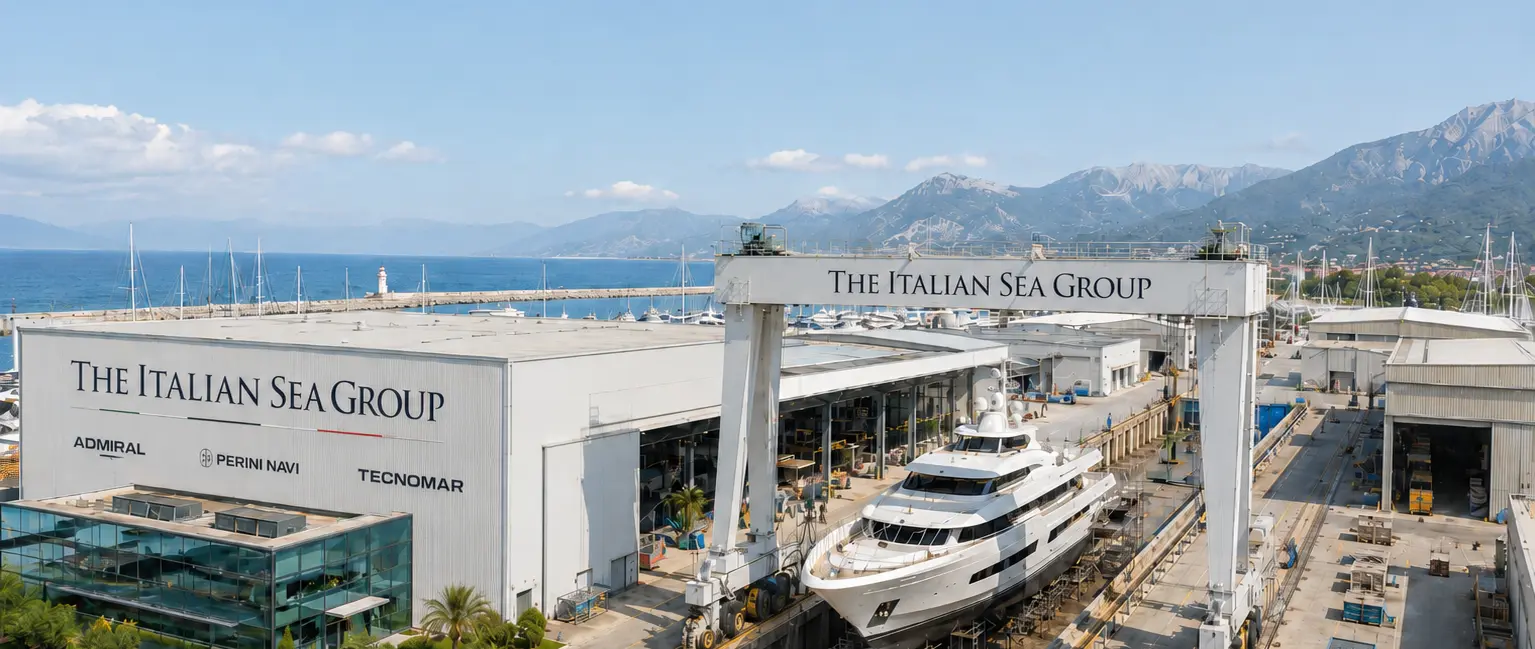
The Italian Sea Group has formally opened a competitive investor process that could lead to the sale of shipyards and yacht brands or a recapitalisation of the company under new ownership.
The future of The Italian Sea Group has moved into a more decisive phase after the Italian yacht builder formally launched a competitive process to identify new investors, replacing a series of unsolicited approaches with a structured procedure under the supervision of its court-appointed commissioners.
The process gives potential investors two fundamentally different routes into the company. One is an asset transaction that could involve the entire operating business, individual shipyards, yacht brands or combinations of assets. The other is a share transaction built around a capital increase intended to recapitalise the existing company and restore the financial conditions required for it to continue as a going concern.
That distinction makes this considerably more significant than the individual expressions of interest that emerged during recent weeks. The question is no longer simply whether one shipyard or investor wants to buy The Italian Sea Group. The company has created a formal mechanism through which competing proposals can be compared, due diligence can be conducted on common terms and the restructuring authorities can consider which solution offers the strongest combination of value, continuity and creditor protection.
The Italian Sea Group said the process follows numerous unsolicited expressions of interest and is intended to place interested parties inside a common framework. Meti Corporate Finance and KPMG Advisory have been appointed as joint financial advisers, with participants receiving common information under confidentiality arrangements, a process letter, an information package and uniform deadlines.
For the restructuring, this is an important change. Earlier approaches could be evaluated individually, but they did not in themselves establish the market value of the whole business or its component parts. A competitive procedure allows The Italian Sea Group and the judicial bodies supervising the process to compare proposals against one another and consider whether selling the business as a whole produces more value than separating selected assets.
Sanlorenzo had already provided one of the clearest indications of strategic interest. On 27 July it confirmed its backing for an offer submitted by the promoters of Polo Nautico Carrara for The Italian Sea Group's entire operating business. Sanlorenzo said it was interested in taking a minority stake in the proposed consortium and had provided support for up to 10 per cent of the purchase price. earlier Superyacht Guide coverage examined that proposal before the formal competitive process had been launched.
The official Sanlorenzo announcement expressly anticipated participation in any competitive sale procedure subsequently launched by The Italian Sea Group. That procedure now exists, moving the proposal from an isolated expression of interest into a wider contest conducted under common rules.
The asset-sale route is particularly significant because The Italian Sea Group has defined a broad disposal perimeter rather than requiring a buyer to acquire the group intact. The assets potentially available include the Carrara and La Spezia shipyard sites, the Viareggio site, and the Admiral, Perini, Picchiotti and Tecnomar brands. The process also includes the group's shareholdings in Celi S.r.l. and TISG Turkey Yat Tersanecilik A.Ş. within the potential transaction perimeter.
Bidders do not have to submit an offer for everything. They may propose acquiring the complete operating business, individual business units, particular assets or combinations of assets. Offers can also cover several different perimeters, while The Italian Sea Group retains the ability to consider separate offers together where doing so would create a higher aggregate value.
For the superyacht industry, that structure creates several possible outcomes. A strategic buyer could attempt to preserve The Italian Sea Group substantially intact, maintaining the connection between large-yacht construction, specialist facilities and brands such as Admiral and Perini Navi. Alternatively, different buyers could place different values on the shipyards, brand names, refit infrastructure and international production assets, ultimately producing a more fragmented group.
The industrial consequences would differ sharply between those outcomes. A yacht brand is valuable not only because of its name and intellectual property but because of the designers, engineers, production teams, supplier relationships, facilities and technical records that allow yachts to continue being designed, constructed and supported.
The second route avoids an asset sale altogether. The competitive process explicitly allows for a share deal through a capital increase. Under that scenario, new capital would be injected into The Italian Sea Group with the objective of recapitalising it and restoring the capital and financial conditions necessary for continued operation as a going concern.
This could preserve more of the existing corporate structure, but it would require investors to become comfortable with the group's financial position, restructuring obligations and risks attached to the operating business.
The latest preliminary figures illustrate the scale of that challenge. In unaudited management accounts filed with the Florence court, The Italian Sea Group reported shareholders' equity of approximately negative €392.3 million at 30 June 2026 and cash and cash equivalents of approximately €2.6 million. Current liabilities stood at approximately €505.3 million, while the company reported a net loss of approximately €15.8 million for the first six months.
The company has emphasised that those figures remain preliminary and may change during the formal reporting and audit process. They are contained in The Italian Sea Group's official August restructuring and financial update .
An investor choosing the recapitalisation route would effectively be betting that the value of the shipyards, brands, workforce, customer relationships and remaining yacht programme can support a viable operating business once sufficient capital and a sustainable balance sheet are restored. An asset buyer faces a different calculation: which individual parts of the group retain the strongest industrial value when considered separately?
Whatever ownership solution eventually emerges, the position of yachts already under construction will remain critical. Sanlorenzo's earlier consortium proposal provided an indication of that complexity because continuation of existing shipbuilding contracts was to depend on direct negotiations with the respective yacht owners rather than simply transferring every project unchanged to a new operator.
The Florence court has also altered some of the protective measures surrounding current contracts. In its 29 July ruling, the court withdrew interim protections that had prevented certain shipowners from exercising contractual remedies and enforcing guarantees. The Italian Sea Group stated that the restructuring plan did not envisage continuing work on the majority of contracts, while temporary protection remained for strategic suppliers connected with projects the company intended to complete.
The company's official disclosure of the Florence court decision therefore makes the order book different from an ordinary backlog being transferred with a healthy shipyard. Prospective buyers must consider the economics and legal position of individual projects as well as the value of the shipyards themselves.
For owners, the identity and financial strength of a future operator could be equally important. Large custom yachts can remain in construction for years, making continuity of engineering records, subcontractors, project managers and warranty responsibility fundamental to any decision about whether to continue.
The official regulated disclosure launching the competitive process sets out a series of clear milestones. Initial non-binding indicative offers are due by 12:00 CEST on 15 September 2026 and must remain valid for 90 days unless an extension is requested.
The company will then select investors to proceed into a second phase involving more detailed due diligence. That phase is currently expected to last approximately five weeks, with binding offers due by 15 October and signing presently targeted for approximately 26 October 2026. The Italian Sea Group has cautioned that the timetable can change where corporate, regulatory or procedural requirements make that necessary.
Any completion remains subject to supervision by the judicial commissioners and the required court approvals. The identities of participants and the detailed terms of their proposals are intended to remain confidential during the process, meaning that the public contest may appear quieter than the strategic activity taking place inside the data room.
What is now clear is that the restructuring has moved beyond speculation about individual interested parties. The Italian Sea Group has formally put several possible futures into competition with one another. One bidder may see greater value in keeping the shipyards and brands together, another may want only particular assets, while an industrial or financial investor may conclude that recapitalising the existing company offers the stronger route.
For the Italian superyacht industry, the outcome matters because the assets involved include established large-yacht brands, specialist shipyard infrastructure and a workforce embedded in one of Europe's most important yacht-building clusters. The competitive process is therefore becoming a test not only of how The Italian Sea Group can be restructured, but of how the market values the individual pieces from which the group was built — and whether those pieces ultimately have greater value together or apart.
Explore
Go deeper into the yachts, companies, events and destinations directly connected to this article.
Continue reading

Metstrade has confirmed six initial exhibitors for its dedicated 2026 Superyacht Startups Area in Hall 8, with Fort Insurance sponsoring the wider programme.
D-Marin has partnered with ult. Insurance to connect yacht owners at its UAE marinas with specialist cover reviews, placement, claims assistance and a dedicated …
The Italian Sea Group has received 11 non-binding offers in its investor process. Selected bidders will proceed to due diligence ahead of a 15 …
The Court of Florence has granted The Italian Sea Group another 60 days to file its definitive restructuring plan and proposal under Article 44 …
Superyacht Guide
Continue into the wider Superyacht Guide.