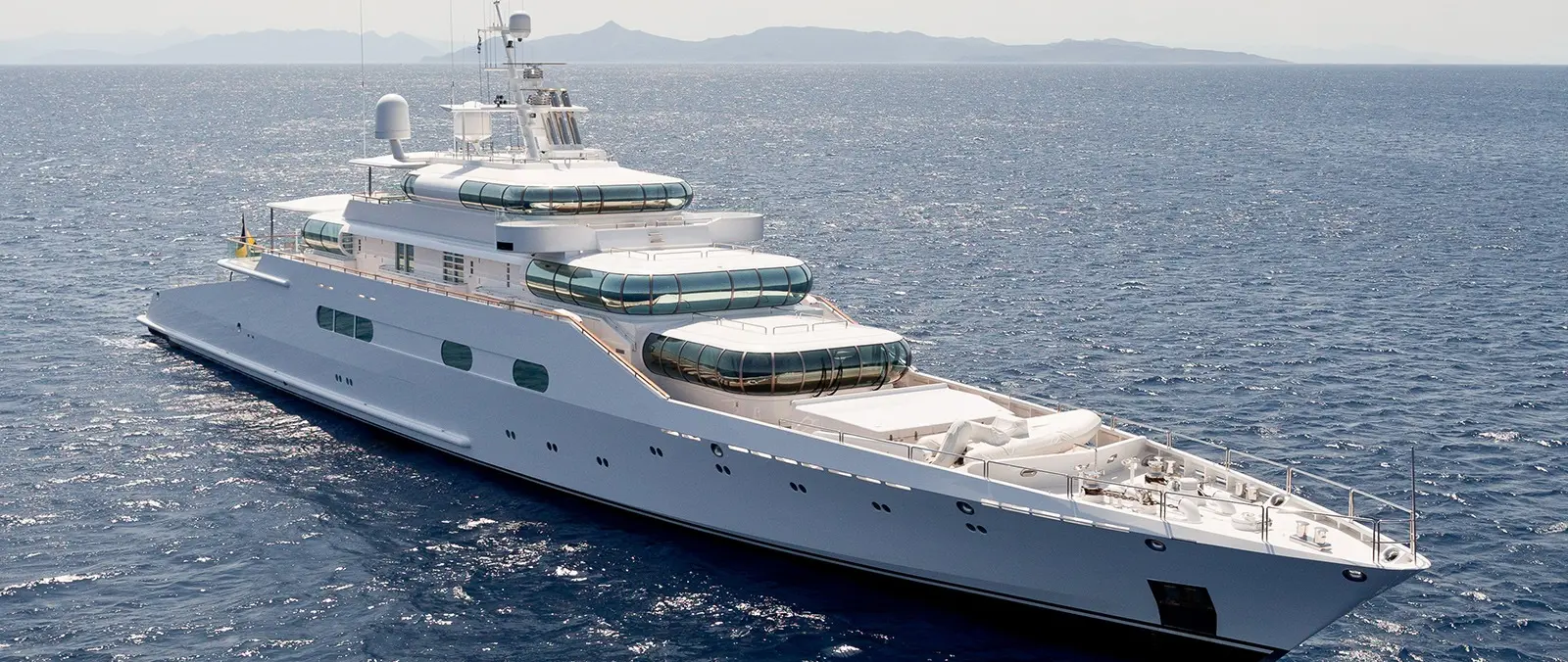
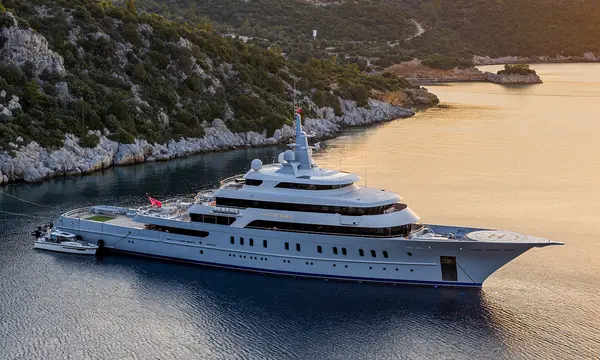
ZEUS Blohm Voss 74.5 metre official IYC gallery photograph Jeff Brown November 2026
IYC's November retrospective reunites the original designers of 74.5m ZEUS, examining her distinctive glazing, engineering and continued appeal to buyers.
International Yacht Company has released a new retrospective on the 74.5-metre Blohm & Voss superyacht ZEUS, featuring a walkthrough with exterior designer Martin Francis and interior designer François Zuretti. Published by the brokerage on 12 November 2026, the feature revisits the decisions behind a yacht delivered in 1991 that challenged established expectations of large motor yacht architecture. IYC currently represents the yacht for sale as central agent and lists an asking price of €77 million.
The significance of the November feature is its access to the original design team rather than a change in price or a new sales appointment. The yacht has already been presented to buyers at the Monaco Yacht Show. This latest material provides a different opportunity to examine the relationship between the original design ambitions, the engineering needed to execute them and the challenges of operating such a specialist craft after more than three decades.
The conventional exterior of a large motor yacht often gives a clear visual indication of the relationship between its main hull and the superstructure. ZEUS instead relies on a highly sculpted form, with curved glazing and distinctive transitions between surfaces. The effect remains striking even in a market that has become much more receptive to unconventional exterior design.
Such an appearance depends on cooperation between the designers, naval architects and the systems teams responsible for what lies behind the exterior. The position and geometry of a window, for example, affects the space available for the interior fit-out, the amount of light entering a space and the work required to build and maintain the surrounding structure. A complex external feature may need to be reconciled with structural requirements, sightlines and the operation of equipment. For someone contemplating a new custom yacht today, the design process remains just as important as the final external profile.
The walkthrough brings together Francis and Zuretti, whose exterior and interior contributions are central to the yacht's character. IYC says that they discuss the thinking behind the vessel and the decisions that created her identity. A retrospective with people involved in a project's origins can offer useful context that is difficult to reconstruct from photographs alone.
A yacht's exterior and interior are often discussed separately, but the two are necessarily connected. An exterior design establishes parts of the volume and the physical boundaries within which the interior designer works. Changes to circulation, staircases or guest accommodation can have consequences for how the superstructure is arranged. Conversely, a visually important exterior characteristic may influence the position of furniture, the layout of a room or the treatment of lighting.
The brokerage's feature is a presentation connected with the sale of the yacht, not an independent technical assessment. A prospective owner should use it to understand the original design intent while commissioning separate professional advice about the current vessel.
In its current sales particulars, IYC describes a combination of diesel engines and gas turbines capable of producing a total of 28,500 horsepower. The listing identifies waterjet propulsion and an underwater foil, with a quoted maximum speed of 35 knots and a cruising speed of 18 knots. These are notable published figures for a yacht of this length and volume.
The arrangement illustrates a fundamental distinction between designing for relatively high speed and designing for economical long-distance passage. A specification that prioritises maximum speed involves different machinery, weight and hull-performance decisions from one that prioritises range at modest speeds. The fact that a yacht has an unusually high quoted maximum speed does not establish the fuel consumption, range or machinery configuration associated with a particular voyage. Those details are not provided in the November retrospective.
A buyer interested in the engineering should request current technical documentation and applicable sea trial data. The performance achievable under specific conditions will depend on the condition of the propulsion machinery, hull and associated systems as well as the yacht's displacement and environmental conditions. It is particularly important to understand the distinction between historical design performance and the results that can be substantiated after decades of operation.
ZEUS has a quoted gross tonnage of 1,150 GT and a beam of 11.2 metres. The current IYC listing describes accommodation for up to 15 guests across six cabins and capacity for up to 21 crew members. It also identifies an upper level reserved for the owner, with a private lounge and outdoor dining area. Gross tonnage is a measurement derived from enclosed volume, not the weight of the vessel.
In practical terms, a six-cabin arrangement of this scale provides an important example of how an owner can elect to use available internal space differently from a yacht designed for the maximum possible number of individual guest cabins. It is the configuration of the spaces, their access arrangements and the relationship between guest and service circulation that will determine their suitability for the next owner's intended use.
An inspection should establish what the stated guest capacity means in the context of the yacht's actual certification and intended operating regime. A private accommodation figure does not automatically establish the maximum number of guests permitted under a particular commercial charter arrangement or for a particular voyage.
The listing records the yacht's most recent refit year as 2024 and describes ongoing upgrades during her life. These statements provide a starting point rather than a comprehensive record of the work carried out. An owner investigating the yacht should seek an itemised history of significant repairs, modifications and surveys, together with the current status of maintenance requirements.
When a particular part of a yacht is highly specialised, replacement can involve substantially more work than ordering a standard component. Examples could include curved exterior glazing, structural interfaces or specialist propulsion equipment. The difficulty depends on how the original system was designed, whether equivalent parts remain supported and what documentation is available to the technical team. The buyer's survey should identify potential long-lead items and examine the accessibility of components whose servicing might require extensive dismantling.
The present-day value of the yacht's distinctiveness must therefore be considered alongside the level of commitment required to preserve it. Alterations acceptable on a more conventional vessel could compromise features that form part of ZEUS's architectural identity.
The €77 million asking price is the amount advertised by IYC at the time of this report, not a sale price or independent valuation. Large used yachts of unusual provenance are not always easy to compare directly. Length, delivery year and gross tonnage provide useful parameters, but they do not fully reflect the nature of the original commission, the engineering installation or the level of specialist maintenance associated with ownership.
One prospective owner might regard the distinctive design as a benefit worth preserving, while another seeking an easily adaptable yacht might prefer a less specialised alternative. The question is how closely the vessel's design and operating characteristics correspond to the buyer's intended lifestyle and requirements. Independent advice on condition, operating costs, tax status and contractual terms remains essential. IYC lists European VAT as paid; the documentary position and consequences for a particular transaction should be confirmed by the buyer's advisers.
The new walkthrough offers an opportunity to look beyond the familiar external photographs of ZEUS and consider the original creative decisions in their own context. The circumstances in which the yacht was designed were different from those confronting a present-day design team. Expectations of energy consumption, equipment, communications and environmental performance continue to change. Retaining a vessel with a significant design history does not mean maintaining every aspect of its original systems indefinitely.
Well-planned upgrades can protect the character of the yacht while supporting reliable operation. The challenge is to understand which elements are integral to the original design and which can be renewed without undermining that identity. That process requires a dialogue between technical specialists, the owner's team and designers who understand the existing vessel.
IYC's retrospective is a brokerage-led account of the yacht's creative history. It is not a record of a completed sale or a claim that every original specification remains unchanged. For the superyacht industry, its value lies in the rare opportunity to hear the people behind the design revisit a complex commission and explain how their ambitions became a vessel that continues to attract attention thirty-five years after delivery.
Primary source: IYC November 12 design retrospective.
Current specifications and asking price: IYC ZEUS sales particulars.
Photo: Jeff Brown (as identified in IYC's official gallery asset filename) / IYC, ZEUS brokerage media photograph; not a new photograph of the November interview. Official source.
Explore
Go deeper into the yachts, companies, events and destinations directly connected to this article.
Continue reading
IYC’s nine-month 2026 market review reports 675 yacht sales worth $7.3bn and fewer new listings, while separate BoatPRO statistics show a different picture for …
IDEA Data Solutions release 2026.3.4 introduces structured purchase and work-order wizards, crew Hours of Rest improvements and tablet-friendly yacht management software.
IYC has welcomed the 63m Oceanco LUCKY LADY to its global charter fleet, accommodating 11 guests in five cabins with a crew of 15.
The 85m Akyacht VICTORIOUS has joined IYC’s global charter fleet following a new appointment announced on 1 September 2026. Delivered in 2021, the explorer …
Superyacht Guide
Continue into the wider Superyacht Guide.
Business opportunities · Superyacht Guide
Companies serving the superyacht market can discuss clearly identified advertising, sponsorship and business-profile opportunities. Commercial activity remains separate from independent editorial coverage.
