MAIB Final Report Identifies Unrecognised Stability Risk in Bayesian Sinking
By Superyacht Guide Newsroom · Edited by Superyacht Guide Newsroom
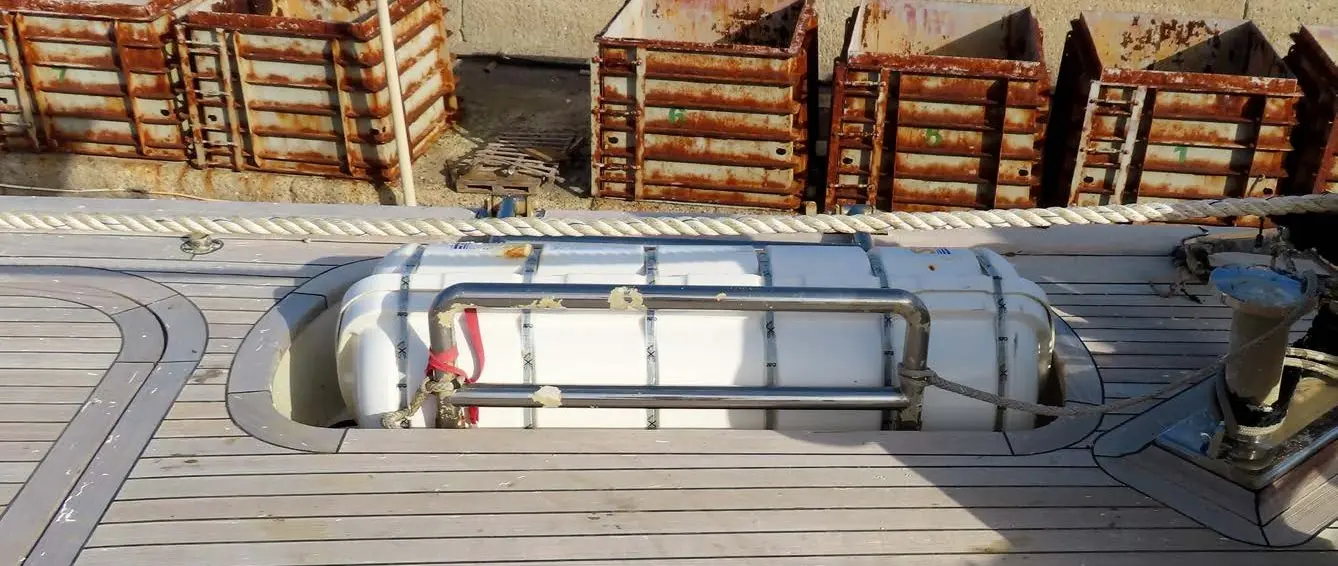
Bayesian starboard liferaft cradle after salvage — MAIB Report 22/2026 Figure 5
The UK MAIB's final report finds the 56m Bayesian had an unrecognised knockdown vulnerability at anchor and recommends changes to stability, training and weather guidance.
The United Kingdom's Marine Accident Investigation Branch published its final investigation report into the loss of the sailing yacht Bayesian on 19 November 2026. The 56-metre yacht foundered while anchored approximately half a nautical mile south-east of Porticello, Sicily, on 19 August 2024. Seven people died. Fifteen survived after members of the crew assisted them into a liferaft and a nearby vessel came to their aid.
The report's central finding concerns an unrecognised vulnerability to knockdown in severe winds while the yacht was at anchor without sails set. The MAIB states that the vulnerability was influenced by the vessel's loading condition, apparent wind angle and centreboard position. Crucially, the originally approved stability information available to the crew had not identified that risk in the relevant configuration.
The branch's investigation is a safety inquiry intended to establish circumstances and prevent similar accidents, not a judicial determination of liability or criminal blame. That distinction matters because separate legal proceedings and investigations have been reported. The findings should be accurately attributed to the MAIB rather than represented as a court judgment.
According to the investigation, the yacht was anchored overnight when a violent thunderstorm downburst struck the area. The MAIB records the decisive event at approximately 04:06 local time, with winds of at least 68 knots identified in its public explanation. The chief inspector said conditions developed from relatively calm to violent in only fourteen minutes and the yacht was pushed onto its side in less than fifteen seconds.
The vessel was unable to right itself. Water entered, it flooded and eventually sank in approximately fifty metres of water. The precise sequence is important for understanding how little time can be available when an extreme weather event develops close to a yacht at anchor.
The account does not mean that every thunderstorm will produce comparable conditions. Nor does it establish a generally applicable wind speed at which every sailing yacht would become unstable. The behaviour of a particular vessel depends on its design and circumstances. The MAIB's findings relate to Bayesian and the information and conditions examined in its investigation.
The speed of the event is a reason to consider preparedness before adverse conditions develop, rather than assume a crew will always have enough time to reorganise the yacht after an extreme gust arrives.
The MAIB identified a vulnerability associated with the yacht being without sail while at anchor. The official safety flyer explains that sailing vessels can ordinarily manage wind-induced heeling by changing apparent wind angle or releasing, reefing or lowering sails. Bayesian had a system that monitored the loading of the sails and eased the sheets when necessary while sailing.
However, when the sails were down that particular means of managing sail-generated loading was not applicable. The investigation found that a knockdown risk remained and had not been recognised in the information supplied to those operating the yacht.
This does not support the simple conclusion that lowering sails is generally unsafe. It concerns the interaction of this yacht's stability, windage and operating condition. The MAIB specifically emphasised that the approved stability booklet did not adequately reflect the vulnerability in the circumstances examined.
For the wider industry, the important question is whether the information provided to a crew covers all relevant operating configurations rather than only those associated with ordinary sailing or motoring in expected conditions. The answer must be derived from the design and assessment of the vessel concerned.
A stability information booklet is intended to help a crew understand the vessel's characteristics and operational limits. The MAIB's finding that the relevant condition had not been assessed shows why the completeness of those assumptions can be critical. The investigation identifies loading, centreboard position and direction of apparent wind as factors affecting Bayesian's vulnerability.
A change in centreboard position can affect a sailing vessel's characteristics, but the significance of that change cannot be generalised without examining its design. The report does not provide authority for a blanket instruction that all centreboards must be kept in a single position at anchor. Appropriate procedures should be established through vessel-specific analysis.
The MAIB recommends that the Red Ensign Group examine the vulnerabilities disclosed by the accident and consider amendments to the Red Ensign Group Yacht Code and associated guidance. That is a recommendation for review and possible regulatory development, not an announcement that the Yacht Code was immediately amended on 19 November.
Owners and managers may wish to seek qualified advice about whether their existing stability information covers the operational conditions relevant to the intended cruising programme. Any assessment should be undertaken by appropriate specialists and under the requirements applicable to the yacht.
Thunderstorms were forecast in the area on the night of 18–19 August 2024, but the MAIB found that the information available to the crew did not make the possibility or severity of the associated downburst winds clear enough for the relevant decision-making. The branch described the forecast as broadly accurate without explicitly indicating the risk of this extreme localised wind event.
A downburst is a severe wind associated with a thunderstorm. Conditions can change over a short period and in a relatively limited geographical area. The incident illustrates the distinction between knowing that thunderstorms may occur and understanding the potential consequences of a rare, particularly intense event.
The MAIB recommends that the UK Met Office raise with the World Meteorological Organization how low-probability, high-impact weather hazards should be represented in meteorological services. It also recommends improvements to guidance issued by the UK Hydrographic Office.
These recommendations concern the communication of uncertainty and potential severity, not a promise that every downburst can be forecast precisely. Yacht crews should continue to use authoritative weather information, monitor changes and understand the limitations of the forecasts available for their area.
The report records that none of Bayesian's liferafts automatically released or inflated during the loss of the vessel. A crew member launched a liferaft manually. Survivors gathered in the water and were assisted into it, with crew members providing first aid and searching for others.
The sailing vessel Sir Robert Baden Powell was nearby and its crew responded after seeing distress signals. Its tender helped recover the people from the liferaft. The eventual rescue is described in the MAIB safety material and forms part of the investigation's factual account.
The performance of lifesaving equipment should not be assessed solely from whether an automatic function occurred. The circumstances of a particular casualty, equipment type, installation, release arrangements and procedures all matter. The MAIB's report provides specific facts about the Bayesian accident without establishing that the same outcome would occur on another yacht.
The crew's response is an important part of the record, but the survival of fifteen people cannot erase the loss of seven lives. The investigation considers escape and abandoning ship as separate issues within the wider sequence, rather than treating the event as a simple question of one piece of equipment.
The MAIB has issued recommendations to several bodies. Alongside its recommendation for the Red Ensign Group, it asks the Maritime and Coastguard Agency to amend the meteorological element of yacht master training so that downbursts and severe gusts receive appropriate attention.
The Met Office is asked to raise the representation of rare but serious weather hazards at international level. The UK Hydrographic Office is asked to review and update relevant guidance. These actions concern different parts of the system through which knowledge reaches crews, from formal training to the weather information used during a passage.
The recommendations do not constitute an immediate change to the qualifications of every yacht master. Any changes to training syllabuses or published guidance would need to be developed and implemented by the responsible organisations.
For superyacht managers, the report provides a reason to examine their existing procedures and identify whether training covers conditions relevant to the yachts they operate. That review should be informed by competent technical advice, rather than rely on an improvised rule drawn from the experience of a single vessel.
The final MAIB report is particularly significant because its conclusions must be understood in their proper legal and investigative context. The branch states that its sole purpose is the prevention of future accidents, through establishing the causes and circumstances of casualties. Its investigation is not intended to apportion liability except insofar as circumstances must be examined for safety learning.
Other investigations and proceedings concerning the sinking have been reported in the public domain. Claims made in those processes should not be substituted for the findings of the MAIB, and the MAIB's safety conclusions should not be presented as criminal findings against crew members or shipyard personnel.
The branch's published material also explains that its safety investigation operated in parallel with proceedings in Italy. The information available to different investigators and the legal purposes of their work may not be identical.
Superyacht Guide's account is therefore confined to clearly identified findings, recommendations and the factual sequence published by the UK safety investigator. That approach is necessary both out of respect for the people affected and to avoid suggesting conclusions that the official report does not make.
The 19 November publication is a major safety development for the large-yacht sector. It identifies a vulnerability that had not been included in the relevant stability information, describes the speed of the downburst and records difficulties associated with the available weather guidance. It also provides a set of recommendations directed at regulation, training and the communication of exceptional weather risks.
The MAIB has issued a separate safety flyer urging owners, managers and crews of larger yachts to examine their vessels' vulnerability to extreme weather. It recommends that their procedures reflect the risks identified through appropriate assessment.
The official investigation does not establish that every sailing yacht shares Bayesian's characteristics. The practical response should therefore be based on the design, approval documents, operational arrangements and professional advice relevant to each vessel. An article cannot replace a vessel-specific stability assessment or the instructions of its qualified crew.
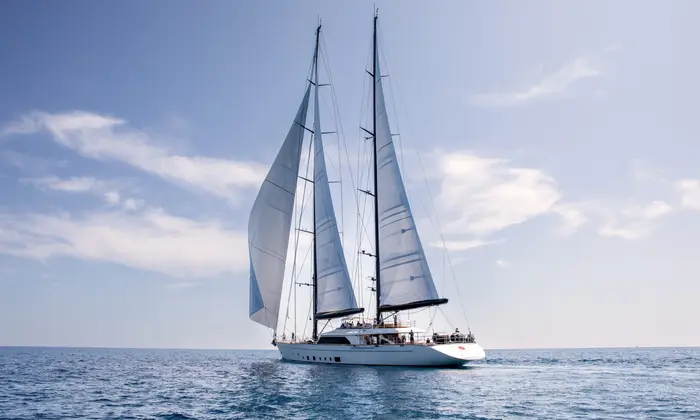
The accompanying archival photograph shows Bayesian in Milazzo, Sicily, eleven days before the disaster. It does not depict the capsize or the rescue. Its inclusion is to identify the vessel respectfully, with the photographer's attribution and Creative Commons licence stated.
The investigation's purpose is forward-looking: to prevent a comparable loss of life. That makes the report essential reading for specialists responsible for sailing-yacht design, operational safety and the training of the people entrusted with large vessels.
Primary source: UK Marine Accident Investigation Branch, Accident Investigation Report 22/2026, published 19 November 2026.
Further information: MAIB safety flyer for the yachting industry, published 19 November 2026.
Image: UK Marine Accident Investigation Branch, Report 22/2026, Figure 5, forward starboard liferaft after salvage. © Crown copyright 2026; reused under the Open Government Licence. The image does not depict the sinking. Official source.
Explore
Go deeper into the yachts, companies, events and destinations directly connected to this article.
Continue reading
The Italian Sea Group: SY Katana wins Judges’ Special Awards at the World Superyacht Awards Venice, May 4, 2026 – The Italian Sea Group …

Superyacht Design Festival awards Perini Navi S/Y Katana in Kitzbühel Marina di Carrara, February 2nd, 2026 — Perini Navi S/Y Katana has received her …

Perini Navi’s S/Y Katana was recognised at the Superyacht Design Festival in Kitzbühel, adding another award success to the 60-metre sailing yacht’s public record.
S/Y Perini Navi Katana 60m Delivery Marina di Carrara, July 1st, 2025 – The Italian Sea Group is proud to announce the delivery of …
Superyacht Guide
Continue into the wider Superyacht Guide.
Business opportunities · Superyacht Guide
Companies serving the superyacht market can discuss clearly identified advertising, sponsorship and business-profile opportunities. Commercial activity remains separate from independent editorial coverage.