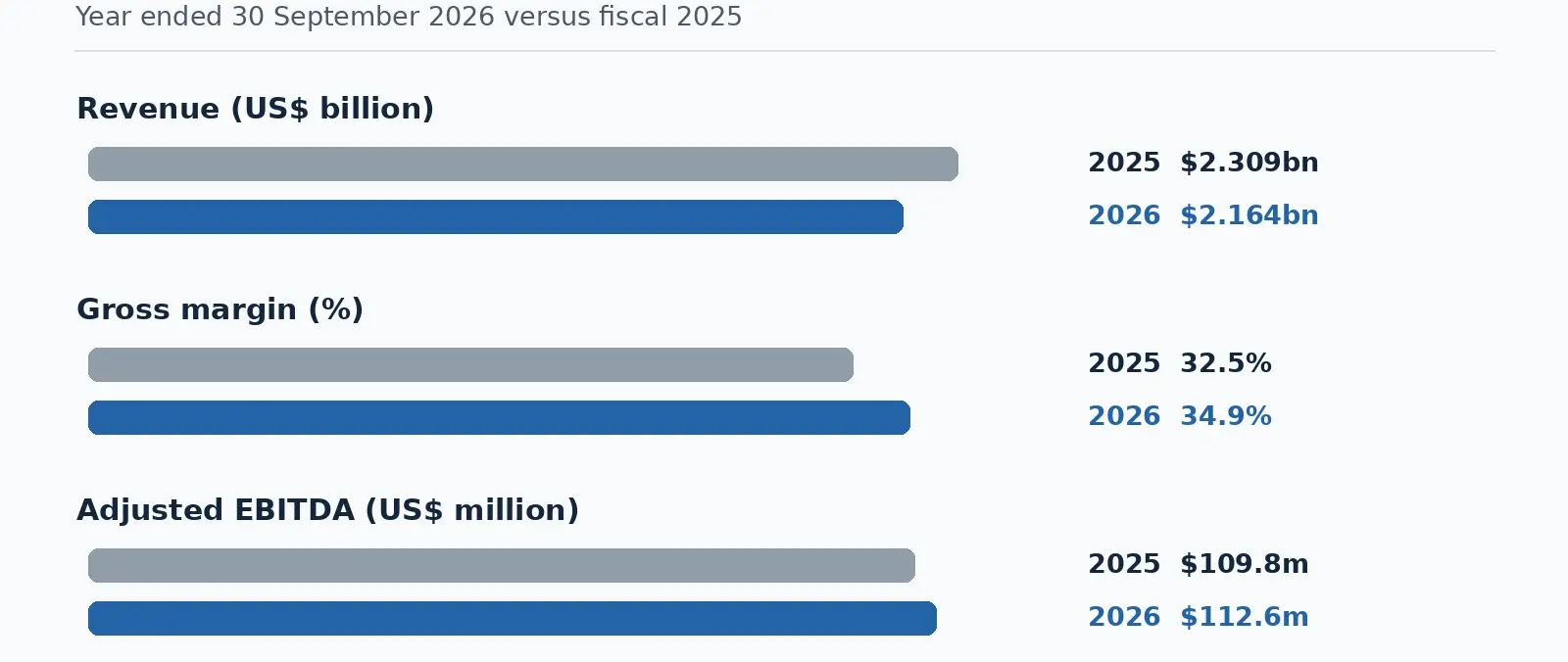
Image: Superyacht Guide original chart using MarineMax fiscal 2026 results (Business Wire, 4 November 2026)
MarineMax reports a fiscal 2026 loss of $8.2 million despite improved gross margins, against lower boat sales and a pending Safe Harbor takeover.
MarineMax reported fiscal 2026 revenue of $2.164 billion and a net loss attributable to its shareholders of $8.2 million for the year ended 30 September. The US-based boat and yacht retailer, marina operator and superyacht-services group released its results on 4 November, presenting a business whose sales remain under pressure even as the gross profit retained from each dollar of revenue has improved. The figures are especially relevant because the group is also preparing for an agreed acquisition by Safe Harbor.
The distinction between falling revenue and rising gross margin runs through the announcement. MarineMax says the boat-sales environment remained challenging, while activity in businesses such as marinas, parts and service helped offset some of the weakness. That does not mean the company returned to a full-year net profit: it did not. The important question for yacht-industry observers is whether the group can maintain higher-margin operations while adapting to more difficult demand for boats and yachts.
MarineMax recorded $2.164 billion of revenue in fiscal 2026, compared with $2.309 billion a year earlier. The difference is approximately $145.3 million, or 6.3 per cent, based on the reported consolidated figures. Same-store sales decreased 5.5 per cent, indicating that the slowdown was not solely a product of changes to the store network or the composition of the business. The financial statement does not justify projecting that decline unchanged into the next fiscal year.
These figures describe a diversified corporate group rather than the global value of superyacht transactions. MarineMax operates boat dealerships, marinas, service businesses and other activities, and group revenue is not a direct measure of superyacht brokerage demand. For the industry, the report offers one useful indicator of conditions facing a significant American marine retailer and services platform, but it should be read alongside shipyard order books, other dealer results and brokerage evidence before drawing wider market conclusions.
Gross margin for the full fiscal year improved from approximately 32.5 per cent in 2025 to 34.9 per cent in 2026, an increase of 240 basis points according to the company. Gross profit was $754.2 million, slightly above the $750.2 million reported the previous year, despite the lower revenue. The combination illustrates how changes in product mix, pricing and service contributions can have a material effect on gross profit even without a rise in total sales.
Chief executive Brett McGill attributed part of the improvement to a greater contribution from the group's higher-margin, non-boat businesses. MarineMax also highlighted that its gross margin was 26.1 per cent in fiscal 2019. That historical comparison is a management reference point rather than proof that the latest improvements will continue indefinitely. Gross margin is only one part of profitability: the company still needs to cover its operating expenses, financing charges, taxes and other items.
For the quarter ended 30 September, MarineMax generated $520.1 million in revenue versus $552.2 million in the comparable 2025 quarter. Same-store sales declined 5.7 per cent. The group's quarterly gross margin nevertheless increased 270 basis points to 37.4 per cent, with gross profit reaching $194.3 million compared with $191.4 million a year earlier. On the face of these figures, improved gross profitability did not require stronger overall sales volumes.
However, the company reported a fourth-quarter net loss attributable to MarineMax of $13.0 million, compared with a loss of $0.9 million in the prior-year quarter. The difference is substantial, and it is important not to report the gross-margin improvement as an overall earnings recovery. MarineMax said selling, general and administrative expenses increased, with the pending Safe Harbor acquisition contributing to the change. That transaction-related context helps explain the quarter but does not eliminate the reported loss.
Selling, general and administrative expenses were $196.1 million in the fourth quarter, equivalent to 37.7 per cent of revenue, compared with $177.6 million and 32.2 per cent of revenue a year earlier. MarineMax said the increase primarily reflected costs related to its planned acquisition. Its adjusted version of those expenses, after excluding specified items such as transaction costs and restructuring charges, rose by $3.2 million to $181.1 million.
The difference between reported and adjusted figures needs to be visible to readers. Adjusted measures can clarify the underlying operating trends management is trying to describe, but they are not a substitute for the accounting results. MarineMax reported a fourth-quarter adjusted net loss of $1.8 million, or eight cents per share, while the statutory shareholder-attributable loss was $13.0 million, or 59 cents per share. Both figures belong in a balanced account of the same period.
MarineMax said fourth-quarter adjusted EBITDA increased by 26 per cent, reaching $21.8 million compared with $17.3 million a year earlier. For the full year, adjusted EBITDA was $112.6 million versus $109.8 million in fiscal 2025. These figures provide another perspective on performance, particularly because depreciation, amortisation, financing and selected adjustments can affect the reconciliation from operating activity to net income.
Adjusted EBITDA is a non-GAAP measure, meaning that its calculation follows company-specified adjustments rather than the standard net-income presentation. Readers should therefore avoid interpreting the increase as a matching rise in cash available to shareholders or as evidence that every operating unit improved. It is possible for adjusted EBITDA to increase during a year in which revenue declines and the business still reports a loss. MarineMax's latest release illustrates precisely why the measures should be considered together.
MarineMax reported inventories of $812.8 million at 30 September 2026, down from $867.3 million at the previous year end. The $54.6 million reduction amounts to approximately 6.3 per cent. Lower inventory may help reduce exposure to financing costs and unsold stock in a slower market, but the announcement does not establish how much of that change resulted from sales, procurement decisions, changes in product range or other movements.
Cash and cash equivalents were $156.4 million at year end, compared with $170.4 million twelve months earlier. The balance sheet figures should be read in conjunction with liabilities and financing arrangements rather than in isolation. For marine retailers and builders, inventory discipline matters because vessels and related equipment can absorb considerable working capital before the final sale. The reported reduction is a relevant operational development, although it should not be described as an automatic improvement in every measure of liquidity.
MarineMax's corporate structure is broader than a network of boat dealerships. Its portfolio includes IGY Marinas, superyacht brokerage and services businesses Fraser Yachts Group and Northrop & Johnson, and manufacturers including Cruisers Yachts and Intrepid Powerboats. MarineMax says it operates more than 120 locations worldwide, with a substantial marina and storage presence alongside its dealerships. The latest results therefore cover several different forms of exposure to the recreational marine economy.
This diversification is particularly significant to a superyacht audience because a marina business, a brokerage platform and a new-boat dealership do not earn revenue in the same way. Berthing, management, repair and other services can recur after the original purchase, whereas large-ticket retail sales are more sensitive to timing and consumer decisions. The release identifies stronger contributions from higher-margin businesses, but it does not provide enough detail to assign a precise share of the latest gross-margin improvement to each superyacht-related subsidiary.
MarineMax reiterated that it has agreed to be acquired by Safe Harbor in a cash transaction valued at approximately $1.5 billion on an enterprise-value basis. The agreement calls for shareholders to receive $53 per common share. The company's board unanimously approved the transaction, but the completion is still subject to customary conditions, including shareholder approval. The companies expect to close by the end of calendar 2026, a timetable rather than a completed event.
The proposed combination has significance beyond MarineMax shareholders because it would bring together major marina, storage, services and yacht-industry operations. It also creates an important reporting distinction: management's expectations about integration and future opportunities are forward-looking claims, not realised results. MarineMax said it would not conduct a conference call for these results and does not intend to give fiscal 2027 financial guidance while the acquisition is pending. Readers should not infer the following year's outlook from an absent forecast.
The broad message from the company's latest financial statements is that marine businesses can be improving certain operating measures while still facing weak retail demand and considerable corporate expenses. MarineMax delivered a higher full-year gross margin and modestly stronger adjusted EBITDA, yet revenue fell and the company remained loss-making. That combination offers a more nuanced picture than either a simple industry-recovery headline or an equally broad claim that the entire yacht market is contracting.
For shipyards, brokers, suppliers and marina operators, the useful questions now concern stock levels, buyer confidence, recurring service demand and how the proposed ownership change affects commercial relationships. These results establish what MarineMax reported for the fiscal year and fourth quarter ended in September; they do not settle the outlook for the global superyacht fleet. Future reporting should track the final acquisition decision, any subsequent operating disclosures and whether the improved gross-margin mix proves durable under new ownership.
Primary source: MarineMax, Inc. — fiscal 2026 results released through Business Wire.
Explore
Go deeper into the yachts, companies, events and destinations directly connected to this article.
Continue reading
Safe Harbor Marinas has agreed to acquire MarineMax for $53 per share in a $1.5 billion all-cash transaction. The deal would bring IGY Marinas, …
IYC’s nine-month 2026 market review reports 675 yacht sales worth $7.3bn and fewer new listings, while separate BoatPRO statistics show a different picture for …
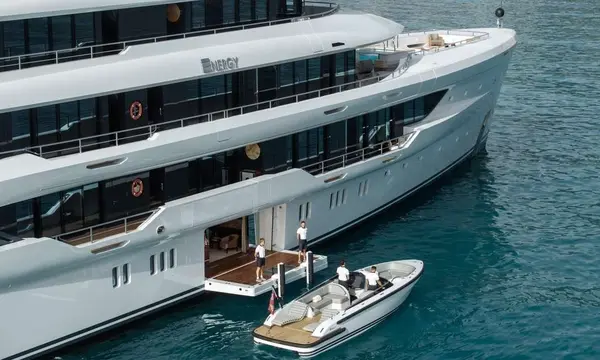
Burgess spotlights four recently delivered Dutch-built yachts above 70m—ENERGY, BOARDWALK V, SYNTHESIS and VANISH—in its October sales overview.
Gulf Craft CEO Erwin Bamps notes 36 superyachts over 24 meters visited Southern Africa in 2025, up from 14 in 2019, signaling rising interest …
Superyacht Guide
Continue into the wider Superyacht Guide.
Business opportunities · Superyacht Guide
Companies serving the superyacht market can discuss clearly identified advertising, sponsorship and business-profile opportunities. Commercial activity remains separate from independent editorial coverage.