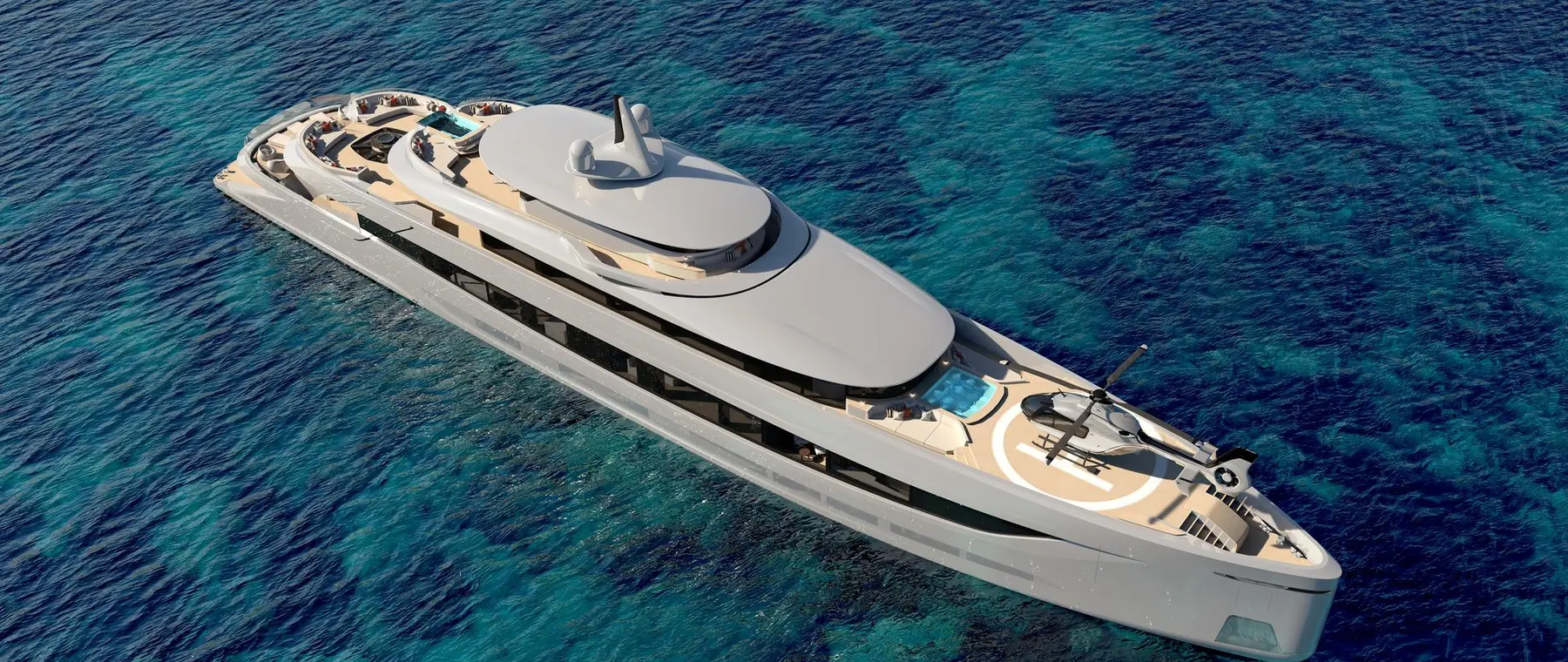
Fraser’s RMK Yachts listing describes the 70-metre LIVIA PLUS design concept, featuring 1,750GT of proposed volume, a two-deck owner suite and extensive customisation.
Fraser is marketing LIVIA PLUS, a 70-metre superyacht concept developed by RMK Yachts, as a prospective custom-build opportunity. The brokerage catalogue gives 2030 as the indicative build year and describes a delivery period of around 36 months. These figures should be treated as planning assumptions tied to a future contract rather than confirmation that a completed yacht already exists. The published images are official concept renderings, and prospective owners will need to distinguish completed design work from machinery, structure and details that have yet to be finalised.
LIVIA PLUS is notable for the amount of accommodation proposed within a platform below the 80-metre category. The design calls for a 12.3-metre beam and approximately 1,750 gross tons, a figure describing intended enclosed volume. A future owner should examine where that volume is allocated among personal living quarters, guest spaces, service functions, tender storage and machinery. The answer will determine how effectively the yacht performs as a long-term private residence rather than simply as an impressive general arrangement.
Red Yacht Design is credited with both exterior and interior design, while RMK Marine is named for naval architecture and engineering development. Fraser describes a proposed steel hull and aluminium superstructure, a conventional material combination for a long-range yacht of this size. The brochure also references BV classification and the possibility of an ice-class specification on request. That option would require precise agreement about class notation, structure, machinery and operational limits before anyone could describe the completed yacht as suited to icy waters.
A custom project presents considerable freedom, but every requested change can affect cost and delivery. Altering windows, internal partitions or deck openings can have implications for structure, fire protection, stability and service routing. If the owner wants a different arrangement from the published concept, the builder and design team should provide a revised technical specification and change-control procedure. Attractive renderings cannot show the complete engineering consequences of moving a pool, tender crane or helicopter facility.
The owner’s accommodation is intended to occupy two levels, with a private lounge, dining space, office and personal outdoor deck with pool. This is a relatively residential approach to superyacht planning and could appeal to clients who work aboard for long periods. It also establishes a clear separation between the owner’s territory and the social spaces used by guests. Red Yacht Design’s published arrangement suggests privacy is part of the core brief rather than an afterthought fitted around standard cabins.
The main-deck guest and VIP suites are drawn with individual terraces, another feature that requires detailed attention to structure, drainage, watertight boundaries and operational procedures. Private outside access is valuable at anchor but must not compromise safety on passage. Owners should explore how servants, security personnel and technical crew enter the private zone without disrupting its intended tranquillity. A plan can look exceptionally generous while still needing careful development of storage, emergency escape routes and day-to-day service logistics.
Fraser’s standard particulars describe accommodation for twelve guests in six staterooms and a crew capacity of fifteen. The concept can reportedly be revised to provide as many as ten guest suites, subject to owner requirements and feasibility. That flexibility changes the nature of the project: a larger guest complement requires more than the physical creation of rooms. Bathrooms, ventilation, escape plans, hotel services, hospitality staffing and the allowable number of people aboard must all be considered together.
For a family that values quiet rooms and generous living areas, the original six-suite arrangement may be preferable. An owner intending to host business parties or larger extended-family groups could see more value in an adjusted layout. Neither path should be treated as free of trade-offs. The builder’s design team must establish the regulatory and operational implications of a substantial cabin-count change before a price and construction programme can be considered reliable.
LIVIA PLUS is conceived with substantial aft leisure decks, a beach club, gym and wellness areas, and two pools. The forward deck incorporates a helipad in the concept, while the plans reserve space for tenders and water equipment. A guest elevator is proposed to link deck levels. The range of amenities suggests that the yacht is intended for a broad lifestyle programme in which exploration, private relaxation and entertaining can occur in parallel without every activity competing for the same space.
These facilities need disciplined integration. Helicopter operations, for example, would depend on the aircraft type, suitable deck design, training, flag requirements and local permissions; a drawing of a helipad is not a certificate to conduct flights. Pools introduce large concentrated water loads and maintenance demands. Tender handling depends on working loads, crew training and sea state. The buyer should require an operational concept and full technical equipment schedule for each facility before allowing amenities to define the project’s final specification.
The official particulars anticipate twin MTU engines, approximately 12-knot cruising and a possible 15-knot maximum. These are target specifications rather than observed sea-trial results. Fraser does not publish a fixed asking price, and a prospective buyer should expect the final number to depend on chosen fit-out, classification, options, schedule and contract terms. The stated 2030 build year likewise should not be mistaken for a guarantee of completion at a particular date without a binding construction agreement.
A serious next step would involve an independent technical representative reviewing the initial general arrangement, contract milestones, payment security, specification and acceptance-testing programme. Classification, construction oversight, noise and vibration trials and defects arrangements all need clear ownership. LIVIA PLUS presents an ambitious way to obtain large-yacht privacy and amenities within seventy metres, but the published concept marks the beginning of the buyer’s engineering and commercial decisions rather than their conclusion.
Primary reporting is based on the official brokerage information. Consult the builder or broker yacht particulars for current equipment and commercial terms.
Explore
Go deeper into the yachts, companies, events and destinations directly connected to this article.
Continue reading
Fraser has announced a new €3.9 million asking price for the 34-metre sailing yacht EP!PHANY, a McMullen & Wing build shaped by German Frers …
Fraser has added the 40-metre Benetti Classic Supreme COFINA to its sales fleet, highlighting extensive 2024 improvements, a completed 2026 class survey and accommodation …
Fraser markets the 46-metre Sanlorenzo 46Steel PICK UP at €13.5 million following an extensive 2025 refit, with four guest suites and 3,500nm economic range.
The nearly 50-metre CRN motor yacht SAHAB IV is offered for sale through Fraser at €8 million, with seven guest suites, original-family ownership and …
Superyacht Guide
Continue into the wider Superyacht Guide.
Business opportunities · Superyacht Guide
Companies serving the superyacht market can discuss clearly identified advertising, sponsorship and business-profile opportunities. Commercial activity remains separate from independent editorial coverage.