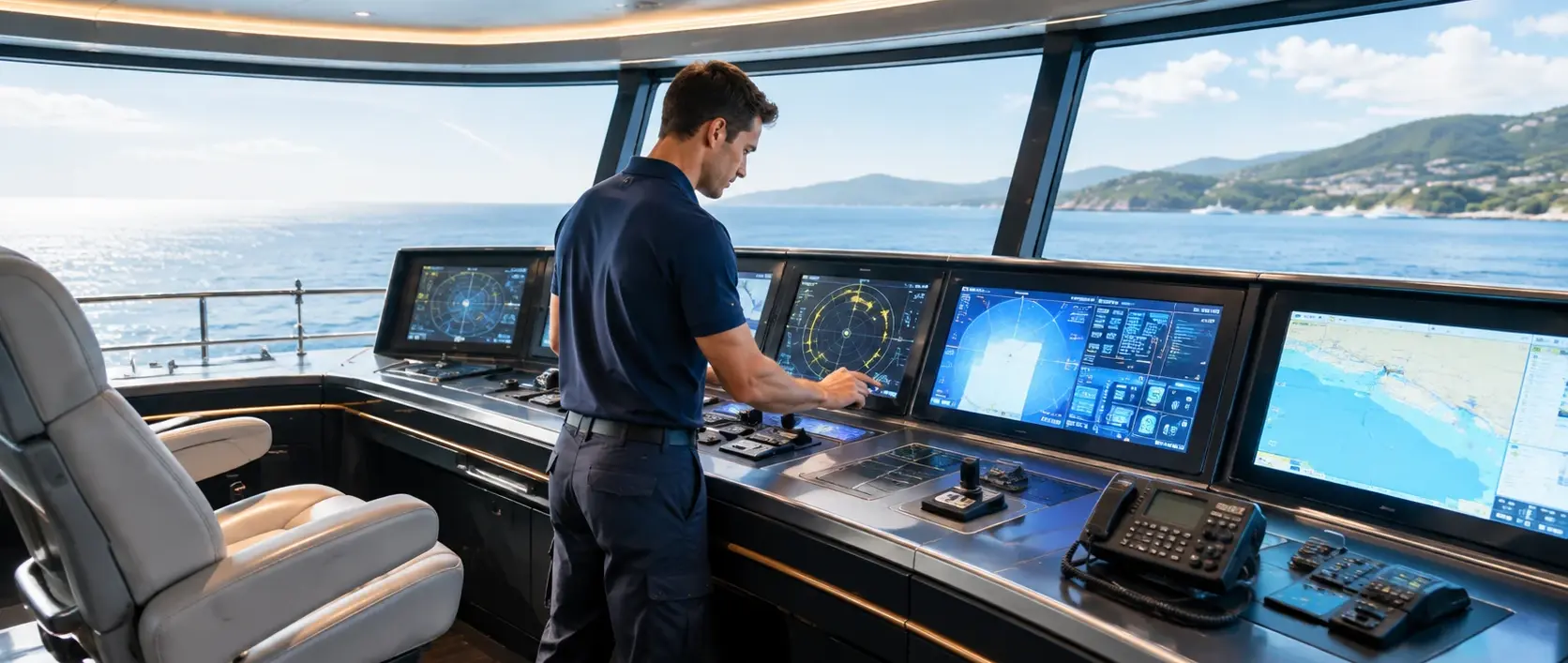
A modern superyacht bridge may contain multiple integrated displays, but the legal minimum is driven by flag, commercial status, gross tonnage and operating area. The result is a layered set of requirements rather than one standard bridge package.
A modern superyacht bridge can resemble an aircraft cockpit, with multifunction displays integrating radar, electronic charts, AIS targets, cameras, machinery data, weather, communications and route information. Yet the impressive glass-bridge layout seen on a new yacht should not be confused with the statutory carriage requirements that determine what navigation equipment the vessel must actually have.
Those requirements vary with flag, private or commercial use, gross tonnage, length, passenger numbers, operating area and construction date. The Red Ensign Group Yacht Code provides a useful large-yacht example because it applies a dedicated regulatory framework to commercial yachts of 24 metres and over carrying no more than 12 passengers.
The basic navigation package starts before the large tonnage thresholds
Under Part A of the current Red Ensign Group Yacht Code, a vessel is required to have a standard magnetic compass or equivalent heading means, an echo sounder, a positioning receiver such as GNSS, speed-and-distance measurement, a gyro compass or spare magnetic compass bowl, a rudder-angle indicator and a 9 GHz radar. For vessels under 300 GT, the Code allows specified equipment in this basic group not to be of an approved type.
At 500 GT and above, an automatic tracking aid or equivalent means to plot targets and determine collision risk is added. These requirements explain why a compliant bridge is not defined merely by the number or size of screens; the underlying sensors, independent heading information, approved equipment, power arrangements and ability to continue navigation after a failure matter just as much.
AIS, LRIT and BNWAS arrive at different thresholds
The same Yacht Code requires approved Automatic Identification System equipment on vessels of 300 GT and over. AIS automatically exchanges identity, position, course, speed and other safety information with suitably equipped ships and shore stations, while Long-Range Identification and Tracking is required from 300 GT and above under the Code unless the vessel operates solely within sea area A1.
Bridge Navigational Watch Alarm System requirements begin at a different point: all vessels of 150 GT and over under the Code are to be fitted with BNWAS, and the system is to be operating whenever the yacht is underway at sea. The purpose is not to navigate the vessel automatically, but to monitor watchkeeper activity and escalate an alarm when the bridge watch does not respond within the prescribed sequence.
At 3,000 GT the bridge requirement becomes substantially heavier
For vessels of 3,000 GT and over, the Red Ensign Group Yacht Code adds a Voyage Data Recorder and an Electronic Chart Display and Information System. It also requires an additional functionally independent radar arrangement and a second independent automatic tracking aid or equivalent, giving the bridge greater redundancy for navigation and collision avoidance.
ECDIS deserves particular attention because it is not simply a large electronic chart plotter. Where ECDIS is used to meet statutory chart-carriage requirements, the equipment, official electronic navigational charts, updating procedures, backup arrangements and crew familiarisation all form part of compliance; a recreational navigation display does not automatically satisfy that standard.
Integrated bridge systems do not remove the need for independence
Integrated bridge systems can combine sensor information and control functions at central workstations, improving situational awareness and reducing the need to move between separate consoles. IMO’s bridge-system principles nevertheless require that failure of one subsystem is brought immediately to the officer of the watch and does not cause the failure of unrelated subsystems, while individual equipment must remain operable where required.
That is why good superyacht bridge design concentrates on redundancy, alarm management, power supplies, sensor diversity, ergonomics and human factors rather than adding displays for appearance. The correct bridge for a 250 GT private yacht is not the same as the bridge for a 3,500 GT commercial yacht, and the final equipment list must always be checked against the yacht’s flag-state rules, class notation, certification and intended area of operation.