
Ferretti Adds One-Year Quality Promise Cover for Yachts to 45m
Ferretti Group has introduced its Quality Promise programme, adding one year of limited coverage beyond the standard warranty for eligible yachts up to 45m.
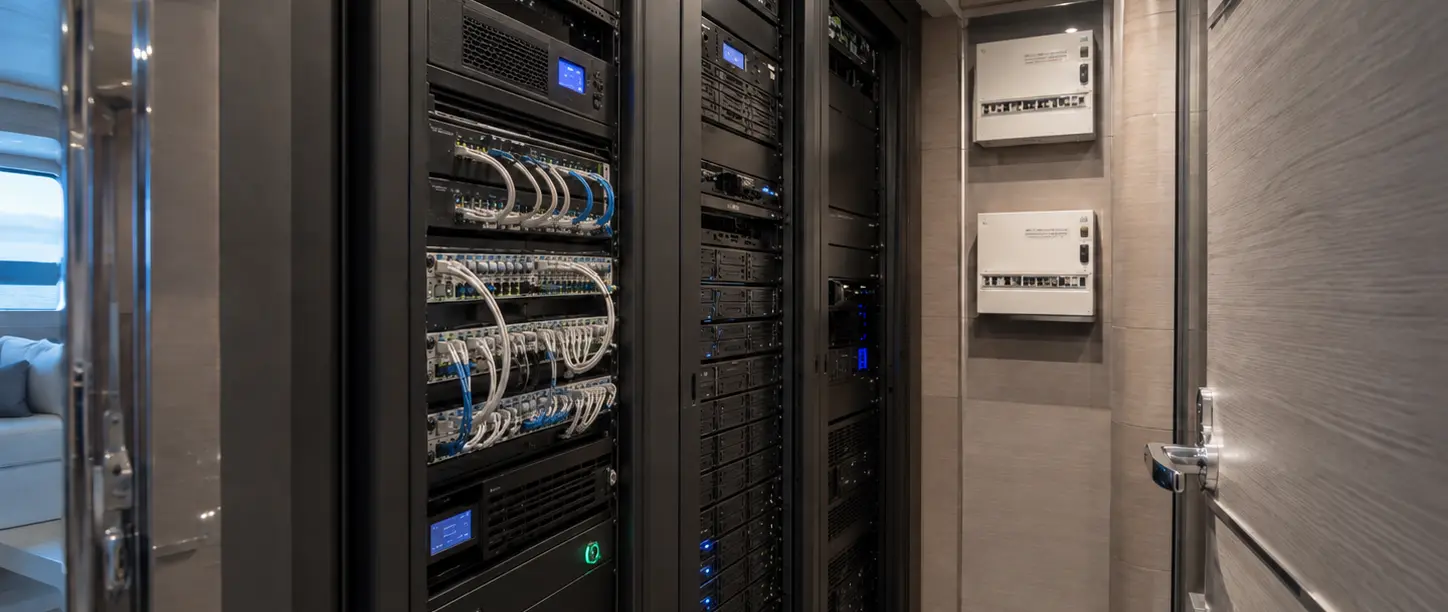
A modern superyacht may hold thousands of legal, technical, financial, operational and personal records, yet the owner may not control the systems in which they are stored. A properly governed data room protects continuity, strengthens oversight and prevents vital knowledge from leaving with a captain, manager, shipyard or contractor.
A superyacht is supported by an extraordinary volume of information. Registration records, class certificates, technical drawings, maintenance histories, warranty correspondence, crew documentation, insurance files, inventories, software licences and refit reports all contribute to the yacht’s ability to operate, remain compliant and preserve its value. The yacht may appear to be a physical asset, but much of its operational memory now exists only in digital form.
Despite the importance of those records, ownership and control are often surprisingly unclear. Documents may be divided between a captain’s laptop, the chief engineer’s maintenance system, a yacht manager’s cloud account, a family office server, a shipyard portal and folders retained by individual contractors. Each participant may hold part of the picture, while nobody acting directly for the owner can confirm that a complete, current and recoverable record exists.
This weakness may remain hidden while the same captain, manager and technical team remain in place. It becomes visible when somebody resigns, a management agreement ends, a warranty dispute begins, the yacht enters a major refit or the owner decides to sell. At that point, the difference between having records and controlling them becomes commercially significant.
A data room is sometimes understood as a temporary collection of documents assembled when a yacht is offered for sale. That is one legitimate use, but it is too narrow for a large and technically complex vessel. The more valuable function is an owner-controlled repository maintained throughout the ownership period, providing an organised record of what the yacht is, how it has been operated and what has happened to it.
The system does not need to contain every working file produced aboard. Daily operational records may remain within specialist maintenance, accounting, safety-management or crew-administration platforms. The owner’s data room should instead preserve the authoritative documents, key exports, approvals, reports and evidence needed to understand the yacht independently of any one employee or service provider.
This distinction is important because the owner may pay for a management platform without owning the account through which it is administered. The same problem can arise with satellite services, software subscriptions, electronic chart licences, planned-maintenance systems and shipyard portals. An account may appear to belong to the yacht while the highest level of administrative control remains with a manager, contractor or former member of the crew.
Proper control does not require the owner personally to manage files or passwords. It requires the owning entity, family office or formally appointed representative to retain ultimate authority over the system, including the ability to appoint administrators, review access, obtain complete exports and recover the records if a commercial relationship ends. Operational responsibility can be delegated without surrendering ownership of the yacht’s digital history.
A well-run data room also provides context rather than merely storage. A certificate should be identifiable by issuing authority, date, expiry and superseded version, while a technical report should be connected with the equipment, defect, work order or warranty issue to which it relates. Without this structure, a large folder of documents can create the appearance of control while leaving the owner unable to determine which record is current or what remains missing.
The objective of an owner-controlled data room is not to place every document in one folder that everybody can open. A yacht produces records with very different levels of sensitivity, and the person who needs an engine-service report does not necessarily need access to crew salaries, ownership documents, insurance correspondence or the owner’s personal information.
Access should follow defined roles. The captain may require broad operational visibility, while the chief engineer needs detailed technical and maintenance records. The management company may need financial, compliance and crew-administration access, whereas a shipyard working on a refit should receive only the drawings, specifications and records relevant to its contracted work.
The International Maritime Organization’s current Guidelines on Maritime Cyber Risk Management, revised in May 2026, recognise that shipboard information technology includes commercial information and crew data such as salaries and certificates. The guidelines recommend unique user credentials, separation of privileged accounts, deactivation of accounts belonging to departing users, strong password policies, multi-factor authentication and regular system backups.
Those principles translate directly into data-room governance. Shared logins should be avoided because they make it difficult to establish who viewed, changed, exported or deleted a record. Temporary access should have an end date, privileged administrator rights should be tightly controlled, and an individual leaving the yacht or a service provider should not retain continuing access simply because nobody remembered to remove it.
The owner’s representative should be able to review an access log showing who has entered the system and what significant actions have taken place. This is particularly important during refits, disputes, management transitions and sale preparations, when a larger number of advisers and contractors may require limited access for a defined period.
Backup arrangements also need to be independent of the main platform. A cloud repository may provide resilience, but it is not a complete backup strategy when the same administrator, subscription or compromised account controls both the files and their recovery. The yacht should maintain tested backups that can be restored without depending entirely upon the provider whose failure, dispute or security incident created the need for recovery.
The legal and corporate section of the data room establishes the yacht’s identity and the authority through which it is owned and operated. Depending upon the structure and jurisdiction, it may contain registration records, ownership documents, corporate authorities, mortgages, deletion certificates, radio licences and other documents required to establish title, flag and legal status.
The importance of accurate registration documentation was reinforced by IMO guidelines on the registration of ships issued in June 2026. Those guidelines encourage ship registries to improve verification and due-diligence procedures, maintain accurate ownership records and verify the authenticity of information submitted during registration, transfer and deletion. Although the guidelines are directed primarily at flag States and merchant-ship registries, the underlying message is directly relevant to yacht ownership because documentary accuracy is central to proving what the vessel is and who has authority over it.
A separate compliance area should hold the current class and statutory record, together with previous certificates where retention is necessary to show continuity. Survey reports, conditions of class, recommendations, exemptions, safety-management records and evidence of corrective action may all become important during audits, insurance reviews, financing, flag changes and sale preparation.
The technical record is usually much larger. It may include original drawings, equipment manuals, commissioning data, machinery histories, oil-analysis reports, service records, alarm histories, software information, modification approvals and the planned-maintenance record. These documents should make it possible for an incoming engineer, surveyor or technical manager to understand not merely what equipment is installed, but what has been changed and how recurring problems have been addressed.
Refit and warranty records deserve their own controlled structure because disputes are often decided by chronology. The signed contract, technical specification, variation orders, approvals, progress reports, photographs, test results, defect notices, invoices and final acceptance documents should be linked so that the owner can reconstruct what was ordered, what was changed and what was actually delivered. Important evidence should not remain solely in personal email accounts or informal messaging threads that may disappear when individuals leave.
Financial and insurance records require similar discipline, although access should be more restricted. Budgets, management reports, invoices, claims files, valuations and evidence of expenditure may help explain the yacht’s operating history and support future decisions. The data room should preserve the significant record without becoming an uncontrolled duplicate of every accounting transaction.
Crew records present a different responsibility because they contain personal information. Where the General Data Protection Regulation applies, organisations must follow principles including data minimisation, accuracy, storage limitation, integrity, confidentiality and accountability. This means that personal records should not be retained indefinitely merely because storage is inexpensive, and access should be limited to those who have a legitimate purpose for processing them.
Sensitive owner and guest information should be separated even more carefully. Passports, travel details, preferences, medical information, security arrangements and photographs should not be mixed casually with general yacht documentation. A data room designed for asset control must protect privacy as well as preserve records, and the owner should know which organisations hold copies outside the principal system.
A stable yacht team can conceal weaknesses in record ownership because experienced people carry a large amount of knowledge personally. The captain knows which surveyor handled an issue, the engineer remembers which contractor modified a system, and the manager knows where the insurance correspondence is stored. The arrangement can appear efficient until one or more of those people leave.
A captain’s departure should not create uncertainty over where the yacht’s certificates, passwords, contracts or service histories are located. The same principle applies when the management company changes, because the owner should not have to negotiate for the return of records that were created and maintained on the owner’s behalf. The management agreement should state clearly who owns the data, what must be maintained, how access is controlled and in what format a complete export will be delivered.
The transition should involve more than transferring folders. Current administrators must be identified, departing accounts removed, shared passwords replaced and external suppliers informed of the correct new authority. Software licences, remote-access tools and automatic forwarding rules should also be reviewed, because control can remain with a former provider even after the visible documents have been copied.
A major refit creates another point of vulnerability. Drawings may be revised by the yard, technical decisions may be recorded in email, contractors may upload reports into separate portals and the crew may maintain its own defect list. Unless the owner’s representative requires regular consolidation, the completed yacht can emerge with valuable knowledge scattered across several organisations.
The International Maritime Organization treats corrupted, lost or compromised information as capable of producing operational, safety and security failures. Its current cyber-risk framework emphasises governance, identification, protection, detection, response and recovery rather than relying only on defensive technology. The lesson for yacht owners is that control begins with knowing which records and systems exist, who is responsible for them and how the operation will continue if access is lost.
The quality of a yacht’s records becomes especially visible when the vessel enters the market. A buyer may request evidence concerning ownership, registration, class, surveys, maintenance, engine hours, refits, warranties, tax status, insurance and equipment. The seller who can provide a controlled and credible response is in a stronger position than one who must ask former captains and contractors to search old computers.
A data room does not prove that a yacht is in good condition, and it cannot replace an independent survey, sea trial or legal due diligence. It does, however, allow advisers to distinguish between a documented history and an unsupported assertion. When records are complete, current and internally consistent, the buyer can investigate the yacht more efficiently and focus attention on genuine technical or legal questions.
Poor documentation creates uncertainty even when the yacht itself has been maintained well. Missing service records may make it difficult to establish whether machinery work was completed, while incomplete modification drawings can complicate future maintenance and class review. Unclear ownership or registration documents can delay a transaction at the point where the buyer, lender, insurer or registry requires certainty.
The seller may also need to disclose information selectively. A prospective buyer at an early stage should not receive unrestricted access to crew information, security arrangements, confidential owner details or commercially sensitive correspondence. A properly designed data room permits staged disclosure, allowing basic yacht information to be reviewed first and more sensitive documents to be released only when the transaction has advanced and appropriate confidentiality arrangements are in place.
Control must continue through completion. The sale agreement should define which records, accounts, software rights and physical documents will pass with the yacht, while the seller should retain only those copies required for legal, tax or contractual reasons. The closing process should include a documented transfer of administrative control rather than merely sending a link to a folder.
The owner does not need to prescribe a particular software brand, because the correct platform will depend upon the yacht, management structure and existing systems. The minimum standard should instead be expressed through outcomes: the records must be complete, organised, searchable, protected, backed up and capable of being transferred without the consent of a departing employee or supplier.
Responsibility should be assigned to a named records custodian who reports to the owner’s representative. That person may work for the management company, but the reporting line and obligations should be explicit. The custodian should maintain the document structure, identify missing records, control versions and ensure that important information is uploaded rather than remaining only in private inboxes.
The owner should receive periodic confirmation that the system remains functional. This can include an access review, a list of expiring documents, confirmation that backups have completed and evidence that a sample restoration has succeeded. A data room that is never tested may fail precisely when a dispute, cyber incident or management change makes it essential.
Retention periods should be defined rather than improvised. Some records must be retained for statutory, contractual, employment, tax or insurance reasons, while other personal or duplicate material should be removed when there is no continuing lawful or operational purpose. The policy should be developed with appropriate legal, flag, class and data-protection advice because obligations vary according to the yacht’s registration, use and operating jurisdictions.
The most important principle is that control should survive changes of personnel and providers. Captains, engineers, managers, accountants, yards and consultants all contribute to the yacht’s records, but none should become the sole gateway through which the owner can reach them. Delegation is necessary in yacht ownership, yet dependency is not.
A superyacht data room is therefore more than an administrative convenience or a sales tool. It is part of the governance of a valuable, mobile and technically complex asset, preserving the evidence needed to operate it, defend decisions, resolve disputes and transfer it responsibly. Owners who control their digital records are not interfering with the professionals who run the yacht; they are ensuring that the yacht’s memory remains with the yacht.
Continue reading
Ferretti Group has introduced its Quality Promise programme, adding one year of limited coverage beyond the standard warranty for eligible yachts up to 45m.
Where Is the Best Place to Buy a Superyacht? There is no single best country or boat show for every buyer: the strongest market …
What Paperwork Do You Need When Buying a Superyacht? A superyacht acquisition requires far more than a bill of sale: buyers normally need a …
What Is a Superyacht Sea Trial? A superyacht sea trial is the buyer’s opportunity to observe the yacht operating underway before contractual acceptance, testing …
Superyacht Guide
Continue into the wider Superyacht Guide.