Company
Superyacht Builders Association (SYBAss)
Explore the company profile and related Superyacht Guide coverage.

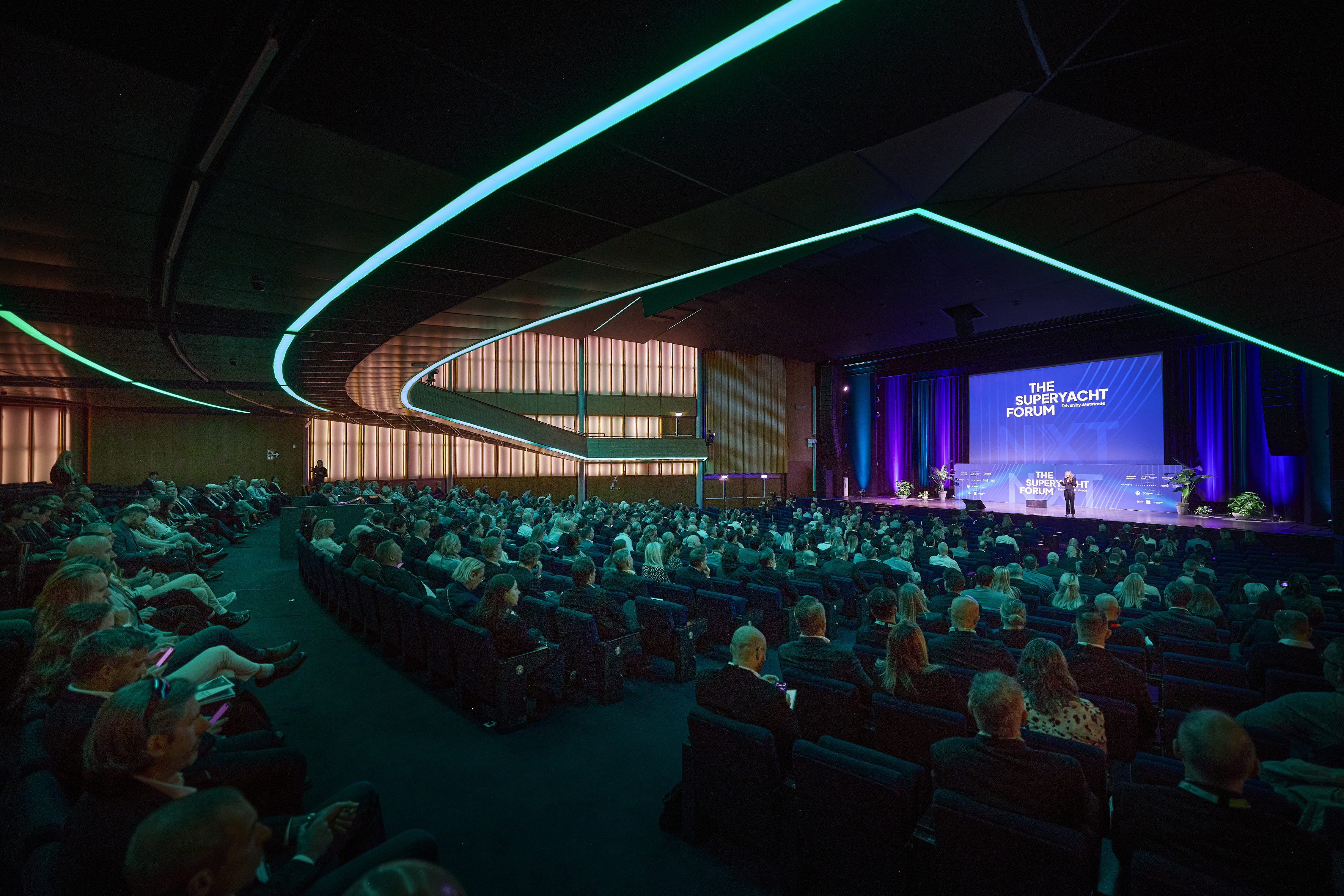
The Superyacht Forum 2025 archival official press-room opening photograph
The Superyacht Forum closes with a SYBAss economic study highlighting market growth, regional demand and constraints on large-yacht production capacity.
The closing programme of The Superyacht Forum in Amsterdam brought fresh attention to the relationship between the expansion of the global wealth pool and the industrial capacity available to convert that potential into actual superyacht deliveries. In its official closing release on 18 November 2026, the organiser reported attendance of 900 delegates and described an industry focused on turning the conversations of the two-day meeting into work that can continue throughout the coming year.
A presentation by Erik Floor, the author of the Superyacht Builders Association economic study, supplied the market context. The organiser's summary describes a healthy year for contracting and deliveries across length bands, alongside marked differences in the geographical distribution of demand. The study's reported observations are particularly useful when considered against the constraints of large yacht construction, technical staffing and the infrastructure that supports an operating fleet. They are not a prediction that every yard will enjoy the same order intake or that future demand will materialise on a particular timetable.
The attention devoted to the very largest yachts is understandable. At that scale, a single commission can have consequences for a design office, an engineering department and an entire construction facility over several years. Seven shipbuilders launched yachts measuring at least 100 metres during the period discussed, according to the Forum's account of the presentation. That is a measure of the distribution of capability, not a count of all vessels launched in that category.
An equally significant consideration is the continued activity between forty and one hundred metres. This is a broad technical and commercial territory in which a buyer may choose a thoroughly developed platform or commission an extensively individual design. The resulting contracts vary substantially in engineering complexity and the resources needed to deliver them.
It would therefore be misleading to interpret the study solely as an indication of the number of new yachts that might be built. A yard considering how to allocate its facilities must weigh the mix of work, the length of commitments, the skills required at different stages and the availability of berths for completion and trials. A growing market in terms of vessel volume does not necessarily generate equivalent growth in the number of vessels launched.
The presentation also distinguishes the customer markets by aggregate yacht gross tonnage. North America leads on that basis, while the organiser notes the continuing significance of Eastern Europe and the appetite for especially large yachts in the Middle East and Africa.
Gross tonnage measures enclosed volume under a defined measurement system; it is not the weight of a yacht. Its usefulness in market comparisons comes from the way it captures differences that a simple hull count might obscure. A region accounting for fewer transactions can nevertheless support substantial construction activity if its customers purchase vessels with considerably greater volumes.
For brokers and shipyards, neither measure should replace the other. The number of orders may help describe the breadth of the buyer base, whereas volume can inform estimates of the industrial resources likely to be committed. Neither directly reveals the price of a contract or the profitability of the project. Differences in interior specification, propulsion architecture and contractual risk can make apparently comparable volumes very different commercial propositions.
There is also a distinction between the customer's geographical market and the location where a yacht will be registered, based, maintained or used. Marina developers and yacht management companies must research those patterns independently rather than assume that the geography of construction orders translates directly into local demand for facilities.
One of the economic study's observations reported by the organiser is a divergence over a decade between the growth of the billionaire population and the growth of the comparatively recent yacht fleet. This is an indication of possible headroom, but it is not a sales forecast.
The decision to acquire a superyacht is influenced by more than the purchaser's theoretical financial capacity. The owner's expected time aboard, preferred cruising areas, privacy considerations and willingness to employ a permanent professional crew all matter. Some prospective owners may find charter more appropriate for their circumstances. Others may wish to share their time between several vessels or rely on different arrangements at different points in their lives.
An increase in the number of wealthy households is therefore only the beginning of the commercial analysis. The industry also needs to understand how people discover yachting and how confidence develops between a potential owner and the specialist teams involved in a transaction. First-time buyers particularly benefit from explanations of responsibilities that are not apparent from a yacht's design presentation, including long-term maintenance, certification and the management of a crew.
Even where the demand is clearly established, the production of a large yacht cannot normally be accelerated simply by adding a construction shed. The building programme depends on an interlocking sequence of structure, engineering installation, outfitting, systems integration, commissioning and acceptance.
Skilled professionals are required at each of those stages. Some expertise is concentrated in particular regions or among a small number of specialist companies. A yard that commits to additional projects without securing the appropriate resources may encounter competition for the same suppliers or struggle to maintain continuity between departments.
Future capacity planning should therefore include apprenticeship programmes, technical training and the development of experienced supervisors alongside investment in facilities. Training is not merely an administrative obligation. It is an important means of preserving hard-won practical knowledge when experienced employees move between companies or retire.
The same principle applies beyond construction. A fleet of increasingly complex vessels demands service technicians able to diagnose integrated electrical systems, understand proprietary control arrangements and work within documented maintenance procedures. The cost of a delayed repair far from the builder can be disproportionate to the price of a replacement component.
The Forum's closing account identifies extended delivery programmes as a challenge and refurbishment of existing yachts as one possible response. That observation deserves particular attention in the context of ownership transitions.
A well-chosen existing yacht can provide access to accommodation and operational capability without the time needed to develop a completely new design. A refit also gives a buyer opportunities to adapt the interior, update communications, improve maintainability and address the operational requirements of a planned cruising programme.
However, a refurbishment is not automatically a faster or less expensive alternative. A project involving structural alterations, extensive machinery replacement or changes to regulatory certification can develop into a substantial engineering undertaking. The condition of concealed systems and the quality of existing documentation can materially influence the eventual programme.
Buyers comparing the two routes should establish the extent of required work before relying on a proposed completion date. A realistic assessment from independent surveyors and experienced refit professionals is more informative than an assumption based purely on the age or appearance of the yacht.
The conference discussions also addressed opportunities to improve the utilisation of yachts and develop demand beyond familiar seasonal peaks. From an operational perspective, that requires more than promotional campaigns.
An extended charter season depends on suitable weather, safe navigation, local services and a crew schedule consistent with work and rest requirements. Maintenance periods must remain protected. The attractiveness of a charter destination also depends on what guests can experience ashore, particularly if their itinerary includes several days in the same region.
Operators exploring less traditional cruising periods should build itineraries around their practical strengths instead of treating reduced seasonal demand as a pricing problem alone. Partnerships with destination specialists and shore-side businesses can help establish distinctive experiences while ensuring that the vessel's own operational limits remain respected.
Discussion of intergenerational wealth at the Forum points towards a question that extends well beyond yacht aesthetics: how will the next generation want to use a vessel?
Owners who grew up cruising with their families may have expectations shaped by earlier holidays, whereas new entrepreneurs entering the market may value different activities, onboard technology or more flexible patterns of travel. Neither group can be reduced to a single design preference.
Shipyards and designers should seek evidence of the intended operating profile before translating generational assumptions into engineering decisions. A technically sophisticated beach club is of limited benefit if it cannot be operated conveniently where the owner wants to cruise. A flexible guest arrangement may be more valuable to some families than an additional dedicated entertainment room.
These choices affect specifications long before construction begins. The most effective projects are those in which the designer, owner's team and shipyard share a clear understanding of how the yacht is intended to function over its lifetime.
The organiser indicated that conference breakout discussions will inform the Superyacht Alliance's working groups. That creates a route by which ideas raised in a concentrated meeting can be developed between annual events.
For the industry, the practical test is whether individual companies can identify a manageable set of actions relevant to their own operations. A builder could review its dependence on critical suppliers, a management company could assess career development for senior crew, and a service provider could examine whether its support network matches the expanding range of yacht itineraries.
Progress should be measured against concrete outcomes rather than the number of initiatives announced. The economic presentation suggests there is room to develop the superyacht market, but the ability to convert opportunity into well-delivered and well-operated vessels ultimately depends on the quality of the sector's people, facilities and decisions.
The November meeting thus offers a useful benchmark for planning the next business year. The study's underlying figures should be understood in their original methodological context; this report uses the findings described by the Forum organiser, not an independently obtained copy of the complete economic study.
Primary source: The Superyacht Forum official closing press release, 18 November 2026.
Further information: The Superyacht Forum official virtual press room.
Photography: RAI Amsterdam / The Superyacht Forum, archival 2025 press-room photograph; not a photograph of the 2026 closing session. Official source.
Explore
Go deeper into the yachts, companies, events and destinations directly connected to this article.
Company
Explore the company profile and related Superyacht Guide coverage.
Continue reading
Hill Robinson has appointed Thea Shaw to oversee its Charter Management team, according to an announcement dated 6 November 2026. Her responsibilities extend across …

Hill Robinson appoints Claire Borel as senior charter manager in Monaco, bringing seven years of charter expertise to its owner, captain and crew operations.

MYSEA and Motor Racing Legends bring historic motorsport enthusiasts closer to yacht charter, including a Mediterranean discovery experience aboard the 115ft Sunseeker FLEUR.

CMC Marine has provided new technical detail on the energy-management architecture behind its electric stabilisers and thrusters, explaining how capacitor storage can reduce abrupt …
Superyacht Guide
Continue into the wider Superyacht Guide.
Business opportunities · Superyacht Guide
Companies serving the superyacht market can discuss clearly identified advertising, sponsorship and business-profile opportunities. Commercial activity remains separate from independent editorial coverage.