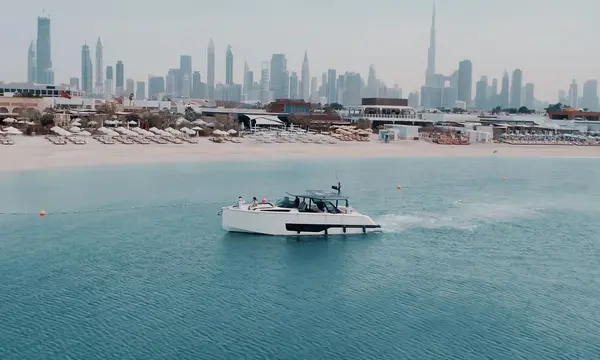
D-Marin Details Dubai J1 Beach Anchorage and Tender Service
D-Marin's October guidance explains how visiting yachts use a permitted offshore anchorage and dedicated tender service to reach Dubai's J1 Beach restaurants.
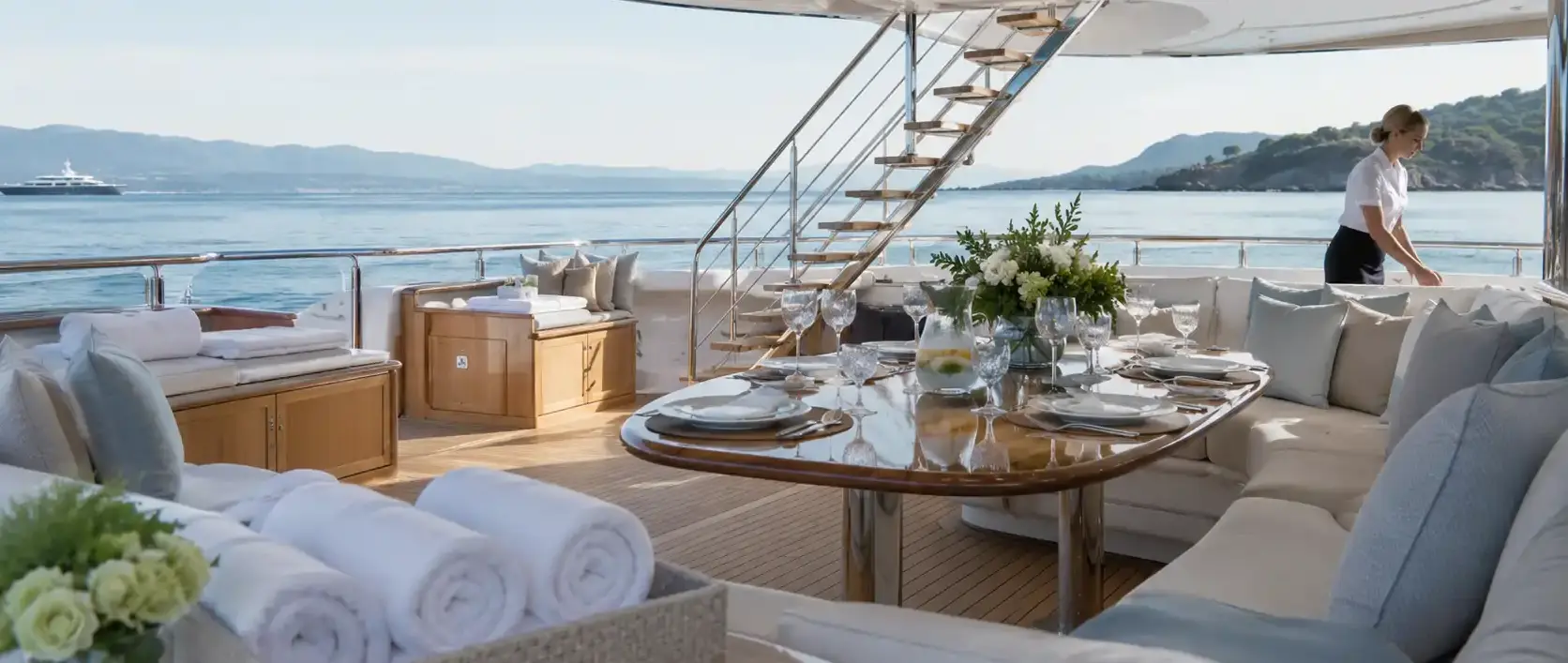
The finest superyacht service often happens without the guest seeing it. Timing, anticipation, privacy and disciplined teamwork make an intensely complex operation feel almost effortless.
Exceptional service on a superyacht has a peculiar quality: the better it becomes, the less of it the guest may consciously notice. A drink appears before somebody has to ask twice, a cabin is refreshed while its occupants are elsewhere, wet towels vanish from the swim platform, lunch moves by an hour without creating drama and the tender is waiting when the group decides to go ashore.
None of this is accidental. A large yacht may have dozens of crew moving through an environment that is simultaneously a private home, hotel, restaurant, transport system and working vessel, yet the owner or charter guest should rarely feel surrounded by the operation required to support them.
That is the art of invisible service. It is not about hiding the crew or reducing human contact; it is about making every interaction feel appropriate to the moment while keeping the machinery of hospitality out of the guest's way.
There is a fundamental difference between discreet service and insufficient service. A guest who repeatedly has to search for somebody, ask where breakfast is being served or request the same item several times is not experiencing invisibility; they are experiencing a gap in service.
Good invisible service works because somebody is nearly always paying attention. Interior crew observe the rhythm of the guest areas, deck crew monitor activity around the water, the galley tracks when people are likely to eat and the bridge understands where the day's movements may intersect with the guest programme.
The skill lies in choosing when that attention should become visible. A steward may approach immediately when an empty glass clearly needs replacing but stay away when two guests are deep in a private conversation, while a deckhand can prepare equipment nearby without making people feel they are being supervised.
That judgement is one of the hardest parts of yacht hospitality to standardise. Procedures can define how a table is laid or a cabin is serviced, but they cannot fully prescribe the moment at which a guest wants help rather than privacy.
The most obvious expression of invisible service is anticipation. Once the crew understand a guest's habits, recurring requests should gradually disappear because the yacht begins to arrange itself around those preferences.
A morning coffee can arrive in the way somebody prefers it, the shaded side of a deck can be prepared before breakfast, favourite water can be placed beside a sunbed and a cabin temperature can be adjusted before the guest returns. None of those gestures is extraordinary in isolation, but together they prevent the guest from having to manage their own service.
Professional interior training reflects this emphasis on understanding guest preferences and applying appropriate service styles. The IAMI GUEST programme exists specifically to develop industry-led operational and professional skills for superyacht crew, with hospitality training forming part of a structured development route for yacht interior professionals.
Anticipation has limits, however. Observing a preference is useful; making a guest feel studied is not. The purpose of remembering behaviour is to reduce friction, not to demonstrate how much the crew know about the people onboard.
A well-designed superyacht effectively contains two circulation systems. Guests move through saloons, dining areas, exterior decks, beach clubs and accommodation, while crew try to reach many of those same spaces through pantries, service stairs, crew corridors and less visible entrances.
This separation is fundamental to invisible service. If every plate leaving a dining table has to travel through the same doorway guests are using, or housekeeping staff must continually cross a main saloon carrying linen, the operation becomes visible regardless of how polished the crew are.
The service pantry is therefore more important than its size might suggest. It allows glassware, coffee, wine, linen and table equipment to be staged close to the guest area so that the interior team does not have to travel repeatedly through the yacht for every small requirement.
The same principle extends outside. Towels, sunscreen, water, lifejackets and watersports equipment are most effective when positioned so the deck team can produce them quickly without turning the aft deck into an equipment store.
Luxury service is often described in terms of responsiveness, but speed by itself can make a yacht feel frantic. The more sophisticated skill is timing: doing something at the point when it is useful without allowing the preparation to become part of the guest's experience.
A cabin does not have to be serviced immediately after somebody leaves it if they are likely to return five minutes later. It needs to be serviced during the window in which the work can be completed properly without forcing housekeeping staff and guests repeatedly around one another.
Meals create the same problem on a larger scale. Guests may swim longer than expected, change decks, decide to eat outside or delay dinner after drinks ashore, while the chef and service team must continually adjust without allowing the revised plan to feel like a disruption.
Invisible service therefore depends on reading the rhythm of the day rather than enforcing a rigid schedule. The yacht still needs structure behind the scenes, but the guest should experience flexibility rather than the timetable required to create it.
A great deal of yacht service is created through information moving between departments. The interior team may need to know that a tender is ten minutes away, the chef that lunch has moved, the deck team that guests want to swim after eating and the bridge that an excursion is finishing earlier than planned.
When those handovers fail, the guest often sees the consequences immediately. People return from the tender before drinks are ready, food waits too long, a beach club has not been reset or several crew members separately ask the same question because the information never travelled through the yacht.
The best communication systems remove that repetition. Radios, departmental meetings, preference notes, service plans and direct handovers give each part of the crew enough information to act without repeatedly involving the guest.
IAMI describes professionalism onboard as extending beyond technical competence to communication, teamwork, leadership and behaviour. Its current GUEST framework is expressly intended to support industry-aligned qualifications and professional development across the superyacht environment.
Superyacht crew inevitably see and hear a great deal. They enter cabins, handle personal possessions, observe family relationships, know travel movements, learn food and drink preferences and may be present around private conversations that would never occur in a public hotel lobby.
The professional response is not curiosity but restraint. Information should move through the crew only when somebody genuinely needs it to perform their role, and conversations that are operationally necessary onboard should not become stories ashore.
MYBA's guidance for charter captains and crew is explicit on this point. It states that information concerning the charter, owner, charterer and guests is confidential, that the obligation continues after employment ends and that information or photographs should not be disclosed to third parties without permission.
Privacy also affects physical service. A guest who closes a door, moves to a quiet part of the deck or repeatedly chooses a private breakfast may be signalling something just as clearly as somebody asking for another coffee.
Invisible service recognises those signals. Sometimes the highest level of attention a crew member can provide is to ensure that nobody needs to enter the space at all.
The interior department sits at the centre of this choreography because it has the most continuous contact with the guest environment. Housekeeping, laundry, cabins, flowers, drinks, meals and general guest care all overlap, yet each task has to happen without making the yacht feel like a workplace.
This means the chief steward or chief stewardess is managing far more than presentation. They are allocating people to areas, judging when cabins can be entered, deciding when formal service is appropriate, coordinating with the chef and determining how visible the interior team should be at different moments of the day.
The IAMI GUEST programme's focus on professional yacht-interior competence reflects how specialised this work has become. Its hospitality pathway combines service knowledge with broader professional standards, communication and operational competence rather than treating interior work as simply domestic housekeeping.
The most effective interior teams also change style without making the transition obvious. Breakfast may be casual and almost self-directed, lunch highly attentive, cocktails conversational and dinner formal, followed later by a much quieter service as the group settles into the evening.
It would be a mistake to treat invisible service as an interior-department technique. Much of what makes a yacht feel effortless comes from crew whom guests may see only occasionally.
Engineering provides perhaps the clearest example. Air conditioning, water pressure, lighting, stabilisation, refrigeration, communications and countless hotel systems should simply work, which means engineering attracts attention most often when something stops behaving invisibly.
Deck operations work in much the same way. A tender that appears clean, fuelled and ready at precisely the right moment represents preparation, machinery checks, safety equipment, weather assessment and often substantial physical work that the guest never needs to witness.
The bridge also contributes by translating navigational and weather constraints into an experience rather than a problem. If an anchorage must change, the most polished outcome is not merely a safe alternative but an alternative that still seems consistent with what the guests hoped to do.
Invisible service is therefore not one department serving another. It is the entire yacht agreeing that the operational complexity belongs behind the scenes whenever safety allows it.
There is a temptation to believe that truly exceptional service means somebody is always available regardless of the hour. A professionally run commercial yacht has to achieve continuity differently, because crew rest is not optional simply because guests remain awake.
UK requirements implementing the Maritime Labour Convention for covered commercial vessels provide for at least 10 hours of rest in any 24-hour period and 77 hours in any seven-day period, subject to the detailed rules and authorised exceptions. They also place responsibility on shipowners, employers and masters to ensure the requirements are observed.
That creates an important distinction between continuous service and continuous work by the same person. Department heads need rotations, handovers and enough staffing depth to allow late dinners, early starts, night watches and changing guest schedules to coexist with meaningful rest.
Fatigue guidance from the MCA goes beyond regulatory arithmetic and treats fatigue as a factor capable of impairing reaction time, coordination, decision-making and other aspects of performance. A service culture that looks perfect for three days but progressively exhausts the crew is therefore not genuinely high-performing service.
The guest should not normally have to think about those rosters. Building them properly is another example of invisible service: the yacht remains responsive because fresh people take over, not because the same tired people are expected to remain perpetually present.
Even exceptional crews cannot anticipate everything. A glass breaks, a tender return is delayed, a preferred wine runs out, a cabin is not ready when expected or somebody misunderstands a request.
The quality of service then depends on what happens next. Poor recovery makes the internal problem the guest's problem, while good recovery fixes what can be fixed, communicates only what the guest needs to know and prevents several crew members from offering conflicting explanations.
Calmness matters because visible panic magnifies a small mistake. Guests do not need to see the discussion about whose responsibility something was; they need to see that the yacht has understood the issue and is already solving it.
This is where strong onboard culture becomes particularly valuable. Crew who trust one another can correct errors quickly without turning every service problem into a departmental argument or a search for blame.
At the end of a successful day, guests may remember the anchorage, the dinner, a swim, a conversation or the feeling of having the yacht almost entirely to themselves. They may not remember the dozens of occasions on which crew entered a space immediately after they left, moved equipment before they arrived or quietly changed plans around them.
That is precisely the point. Invisible service is not an absence of labour but the careful removal of labour from the guest's field of attention.
It depends on observation without intrusion, knowledge without display, communication without noise and presence without hovering. It also depends on enough people, adequate rest, good yacht design and a culture in which departments share information rather than guarding it.
The ultimate luxury is not having somebody constantly ask what you need. It is living aboard a yacht that seems to understand what should happen next, while leaving you with the impression that almost nothing had to happen to make it possible.
Continue reading
D-Marin's October guidance explains how visiting yachts use a permitted offshore anchorage and dedicated tender service to reach Dubai's J1 Beach restaurants.
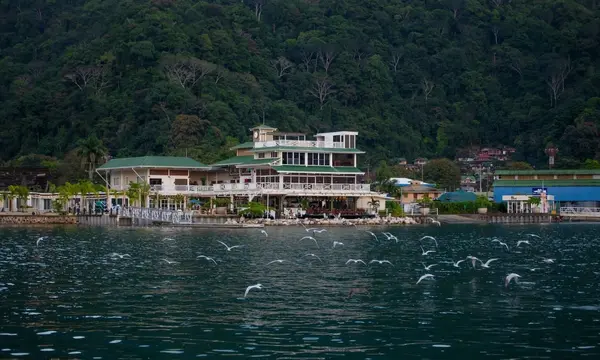
Marina Bahía Golfito highlights prospective customs, port services, road access and research facilities in Costa Rica before FLIBS 2026.
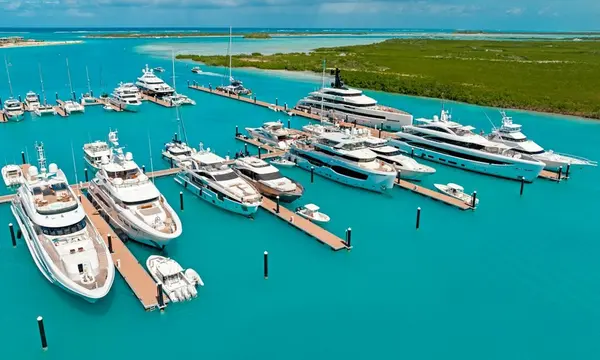
IGY explains how its Trident programme supports eligible superyacht captains seeking short-notice berths during busy events and sudden itinerary changes.
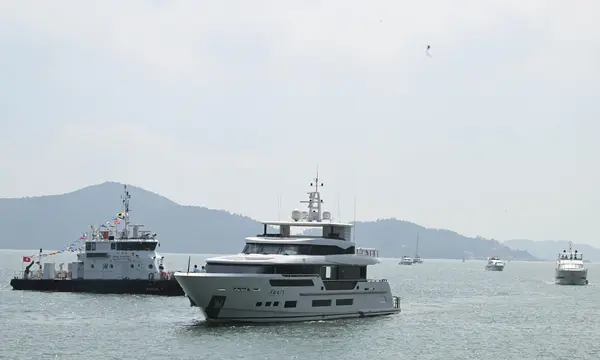
Five Guangdong yachts made the inaugural southbound visit to Hong Kong on 16 October, launching two-way cross-border arrangements and new marina ambitions.
Superyacht Guide
Continue into the wider Superyacht Guide.
Business opportunities · Superyacht Guide
Companies serving the superyacht market can discuss clearly identified advertising, sponsorship and business-profile opportunities. Commercial activity remains separate from independent editorial coverage.