Company
Williams Grand Prix Technologies
Explore the company profile and related Superyacht Guide coverage.
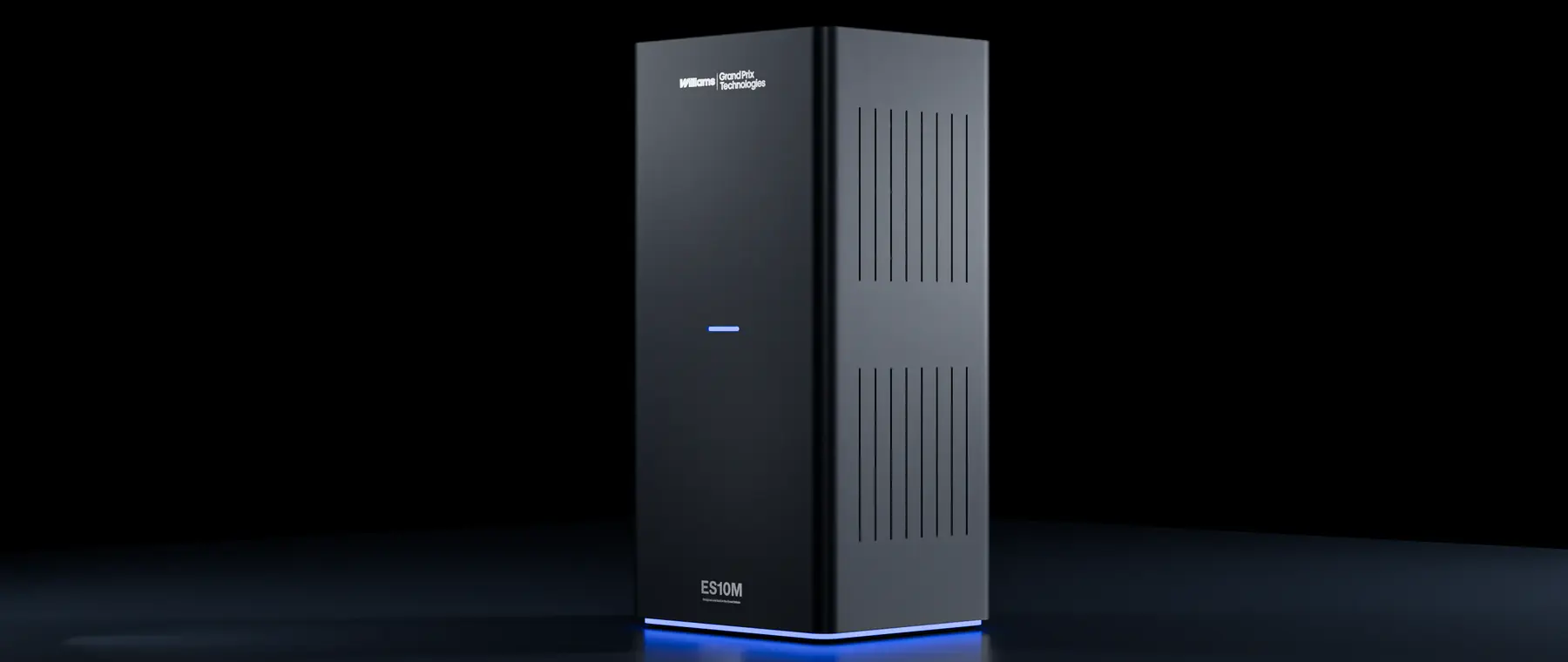
Williams Grand Prix Technologies has entered the marine sector with ES10M, a scalable battery system designed for superyachts, explorers, support craft and refits.
Williams Grand Prix Technologies has entered the marine sector with ES10M, its first dedicated marine battery system. The company is positioning the platform for superyachts, support and explorer vessels, hybrid propulsion, full-electric craft and refit programmes, bringing engineering methods developed alongside elite motorsport into a very different operating environment.
The important point for yacht designers is not the Formula 1 association by itself, but the architecture behind the product. ES10M has been designed as a modular system that can be scaled from compact installations for smaller engineering spaces to multi-bank systems for yachts above 100 metres, giving naval architects a wider range of options for silent hotel loads, hybrid propulsion and battery-supported energy management.
Williams says each ES10M module stores 9.8 kWh at 50.4 volts and weighs 48.8 kg, with module-level energy density quoted at 200 Wh/kg and 325 Wh/l. The system architecture can be configured from 39 kWh to 4.2 MWh and from 201.6 to 907.2 volts, allowing the same basic technology to cover very different vessel sizes and operating profiles.
That scalability matters on superyachts because battery demand can range from a relatively modest hotel-load buffer to several megawatt-hours of stored energy. A yacht seeking quiet overnight operation at anchor has a different duty cycle from an explorer using batteries for peak shaving, while a tender or support craft may require much higher propulsion discharge rates over shorter periods.
The battery-management system uses what Williams describes as physics-informed machine learning to monitor cell and module behaviour. The aim is to anticipate thermal events, degradation and changing load patterns before they become operational problems, while a supervisory controller can isolate individual battery strings when required.
For yacht engineers, predictive control is useful only if it complements rather than obscures conventional safety logic. The ES10M therefore combines software monitoring with cell-to-cell thermal isolation, controlled gas management and string isolation, while the modules carry an IP67 ingress-protection rating and are designed to maritime-grade electromagnetic compatibility standards.
Williams is explicitly promoting ES10M as a refit-ready system, not only a newbuild product. Its modular layout is intended to work with existing power-management systems and make better use of constrained machinery spaces, which is relevant to yachts that were designed before large battery banks became a normal part of the technical conversation.
A retrofit still requires detailed review of weight, cooling, fire boundaries, cabling, ventilation, class requirements and the yacht's existing generators and switchboards. The benefit of a modular product is that the installation can be sized around those constraints rather than forcing the vessel into a single fixed battery-room arrangement.
Williams says Lloyd's Register class compliance is in progress. That distinction is important because a technically capable battery system does not become a complete superyacht solution until its installation, fire strategy, control logic and vessel integration satisfy the relevant class and flag requirements.
Even at this stage, ES10M is a notable new entrant because it brings another high-performance battery supplier into the large-yacht market. Competition among marine battery platforms should give builders and owners more choice over energy density, control philosophy, service model and retrofit flexibility as battery-supported hotel loads and hybrid propulsion become more common.
Explore
Go deeper into the yachts, companies, events and destinations directly connected to this article.
Company
Explore the company profile and related Superyacht Guide coverage.
Continue reading

Gard’s 2026 Crew Claims Report draws on about 3,000 P&I crew claims and finds elevated injury risk early in a crew member’s time on …
Foreship by RINA will exhibit at Monaco Yacht Show 2026, presenting yacht design, marine engineering, refit and sustainability consulting capabilities from Darse Sud.
Junior Yacht Stewardess Salary 2026: Entry-Level Pay and Leave Junior yacht stewardess and steward pay in 2026 is currently benchmarked at about €3,000–€3,500 per …
Yacht Spa Manager Salary 2026: Pay, Rotation and Duties Spa managers with yachting experience on 80m+ yachts are currently benchmarked from about €4,500+ per …
Superyacht Guide
Continue into the wider Superyacht Guide.