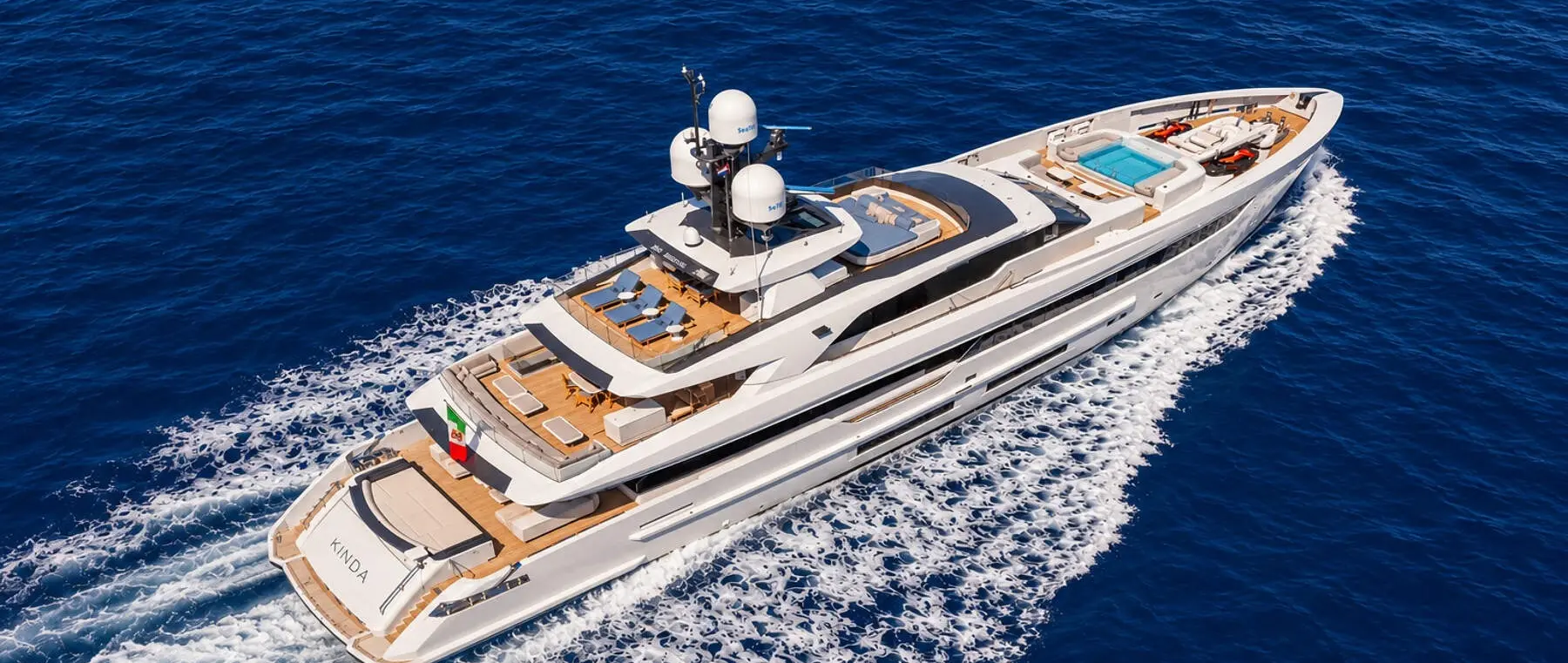
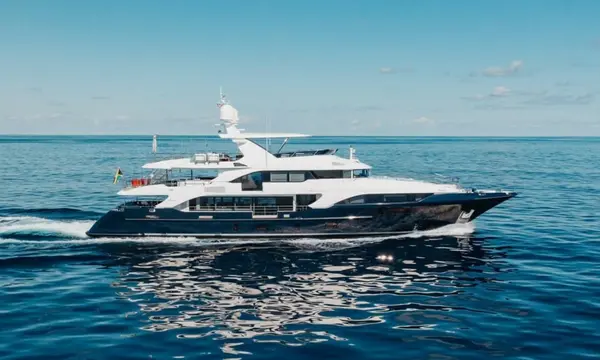
KINDA Fraser official 17 November 2026 brokerage sale press photograph
Fraser confirms the sale of the 2022-built hybrid Tankoa KINDA, with Monaco broker David Legrand representing both parties in the transaction.
Fraser announced on 17 November 2026 that KINDA, the hybrid motor yacht completed by Tankoa Yachts in 2022, has been sold. David Legrand, working from Fraser's Monaco office, acted for both parties. The brokerage identifies the transaction as his seventh yacht sale within eleven months of 2026. The announcement supplies neither the final price nor the identities of the parties, and no conclusions about those details can be drawn from the sale's confirmation. The yacht is an especially interesting brokerage proposition because its original design incorporated hybrid propulsion rather than relying solely on conventional mechanical transmission. For a prospective owner considering an existing yacht instead of commissioning a new build, that distinction has implications extending beyond the headline performance specifications. It affects the way the vessel is operated, maintained and supported over the course of a cruising programme.
Tankoa identifies KINDA as a yacht based on its S501 hybrid platform, with a published overall length of 49.9 metres. The shipyard describes the vessel as its second hybrid-powered yacht in that series. The underlying aluminium construction and the distinctive design by Francesco Paszkowski gave the owner a starting point for individual decisions about appearance and use. The choice of a platform does not mean that every vessel based on it is identical. Interior arrangements, engineering specifications and the distribution of deck facilities can all evolve between commissions. That distinction matters when examining a brokerage yacht because a prospective purchaser needs to understand the particular configuration installed aboard, rather than relying upon generic data about a family of designs. The individual equipment schedule, technical drawings and operating manuals remain more useful than the name of the platform when establishing service requirements and planning future work.
The shipyard identifies three propulsion configurations developed with MAN and Siemens: mechanical diesel propulsion, diesel-electric propulsion and operation using electric power alone. These arrangements offer different ways of supplying the energy required to move the vessel. Conventional mechanical operation can be suitable when a sustained propulsion load is required. Electrical operation introduces other possibilities for matching power production to demand, according to the installation and the circumstances of the voyage. A hybrid yacht should not be described as a vessel that automatically runs without fuel or emissions. Electrical energy has to be generated or stored, and the capacity of the storage system determines how long a particular electrical mode can be sustained. The practical benefits also depend on the load placed on the equipment, the condition of the machinery and the way the captain and engineering team manage it. The sale announcement does not disclose updated measurements for those parameters.
Fraser gives the vessel a transoceanic range in excess of 4,400 nautical miles and highlights operation at a cruising speed of twelve knots. Those particulars help to explain the attraction of the yacht to a purchaser contemplating extended itineraries. They should not be interpreted as an independently verified promise that every passage of that distance can be completed without refuelling. Load, weather, fouling, fuel reserves and the energy required for onboard services all influence endurance. The relationship between propulsion and hotel loads becomes especially important when planning a crossing aboard a yacht incorporating multiple energy sources. A chief engineer will need access to historical consumption records and representative operating data to establish how the system performs under different conditions. Passage planning should be based on the vessel's actual capabilities, with suitable reserves and alternative destinations, rather than on the published maximum alone.
The appeal of a hybrid arrangement can be particularly evident during a stay away from a marina. At anchor, the principal demand may arise from the accommodation rather than from propulsion. Air conditioning, refrigeration, lighting and entertainment equipment all need electricity even though the yacht is stationary. Tankoa describes the possibility of operating without running the generators during certain periods, an important feature for owners who value the sounds of their surroundings. Battery endurance nevertheless varies with demand, and a quiet evening aboard in mild temperatures may require substantially less energy than an afternoon in a tropical anchorage. Crew need to manage the charging cycle in conjunction with the owner's expectations. Access to protected waters depends on local rules and permission, not on possession of electric propulsion alone. The yacht's configuration offers operational options rather than an exemption from navigation and environmental requirements.
The original design also includes an approximately five-thousand-litre swimming pool in the forward deck area. Its position distinguishes it from many other yachts where the principal swimming facility is placed on an upper deck or toward the stern. A forward location offers a different relationship with the surrounding scenery, particularly when privacy is a consideration at anchor. It also requires the design team to address the weight and movement of water, drainage, filtration and access for servicing. Pool operation may be subject to the captain's assessment of weather and yacht movement. The engineering requirements behind such a feature are as relevant to a subsequent buyer as the visual appearance of the installation. Inspection should establish the condition of the plumbing and treatment equipment, together with the procedures for securing or emptying the facility where necessary. The swimming pool is a specific feature of KINDA identified by the builder, not an addition reported during this sale.
The interior was developed by Paszkowski in collaboration with Margherita Casprini. Tankoa describes a scheme based on oak, leather, nubuck and different kinds of marble, with restrained colours throughout. The design includes a prominent staircase, another feature identified by the yard as specific to this yacht. For a second owner, the selection of materials creates practical considerations as well as aesthetic ones. Leather may require specialist cleaning, while stone finishes need appropriate care to preserve their surface. Woodwork should be assessed for damage associated with moisture or alterations to underlying services. It is useful during a handover to obtain the original materials schedule and information about the suppliers responsible for individual finishes. This can simplify the sourcing of replacements and reduce the risk of introducing visually incompatible material during later repairs. A yacht designed around a coherent palette can retain its character through successive periods of ownership if those details are documented.
An existing hybrid vessel brings an opportunity to inspect a working installation rather than assess a proposed technical specification. For a purchaser, that can be valuable if the vessel's records demonstrate the way the equipment has been used and maintained. The review should extend to the energy storage equipment, electrical distribution, control systems, cooling arrangements and the interfaces between electrical and mechanical propulsion. It should identify the availability of replacement components and the technical support required during a voyage. As with conventional yachts, a satisfactory cosmetic inspection cannot substitute for examination of engineering condition. A service history and information about previous faults or repairs can help determine the priorities of the new owner's engineering team. The brokerage's description of the yacht as being in excellent condition is its commercial assessment; the announcement does not independently establish the health of individual batteries or the results of technical surveys during the sale.
The transaction establishes that KINDA has found a new owner several years after delivery. It does not establish a measured resale premium for hybrid propulsion, since the actual consideration and the circumstances of negotiations remain undisclosed. Nor can an individual sale demonstrate the general direction of prices for comparable yachts. It does illustrate how relatively recent yachts with distinctive engineering can enter the secondary market as alternatives to projects requiring a new construction period. A buyer who values an existing interior and a functioning hybrid installation may find that approach attractive, while another buyer may prefer the ability to specify a new yacht from the beginning. The relevant comparison extends beyond acquisition price to future maintenance, support and suitability for the intended cruising programme. Fraser's confirmation provides a concrete new brokerage event; the published technical details from Tankoa explain why this particular vessel is noteworthy within the fifty-metre sector.
Primary source: Fraser official sale announcement, 17 November 2026.
Further official information: Tankoa official KINDA specifications and design information.
Photo: Fraser, official KINDA sale announcement, 17 November 2026. Official source.
Photo: Fraser, official KINDA sale announcement, 17 November 2026.
Explore
Go deeper into the yachts, companies, events and destinations directly connected to this article.
Continue reading
Fraser has reduced the asking price of 31.2m hybrid motor yacht VANADIS to €6.35 million, following her earlier €7.5 million market entry.
Fraser has added the 27m Sanlorenzo LADY LARISA to its sales fleet, with four guest cabins, triple Volvo Penta IPS propulsion and a 23-knot …
Fraser has announced a new €3.9 million asking price for the 34-metre sailing yacht EP!PHANY, a McMullen & Wing build shaped by German Frers …
Fraser has added the 40-metre Benetti Classic Supreme COFINA to its sales fleet, highlighting extensive 2024 improvements, a completed 2026 class survey and accommodation …
Superyacht Guide
Continue into the wider Superyacht Guide.
Business opportunities · Superyacht Guide
Companies serving the superyacht market can discuss clearly identified advertising, sponsorship and business-profile opportunities. Commercial activity remains separate from independent editorial coverage.
